The Platform Podcast · Episode 85
How to Apply Autoregulation in Kettlebell Sport
August 1, 2022 · 42 min
Show Notes
In this episode we talk about autoregulation; what is it, why is it important, and how do I apply it for kettlebell sport training? I hope you find it helpful!
Don’t forget to Register for the 2022 Twin Cities Kettlebell Open
and if you want help reaching your goals please Apply for Coaching
If you enjoy the content please leave a 5 star rating & review, share on social media, and support my work by supporting my affiliates:- Pro Kettlebell, MADE IN THE USA Kettlebells
- Kettlebell Kings, use code TCKB to get 10% off
- Bearfoot Athletics, use code TWINCITIESKETTL to get 10% off
- Driven Nutrition, use code TCKB to get 15% off
- Revive Supplements, use code TCKB for 10% off
- 27 Degrees Apparel, use code TCKB10 for 10% off
Transcript
Machine-generated transcript; may contain transcription errors.
Don’t forget to Register for the 2022 T All right. Welcome into this episode of the platform podcast. I am your host, Jordan Kunde-Wright founder and head coach of the Twin Cities kettlebell club. I hope you guys are having a great week. And I wanted to talk to you a little bit about something I promised you in a previous episode. I said in my angry rant about why injury is not a gift that I would do an episode on auto regulation. So that's what we're going to talk about today. And I just wanted to preface this by saying, I hope y'all were okay with how fired up I was in that episode. I realized there was quite a bit of swearing and I know that it probably was a little bit more angry than I typically come across.
But in my defense, I have had a lot of injuries. So I was a little salty in that episode. I promise I'll be less salty in this one. But maybe that's what people are here for. I don't know. But yeah, this one's going to be a little bit more scientific and a little bit more specific to the approaches for auto regulation in kettlebell sport specifically. But also this can these principles can can be applied to other disciplines. And you'll hear other coaches, you know, within various disciplines talk about aspects of auto regulation and how to apply it. It's, it's an important principle to be able to apply. And I hope that this will be useful for you and that you'll be able to understand how to apply it in your own training and how we apply it at the twinsie discount of a club.
So with that said, we should probably start with a functional definition of what is auto regulation. And what do I mean when I say auto regulation as the words would imply auto meaning something that you do automatically without having to think too much about it. And regulation being the adjustment of stimulus basically the definition on Wikipedia, which we know is the best place to go because anyone can edit it. So therefore only the best information gets on there. Wikipedia is actually really good source most most of the time because they have a pretty solid, a pretty solid regulation policy. But I've always found it funny that anybody can write there. And so therefore, you know, you're getting the best information possible. But anyways, I digress.
According to Wikipedia, auto regulation is a process within many biological systems resulting from an internal adaptive mechanism that works to adjust that systems response to stimuli. So adjusting response to stimuli is essentially what auto regulation is all about now when we talk about it within the sphere of physical training. It is adjusting your response to stimulus within a workout. Right. So, or even between workouts before a workout, but it is essentially adjusting the workload in some form or fashion in order to respond to the current state. So what does that mean and why is it valuable? So we'll start with the why is it valuable part of the question. The reason auto regulation is valuable is we all have variability in our lives, whether that be from lack of sleep or good sleep, stress from work, stress from our partnerships, relationships with others, commuting, being physically tired because of illness, etc, etc, etc.
I could sit and think of all of the different reasons why you might need to adjust the intensity of your workout, but that would kind of belabor the point. There are all sorts of reasons why we might need to adjust our workout or biological preparedness for a particular workout changes from day to day. It's variable. This is where measuring HRV can come in great utility, measuring your HRV is a way of understanding how rested or and or prepared you might be for a particular intensity of stimulus on a particular day. That's just one mechanism of doing so, but I like it because it's relatively objective. It's objective feedback your body measure. It's something you measure with your with your body within your body, excuse me, and gives you a sense of how adjusted and adapted you are for a particular day.
Now, based on that, you are going to manage your intensity. Now, why is that valuable? Well, a couple of reasons. First and foremost, and how it came up from the previous episode about the gift of injury, which is not a gift in case you hadn't listened to that episode, spoiler alert. I have a different perspective on injury. I don't think it's a gift. We work very hard to avoid it. So our regulation helps us reduce our risk of injury by adjusting the intensity of our training appropriately to the state of preparedness that we are in. That requires that you take stock of your preparedness and how you're feeling, how you're doing, how prepared your body is for the stress that you are about to put it under.
That is a very important thing, and it is something that we should always do. And I say always with the understanding that very few people always do anything, but you should always take stock of how your body feels while you are starting training or before you start training. If you are sick and you don't feel like you should train, you probably shouldn't. If you are sick and you feel like, maybe I should train, you probably shouldn't because you're sick. But if you, if you're recovering from being sick and you're like, I feel like maybe it would be a good idea for me to train today. I think I'm ready to start training. You, you probably would benefit from training at the appropriate intensity.
But that's just one example, that's a very real example right now, as I'm recovering from COVID and a bunch of people are recovering from COVID, and that's just a very, a very concrete example that most people can relate to when you're sick. There are all sorts of other reasons why your HRV may be off or where your recovery may be off, and it can be lack of sleep or external stress. There's all sorts of externalities, like I was saying, but taking stock of how you're feeling is part and parcel of it should be at least, at least part and parcel of your warm up routine. Hopefully you have a warm up routine, and while you are warming up, it's not mindless. Now, I keep warm up routines routine for a reason so that you can do them without a high level of mental energy going into them.
But with that said, I also think that they are an opportunity to focus in and check in with our body on how am I feeling today. And there's a number of things that I try and take into account when I go through my warm up. How is my heart rate responding? How is my respiration? How is my mind? How focused am I? How distracted am I? How much energy do I feel like I have today? And then as I go through my routine, we start with a head to toe mobility routine where we work on active joint mobilization first. And so during that, that to me is like a pre flight checklist that a pilot goes through where you literally check in with every part of your body. That's incredibly valuable for me because the list of injuries that I have is so long that, you know, as I work head to toe, I can reel off a bunch of the injuries that I've had, you know, concussions more than I than I am aware of neck cervical straightening from banging my dinosaur head into other dinosaur heads playing football for as long as I did.
You know, working down to my tea spine, you know, my mobility is restricted in my tea spine. I'm working on improving it and getting and getting better at it so that I can round round my shoulders and contract my shoulders and flex and extend the thoracic region of my spine. That's what tea stands for the thoracic region. You know, shoulder, shoulder one my left shoulder surgically reconstructed left shoulder from 2001 surgery. How does that one feel? You know, and on and on and on. I can go I could go down the entire the entire body. And that's what I do. You know, I'm not going to do that live on the podcast because that would get really boring really fast and nobody gives a shit how many injuries I've had.
But I do an actual physical checklist in my head as I go body part by body part and see how does that body part feel? Is anything wrong? Is anything does anything feel off? It doesn't even have to be wrong. Does anything feel offered? Does it feel good? Right? Am I able to work it through its range of motion? Does it feel strong? Does it feel weak? You know, et cetera. So I try and be very present. And the the head to toe joint mobility is a way to check in with each of my body part, each of my body parts. Excuse me. As I go through the warm up. Right. So we start with joint mobility. And that's just working the joints through their range of ranges of motion and trying to get them. Awake online clicked on ready to flyer and making sure that everything feels good.
Then we move on to a general warm up where now we're starting to work in different planes of motion, different movements working different muscle groups moving compound, you know, movement structures. And and starting to see how do my muscles feel? How well can I squat? What is my range of motion on my squad? What is my, you know, what is my choice? You know, what does my chest feel like? What are, you know, my packs feel like? What, what do my shoulders feel like? How do my hamstrings feel? How do my calves feel? Is there anything tight? Is there anything restricted? And if there are things that are restricted, then I mobilize them. You know, so working on, you know, my ankle or you can you can get very specific right like the external rotation on my right shoulder is limited right now because I had shoulder surgery. And so working on external rotation of my shoulder is important for me. So I do, as part of my therapy and working through my warm up, I do external rotation drills. I do.
Stuff with my band and things like that. So going through specific. So we work from general, we work from general to specific, but we focus joint by joint. And then working through a general warm up. And then I get into my specific warm up. Now my specific warm up is starting to do kettlebell movement. So we start with a squat swing where we're working on letting the bell extend away from us. Sitting our weight into our heels and squatting down. And then we do cleans. And then we do bumps. And then we do jerks. And then we do overhead squats. And then we do full long cycle. Right. So in each of those movements, that is an opportunity a to focus on my technique and be to check in with my body and see, I didn't mean see like letter C and see how I am feeling observe how I am feeling within each of those movement planes within each of those movements.
And observe whether or not there is anything that I need to do extra time for now this if this sounds like a longer warm up process than what you are going through currently it probably is and it probably should be longer than what you think kettlebell sport is highly stressful on the systems. So if you're not doing it with any intentionality and intensity, it's a it's a high output sport. So if you're not doing active warm ups if you're not doing joint mobility and doing general warm up and specific warm up like you probably should be. Especially if you have an injury history like mine or if you're over the age of you know 25 or if you care about your performance and your output like even if you're under the age of 25.
If you if you're taking your performance seriously, you should be doing a general warm up and a specific warm up at the very least to be fully prepared to do what you are about to set forth in doing. And we try to use we being the members of the Twin Cities kettlebell club try to use our warm up as an opportunity to check in on technique as well, you can get better at kettlebell sport during your warm up if you're focusing on aspects that you should be focusing on. So that is how we go through the warm up process as part of a pre flight checklist before we even get into our work sets, this is an opportunity for us to observe what is going on with our body and make sure that we are fully prepared to do the work and if there's anything that is bothering us.
You do extra preparation or you know if you're not ready to do the work that is prescribed that day and you need another day or you need you need to do something else, then we do that because as we discussed in the previous episode about the gift of injury. Avoiding injury is our number one priority first and foremost that is rule number one live to train another day be able to go to practice the next time sacrificing tomorrow for the sake of training today is a fools gamble. Do not sacrifice future consistency for training today. That is incredibly important that is our number one principle make sure we avoid injury don't get hurt. If you hurt you can't train if you can't train you can't progress and that goes all the way down to don't tear calluses right I tell people to stop when they're like my I feel like I'm going to tear a callus on my hand.
Right we don't push to the point where we tear calluses in practice practice your skin is an organ that needs conditioning just like any other system in the body right so we don't push to the point where we tear I think it's foolishness when people brag about tearing their calluses. You know or they post their you know if you post a picture of a torn callus because you're like ah shit I messed up and you know or I push too hard and I tore callus okay fine but if you're like ah. To our callus today come back tomorrow you know like we'll get how hard I train you're an idiot frankly that's my opinion typically when I see those posts. tearing a callus isn't a good thing means either you you didn't have good technique or you push too hard too soon and your skin wasn't ready for it and you suffered an injury that is an injury whether you want to call it that now a lot of people considered a minor injury and some people think it makes them tougher more ready for competition because they're they don't need to stop sets when their hands are going to tear like I'm fine with torn calluses and comp don't get me wrong right like a torn callus is a minor injury.
And it is something you can push through right so you tear a callus and comp okay right it shouldn't stop your set typically but it does diminish your capability and I want to avoid it as much possible and we avoid it by not pushing the skin to the point where it rips you can if it's feeling like it's going to rip you stop and you let it heal and then it then it adapts and it comes back stronger right but if you rip it then there's trauma and then you have to take more time off well you. Your conditioning will benefit more from not needing to take days off of training than from pushing through a torn callus so you know again don't get hurt. It's pretty simple pretty simple guiding principle but you know it's not the it's not the way that everybody approaches it calling all kettlebell drinker you honorable warriors and wielders of the steel the time.
The time has come to raid join us and fight for honor glory and the spoils of battle sign up today for the Twin Cities kettlebell open on October 22nd in person in little Canada Minnesota or by video submission from anywhere in the world come fight for your clan or for glory all your own to be told in your saga. Claim your spoils and may your name ring out forever in the hall of champions sign up today at twin cities kettlebell club dot com so auto regulation is a way of avoiding injury we adjust to how our body feels on a given day it is also a way of getting better faster right because auto regulation is bidirectional it doesn't simply mean not dialing it back when you don't feel well it also means pushing extending a little bit when you do feel well that is something that is not often accounted for when we talk about auto regulation.
And part of the reason for that is I will say that I think most people are at least in this sport at least in this sport or at least on my team most people are much more predisposed to pushing themselves to their limits than they are to dialing back when they need to right. They are we tend to be box checkers in this sport and what I mean by that is if coach tells you I want four minutes at 10 rpm's we're going to try and hit those four minutes at 10 rpm's because we want to check those boxes we don't we don't we're achievement based in this sport if you're not if you don't find yourself intrinsically rewarded by. By checking the boxes of achievement and being able to say that you hit pace and time on a specific movement on a specific day you're probably not you're probably not long for this sport or you're probably not cut out for it longitudinally because it's a lot of alone time.
Checking boxes for the sake of of feeling progress that is for lack of a better term. You know fake progress or fake achievement you know practice achievement isn't real achievement it's not real until it's on the platform but it's those it's consistently achieving those things in practice that get you those achievements in in competition and so people. That understand that do really well and people who are wired that way tend to do well because if you're willing to push to achieve to check a box on a spreadsheet or on a piece of paper in practice you're you're probably you're probably going to do well but with that said because that is our natural predisposition. It is important that we understand how to adjust within a given day or within a given session or between sessions right a lot of these things can also be applied outside of sessions so.
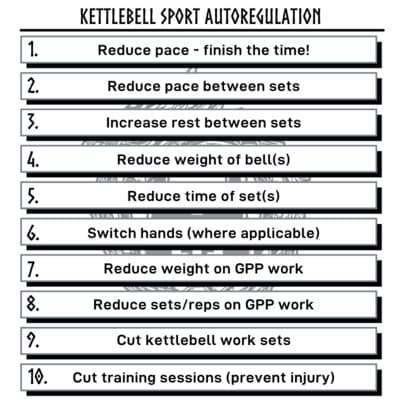
What is a framework for adjusting how do we prioritize the different factors that are potentially out there when it comes to kettlebell sport right and again a lot of these principles can also be applied outside of kettlebell sport but. I will speak about kettlebell sport specifically and then i'll try and generalize to other applications as well so it's hopefully this is useful outside of just kettlebell sport but that's my that's my realm of application most of the time so. So the and this is a hierarchy so that i'm clear this is this is ordered in the most desirable to least desirable so what is the first adjustment you should make and what is the last adjustment you should make and you can think of that is what is the what will be the the least impactful.
way to adjust the intensity down what will be least impactful to my long term success within the sport or achieving my goal and what would be most impactful right so we we start with we start with you know the number one auto regulation hierarchy I give people is reduce your pace within the set but finish the time. So if you have a five minutes at prescribed at 20 rpm's for snatch for example and you have done three minutes at 20 rpm's and you don't feel like you can sustain that pace and finish the time. You might reduce to 18 rpm's for minute four and 18 rpm's for minute five. Right finishing the five minutes at a reduced pace to what was prescribed is better than not finishing the time so reduce pace and finish the time that is auto regulation number one now auto regulation number two is reduced pace between sets so if you're doing again a five minutes set times two sets.
That's on snatch right say I prescribed five minutes times two sets at 20 rpm's with five minutes rest so one to one work to rest ratio times two sets at 20 rpm's we're trying to maintain competition pace for an entire 10 minutes of total time of work right across the sets. We do set number one and you're able to hold pace for set number one at 20 rpm's for all five minutes but you know between sets you will not be able to sustain that for another set right maybe that's because you have tension in your hands. And you're feeling like if I do that pace again I will tear that might be one reason or you know that you don't have adequate recovery or whatever there can be any number of reasons why you just know that you won't be able to maintain that pace for another set then you reduce pace between sets it's okay it's better to do two five minute sets one of which you hit 20 rpm's in the second one you hit 18 rpm's.
Then it is to do five minutes at 20 rpm's and then only get two minutes into the second set because you tried to hold 20 rpm's and couldn't finish because you tore or whatever right so reducing pace between sets is auto regulation number two. Number three is increasing rest between sets now this is different than number two because if upon evaluation as you're as you're thinking about it you think hmm if I gave myself another two minutes I could hit 20 rpm's. But I'm not I'm just not there from a recovery standpoint my cardio isn't back right I'm not quite ready to start again but I know that if I give myself seven minutes rest instead of five minutes rest that I could hit 20 rpm's well that's two sets at competition pace that's great that's good work even if it means that you weren't quite able to hit prescribed work to rest ratio right.
The difference there is going to be you won't be getting the same type of conditioning response in your training set as you would. If you were able to maintain the work to rest ratio now this holds for running this holds for even just lifting weights in the weight room right if you're doing Olympic power cleans and your prescribed you know three sets of three reps with. Two minutes rest in between sets and you just don't feel ready to go again you can bump it up to three minutes between sets you can bump it up to four minutes between sets right so you increase the rest interval between sets while keeping weight the same and keeping the prescription the same you're just changing the rest interval so you feel more recovered.
That's that's auto regulation number three auto regulation number four is reducing weight right reducing weight of the load so that might be you know going from a 20 kilo bell to an 18 kilo bell or a 16 kilo bell now I always tell people reduce weight as little as possible to then hit the prescription right that's another way of doing it so you could do a five minute. Two minutes set at 20 RPMs with a 20 kilo bell and keep your five minute rest interval and then decide that for the second set you're going to reduce weight now that would be if the cardio feels good but you just muscularly or from a stability or joint perspective don't feel like you can handle the weight then reducing the weight of the bell is another adjustment you can make another adjustment you can make excuse me.
Auto regulation number five is reducing the time of your work sets so again we'll stick with the same example throughout if you're first set you're only able to get five minutes and you couldn't hold pace and you don't feel like you could finish the time on a second set you may decide instead of doing two five minute sets you might do a five minute set and a four minute set because you can hold pace for four minutes but not for all five or five minutes and three minutes right reducing the time of the sets reducing work time might be another auto regulation. Number six is switching hands now this is where applicable obviously if you're doing double bell long cycle you can't switch hands if you're doing double bell jerk you can't switch hands so number six applies mostly to snatch or if you're doing one arm training like for marathon or half marathon right or if you're just doing one arm jerk one arm long cycle right switching hands or regularly is a way to auto regulate so if you have a five minute one hand switch works that prescribed on snatch and you get two minutes in and need to switch you can switch and then switch back when you need to switch back you can do multi switch you can take a ten minute set if you can't do all the time you can do it you can't do all ten minutes with five minutes per hand you might do four minutes on each hand and then a minute on each hand to finish for example or you could do a switch every minute right it depends but switching hands more regularly where where applicable right so number seven is reducing weight on GPP work right so if you've gotten through all of your kettlebell training and you still got your you've got your adjunct strength training or your adjunct GPP work to do reducing the intensity of your GPP by reducing weight is another adjustment so if you've got for example you got all the way through your snatch work to do whatever farmer carries as GPP and it's prescribed at 32 kgs in each hand and you're just like there's no way my grip can handle that great reduce go to 24 go to 28 you know whatever whatever you feel like you can do reducing weight on GPP number eight reducing sets or reps on GPP work right so reducing GPP workload right that's that's auto regulation number eight that we have auto regulation number nine is cutting kettlebell work sets right so we want we want that to be after we would cut GPP right this is what we assess as we go through you have to look at your program ahead of time you don't want to cut kettlebell work sets to finish your GPP in order to be able to do your GPP because your kettlebell your specific training for the sport is more important than your GPP right it's in priority lower so applying it to other sports other than kettlebell right you would want to reduce your adjunct training before you cut your sport whatever your sport prescription is right so cutting kettlebell work sets is our ninth hierarchal GPP I'm sorry auto regulation we would cut GPP before we cut kettlebell stuff right and that can be for time to that's not just for that's not just for adjusting to physical stimulus that can also be adjusting to time constraints right if you only have 45 minutes you don't want to reduce your kettlebell sport work in order to get your GPP in right you you want to get your specific work in first right so cutting kettlebell work sets is our second to last regulation right so cutting reducing work within a session cutting out sets and that's still something that happens sometimes you might have you know again if you did a five minute if you had five minutes times two sets of snatch prescribed and you get through the first five minutes and realize that you just can't do another five minutes set without hurting yourself or tearing your hand or you know some other bad consequence then cut the second set or if you know you just you need to cut it because you just don't have time and you you know doing one five minute set and cutting the second one is better than doing nothing right so cutting cutting work sets is our second to last auto regulation and last our last choice is to completely cut a training session and that is also okay that needs to happen sometimes there are phases in training where you might be training five or six days a week and you might just need another day of rest and recovery right so adding a work day or adding a rest to excuse me or cutting a work day might be necessary and that's okay because living to train tomorrow is the most important thing that's the guiding principle that's the guiding principle right so that's the auto regulation hierarchy that I give to my athletes I'll play that back to you real quick so number one reducing pace and finishing the time number two reducing pace between sets number three increasing rest interval between sets number four reducing weight number five reducing the time of the sets or of a set number six switching hands more frequently than prescribed where applicable number seven reducing weight on your GPP work number eight reducing sets or reps on your GPP work so reducing overall GPP workload number nine cutting work sets for your sport whether that be kettlebell or not so cutting kettlebell works work sets is what it says on our you know document and number 10 is cutting training sessions right now there are more than 10 possible applications of auto regulation but these are the most common 10 and usually people don't need to go deeper than this but that's not to say that there aren't other mechanisms by which you can auto regulate but those are those those 10 are generally a pretty good guideline for how you can reduce intensity right and make sure that you have recovery enough to train another day because that is our overall rule number one live to train tomorrow right because that is how we get better longitudinally is consistency always come back and do it again or do more improve get better if you can keep training if you're hurt you can't get better once you're hurt all your focused on is getting back to being healthy so don't get hurt that my friends is auto regulation and why it is important how to do it some specific guidance on how to apply it in kettlebell sport I hope you all found this helpful if you have questions on how to apply this in other sports reach out to me I have programmed for CrossFit program for strong man I program for football athletes soccer triathlon triathlon outside of kettlebell sport like not kettlebell sport triathlon obviously they've prescribed for kettlebell sport triathlon but also just regular triathlon like these are these are principles of regulation auto regulation right so if you have any questions on how to apply this to your chosen discipline if you're not a kettlebell sport athlete please feel free to reach out like it's not going to be outside of my depth and if it is I will tell you you know I don't know this for for your sport but generally I'm pretty good at applying principles across disciplines so anyways hopefully you found this helpful and I will see you all next time on the platform podcast thank you for tuning in thank you for listening to this episode of the platform podcast we'll be back with a new episode soon please be sure to leave a rating and review of the platform podcast in your app of choice support our work by supporting our affiliates and of course if you have questions or you want help reaching your goals reach out to me until next time thanks for listening
Want This Kind of Coaching?
Everything on the show comes out of real coaching. If you want a plan built around your goals and your life, the first step is a free intro call.
Apply for Coaching