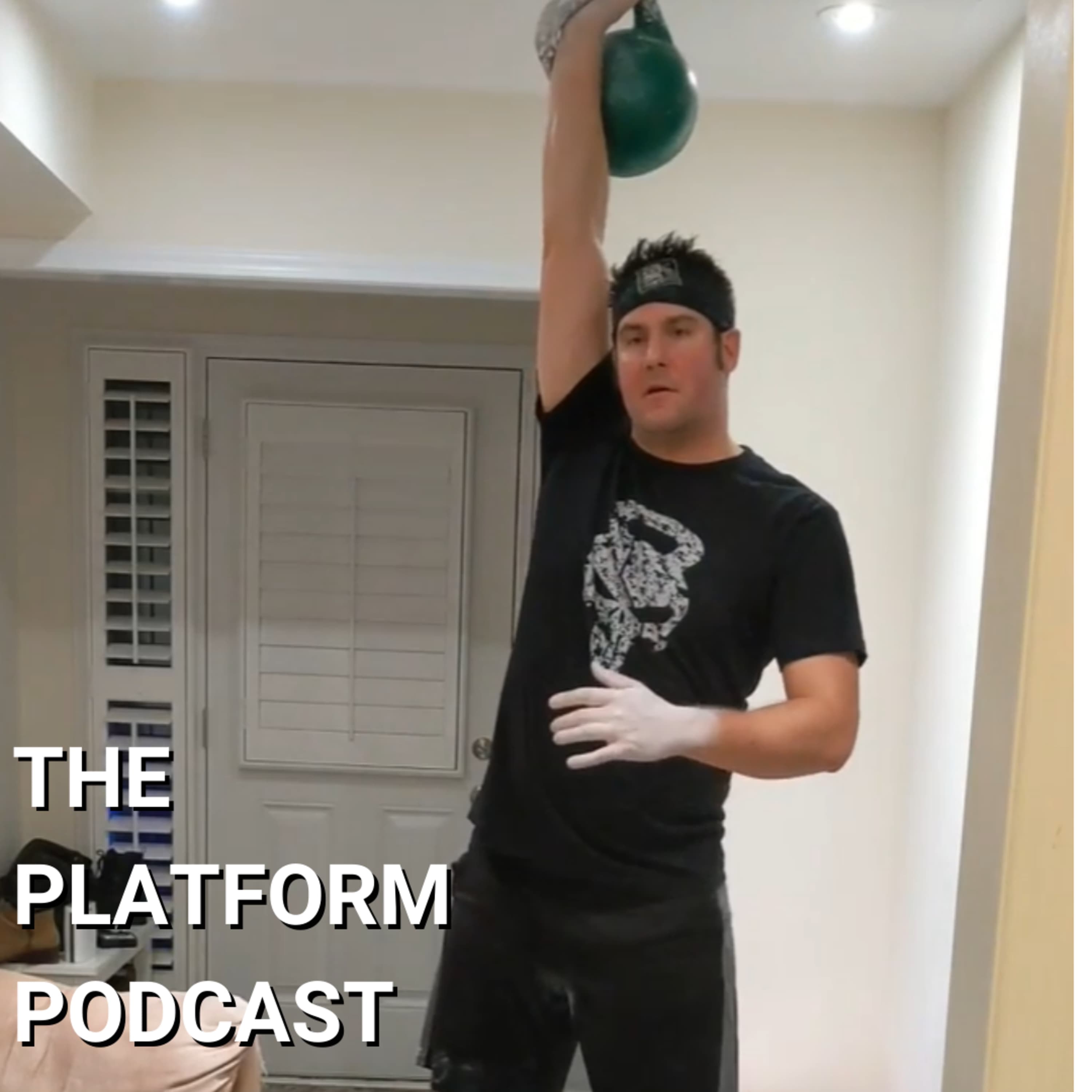
The Platform Podcast · Episode 48
"We're really competing with ourselves."| Matt Borris, Canadian Kettlebell Athlete
May 19, 2021 · 72 min
Show Notes
My guest this week is Matt Borris (@dasmatts04), a Canadian kettlebell sport lifter. We discuss his athletic background and the injury history that came with it, some of the unique challenges of being a very tall lifter in kettlebell sport, and the many aspects of community that make the sport great. Enjoy!
If you enjoy the content please leave a 5 star rating & review, share on social media, and support my work by supporting my affiliates:
- REGISTER for the Twin Cities Kettlebell Open on October 23rd!!!
- Kettlebell Kings, use code TCKB to get 10% off
- Bearfoot Athletics, use code TWINCITIESKETTL to get 10% off
- Gaspari Nutrition, use code JWright20 at check out for 20% off
- Revive Supplements, use code TCKB for 10% off
- 27 Degrees Apparel, use code TCKB10 for 10% off and $4 of every shirt goes to support mental health charities
Transcript
Machine-generated transcript; may contain transcription errors.
Welcome to the platform podcast where we talk to coaches, athletes, experts, and real people to learn about their approaches to training, nutrition, mindset, and much more. I'm your host, Jordan Kondirate, founder and head coach of the Twin Cities Kettlebell Club. And I'm on a mission to help others build sustainable, healthy lifestyles. My guest this week is Matt Boris. He's a Canadian Kettlebell lifter and a member of the team Ritalstruck, as well as my friend. We have a great chat about his background, some of the injury history that comes along with it, some Dalton & Roadhouse references, and as well as some of the unique challenges of being a six foot five tall athlete in Kettlebell Sport.
So I hope you enjoy the talk. I also want to take a second to say that I'm incredibly grateful that you listen to this podcast. If you haven't already, please be sure to leave a rating and review of the platform podcast in your app a choice and support my work by supporting our sponsors, who is affiliate links you'll find in the episode notes. And if you want to step on the platform and competing Kettlebell Sport, please reach out to me. I hope athletes of all levels reach their goals without wasting time using my integrated coaching approach. You can follow me on Instagram, Facebook and YouTube at Twin Cities Kettlebell Club, or email me at Twin Cities Kettlebell Club at gmail.com. Also, don't forget to register for the Twin Cities Kettlebell Open October 23rd here in beautiful little Canada, Minnesota.
Now, without further ado, let's step on to the platform with Matt Boris. Right, welcome into this week's episode of the platform podcast. My guest today is Matt Boris. He is a kettlebell athlete from the team riddle struck out of wealth Ontario, which is somewhere in Canada Stan. Canucka Stan. Canucka Stan. Yeah, that's yeah. Well, actually, Steve's in wealth. I actually live in Milton. I know you know where Milton is. Yes, yes, I do. I do know where Milton is. That guy's dick. So I actually live about two blocks away from Sarah Erickson launch. Does he deliver bread to your house? Yes, he does. And it is the greatest thing ever. You think his jerk form and his endurance is technical bows. No, you even tried to sourdough bread.
That's where it's at. Yeah, MS, that's great air. But yeah, the bread. Just just make with the sourdough. And you know, make with the sourdough. And maybe some biomechanical breakdown of proper technique. And, you know, use your, use your nerdiness for our advantage. We want to take advantage of your brain. But, you know, that's, that's about it. Yeah, yeah, really. Like I'm not joking like literally like you'll, you'll see pictures in the group chat. Like error dropped off right at six o'clock this morning. Well, we're just right into it. So thank you so much, Matt, for taking the time. I really appreciate it. In case you guys can't tell, Matt and I go way back. We, we met like, what like, I don't know, like eight weeks ago.
About eight weeks ago, I think on my birthday. So March, March 12th. Oh, yeah, that's right. It was, it was your birthday. That is, that is true. I forgot about that. That was, that was when we first met. I, I don't think I met Matt that night. I think I met a different version of Matt that. You met one of my cancer egos. Yeah, he, he, he came out. Yeah. It was, it was my birthday. And I did the typical birthday stuff. How many wineries had you been to by the time I signed on to the zoom jet? Well, the wineries weren't the problems. I was, I went to four, but you know, that was through the day. And this and that. And I got myself home. The problem was all the loot I got from the wineries. Sarah wanted to start opening.
And then both my birthday and friend shopped up a beer. So I tried that beer. Then we're going to be a group chat. And then my rugby boys are like, oh, we're going to have a group shot for your birthday. We can't do it in person. And then you came in after all that. So. Sorry. Sorry. Oh, no, no, no need to be sorry. It was, uh, it was great. Uh, I, I didn't realize that you don't always wear a black stetson. Uh, but you should. I mean, that, that look, it looked like it suited you. Here, you, I sign on and you're wearing your black stenson. I was like, all right. This guy with this guy's a cowboy hat wearer. Maybe that's, maybe that's the accessory that goes with the Canadian tuxedo. I don't, I don't know.
Like. Well, make your deal. We can come down and not go where I will be rocking that stetson. All right. All right. I, I, I like that. That would, that would make me very, very happy. Will you wear it on the platform? Oh, I mean, it can't hurt my form. So. Well, if you keep in the jerk tight to the body, though, you're going to knock it off with your thumbs at some point. But, uh, you don't jerk, though, really. No, no, I do. I do long cycle. And, um, I'm one of those rare guys that, even in kettlebell communities, you push the corner. I'm a snatch first guy. That's what? I know there's like six of us. Weird. I know. Yeah. I don't, I don't know. I don't know how, I don't know a nice way to put this.
You're an odd human. Oh, no, I know. I know. I said, usually, you know, like tape off a corner. We can sit and you put down some newspapers and. You know, kind of like it's like high school over again. Turn on the cartoons. But bust out the bust out the cereal and just leave you guys here. Leave you guys. Just hope we don't distract anyone while you're, you know, biathletes are doing their thing and long cycles are getting ready. We're just talking about how we only like to do snatch. Okay. Well, so let's, so let's, let's get into it. I mean, first of all, you, you are, you are competitive athlete in, in kettlebell sport, obviously, and snatches your specialty. What is your, what is your highest, what is your highest rank that you've achieved so far?
Um, I mean, right now it would be, I have a rank one with purple. So I think I, my PB is two 12, but I think when I did the, my rank one, I think I did 196. Okay. So I'm there right now. I've been, uh, I was playing around, um, trying to get to, um, with the greens I have ranked two. So I think I've done a hundred and fifty eight. I think I get to be ranked two. And then right now I'm training to, I'm making my first kind of serious bid at, um, CMS where I'm going to try to do, uh, five minute with the third two. You say 32s, like there's two of them. Oh, sorry. Just, just, just, just, no, it's fair. The 32, the 32, uh, does not leave any room for error. Um, so that's, uh, that is definitely, that is definitely, what do you need to hit in five minutes?
I always feel like five minutes is a trap. Well, and that was part of the thing I looked at it where I, yeah, I thought, you know, you look at, it's like five minutes, 84. I think it's 80, 84, 86. Like, you know what? I can do that. You know, I, I, my big strength is, you know, I, I have good raw horse power. I'm like, you know what? I can keep that up for five minutes and, oh boy, it's, uh, it's been a struggle through training. And, you know, I'm, I'm kind of teetering around there, but it's, uh, it's been fun. So, uh, we'll see what happens because I got about a week and a half left to, uh, put it all together and, uh, go from there. So, uh, that, and then I'm doing, um, five minute long cycles.
Nice. Okay. What do you, what do you compete in? What do you compete in that with long cycle? 24 kilograms. So it's, um, I really, um, I, I, I kind of took a break from long. So I actually became literally snatch only for about six months. I, I had a bad lot of bad sets. And it was all because of me because I wasn't, I was injured and this and the other. So I was just kind of focusing on snatch and just trying to get back into it right now. I try to, uh, 10 minutes set a couple months ago and didn't go according to plan. So, um, Steve and I really are working on just getting me confident and doing sets. I'm happy with locking in mentally, keeping pace, figuring out all that kind of stuff. So this will be the last comp. I'm doing five minute sets at.
But, uh, it's, it's a good kind of introduction to the season where, uh, you know, the competition season gets pretty packed. So this is really just kind of breaking the ice. And let's get a couple of good lifts underneath my belt that I'm happy with. And then move back up to what you kettlebell lifters call real set, which is 10 minutes. Well, don't want me in with that group because I was, I was all too happy to be just a five minute triathlon. That guy until Dennis Vassila told me I was playing. So, you know, that's, I like, I like five minutes sets. I mean, you and I are in the same weight class. We are in the Clyde Stale division. We have the Clyde Stale division hashtag Clyde Stales. Yeah, I'm the big large in majestic.
Yeah, so, so for, for those, for those that have never, have never, uh, gazed upon your, gazed upon your frame. How tall are you? Exactly. I am six five. Yeah. Okay. And you have the, the arm length of what like an eight foot person. Yeah, my arm length, my wings plans plus three. Okay. So I actually, like, other than me, the muscles in the body fat content, I really have the same build as Michael Phillips. High wise length wise, all that kind of stuff. My legs are longer, but wings span height wise. It's literally where I am. So yeah, so you have a long levers. Very say. Also a long distance to move the bell. Yes. Yes. Yeah. So tell me a little bit about the challenges of that, right? Because I'm six foot nothing.
Um, I, you know, I lied in the college football program and said I was, you know, said I was six one. And then my, and then my coach, uh, you know, rounded it up to six two. Um, so, but I've, I've never been six two, uh, even in heels. Um, so let's, uh, let's, let's explain a little bit. How does that change the dynamics of, of the physics for you? Be in, be in that tall. What, what is that? What is that like being that tall? Yeah. And you know what? I mean, it's crazy. Well, it's a, um, a, uh, I think most of the things that you've got to be as long as you're six in girls but other than that, it's is not a whole ton of advantages. So, I think some of the things that I really struggle with, um, I, injuries.
In my past, because I was so tall and monkey. And, um, I was remarkably skinny when I was younger. Like I walk around right now at 240. When I used to compete at jujitsu. I cut down a couple of pounds to 169. Wow. not a lot of muscle on the frame so I got a lot of injuries there and what I kind of find is a little bit harder especially in kettlebell sport is the pacing where, you know, for someone like, you know, look at Steve, like Steve riddles my coach, you know, and I think he's fast nine. Yeah, Steve coach, he's fantastic. He's like a whole shorter than you. You're basically a giant to him. Yeah, literally. So when we're talking, you know, for me to move a bell at nine RPM, I'm probably, and I'm moving the bell at least, you know, two to four feet further every single rep than other people are. So, you know, you think that's nothing much, but you know, you start talking about snatch or you start talking about, you know, 70, 80, 90 reps, like I have a lot more distance to cover. Yeah, so that's one thing I think people don't understand or don't, or don't account for enough is that work, the formula for work in physics is actually weight times reps times distance moved. And we forget about the distance moved component of it because we're so focused on volume. And we just look at, oh, what was your total volume? How much training volume do you have? Because that's an easy calculation. And it's standard, right? No matter how far you're moving the weight, we can, we can all compare volume. Well, we can't, what people don't take into account is like, yeah, my volume at 200 reps is less work than your volume at 200 reps because you have to move it at minimum, you know, there's a, we will say a five inch difference between us, right? At minimum, you're moving the bell five, five inches for it, we'll just say for the sake of easy math, right?
We're, we're, you're moving the bell, moving the bell five inches further than me every time. Well, that's a thousand over, you know, if we just do 200 times five, that's, that's a thousand more kilos in, in total work based just based on distant move. And that, and that's me simplifying the formula because obviously it's non-linear and, yeah, yeah, but, but, you know, like, there is a huge, huge component of, of distance moved to it. That's why I asked the question is because like, I can't, when I see it, when I see your, your snatch sets, I'm, I'm like, God, that bell is moving from a fucking ways. Yeah, it takes, it takes so long to get out there and it's not that you're moving slow, it's just, it's moving a long ways. And that's a big thing, especially I'm looking at with my snatch technique, one of the things I'm working on right now is, especially with the 32 is like, I was doing a shallow backswing because I was just muscling up with the, the 20s, the 24s.
I really got to crank that all the way back because I have so much higher to get that bell up. And so it's a lot of things that I really have to focus on my technique so much because I've, that extra space for things to go wrong, right? Like my longer lovers, you know, when I miss, my elbow slips and I go down, it's, it's a different beast if, so I mean, it's, you know, there's, there's a bandage and there's this bandage. I mean, kettlebell sport isn't one of those things where great to be tall, like not like if I was a roar of his swimmer or something like that, right? So, yeah, you know, it's, it is a bit of a disadvantage, but you do. I mean, the, the leverage helps in some, in some aspects, but in some aspects, it does not. Like he said, like it, in some, in some ways, that, you know, leverage is great. Like having a long lever arm is great in, in the peak of the, in the peak of the snatch, but that's under the assumption of good positioning and, you know, and, and, you know, maybe absence of fatigue and all of those things, but, you know, as you get deeper and deeper into the, into the set, like that can be, that can be, that's not true. Any longer, that assumption is, that assumption is a longer valid. So you're risking it. Yeah, other things kind of outweigh the benefits that longer lever. I mean, still got to move that longer lever too. Like, you know, when we were, we talked about a lot too about how you see kind of lighter lifters on, they go up and meet the bell to have the resistance, you know, the, um, me and you do that.
That's a lot. We have a lot more body mass to propel off the ground. So, you know, that gain of we're getting from cushioning the bell coming down, well, it might be outweighed by the extra amount of energy that we have doing. You look at people like, you know, lighter, lighter athletes, shorter athletes, doesn't really come into effect, right? I mean, yeah. Yeah, it's, well, I mean, it's, it's definitely part of the, is, is the effort worth, is the effort required worth the, uh, worth the return on that effort, you know, it's return on effort is always what we're looking for. So for like somebody like Jessica, our, our, our friend Jessica, like, she's a hundred pounds. So she needs to meet the bells just so that, so that they don't pick up as much, much momentum because she has, like, nothing other than skeleton and muscle to, to land the, the momentum on. I've got some cushioning built in. I've got a built in airbags.
Like, you know, you're, you brought a great point of the drink, Andrew's in it, you know, she, was doing double 24, 80% of her body weight. Yeah, she needs to do everything in her power to make those things lighter. Yeah, yeah, absolutely. It's, it is, I think that is one thing that we, we don't do a good enough job discussing in, in the sport is the differences in technique that need to be applied for different body types, different lever lengths, different, different styles, uh, et cetera, because, uh, bio into the duality is very much a thing. And, and the, uh, the dynamics change based on how far you have to move the bells, how much, how much mass you have to move to, to meet the bells, um, you know, et cetera, et cetera. And then there's always the fun conversation of injury history, which you brought up a little bit. So we'll, we'll go into, we'll go into your background. I know you and I kind of have some similarities in background in that, uh, you know, as younger men, we, uh, we ignored the thing called pain, which apparently is a signal that your brain sends to let you, that, that, that to let you know that something is wrong in your body.
Oh, just weakness. Yeah, I thought it was weakness leaving the body. That's what all my coaches told me. Exactly. Yeah, it's just, it's just a signal that can be ignored, right? So, I think me and you could really do a kettlebell. You don't have seen and jaws were, uh, quinz and hoop are comparing the stars. I think you could do a six part series, just comparing injuries and this, we can pick a different body part. Let's go above the shoulders and we'll talk three hours about our injuries there. Well, so, so, well, we'll, we'll just keep it focused on you for the, for the time being. So let, tell, tell me a little bit about your, your background because you've, you, you alluded to Brazilian, you just see you alluded to rugby. Um, you know, I obviously know these things, um, but so for, for the listeners, let's, let's go back to, let's go back to, to pre-teen Matt and, oh my god.
And what was, uh, what were you doing when you were a kid growing up? Like, did you grow up in an athletic family or have you always been an athlete or like tell me a little bit about how you came up? Yeah, so I've always been an athlete. Um, the, the family, my, my dad was an athlete. My dad was a hockey player. Uh, actually quite good. Um, a Canadian hockey player, I've never heard of such a thing. Yeah, I know. No kidding, right? But it's, it's funny. All his children hate hockey. So, uh, yeah, so he actually, if, you know, back when he was, um, when he was younger, there were only like 16th NHL. And if it was modern day, he would improve, but you just, you couldn't, yeah, the original six, yeah, yeah. Six, six, there's only so many roster spots at that point.
Exactly. You know, are you going to sacrifice everything to go after one and, you know, back then, it wasn't, you know, um, $10 billion to play. I mean, so, you know, I, I always enjoyed sports. I'm, I am probably the most competitive person you're ever going to meet and we can have that debate. Um, no, you're not. I'm more competitive. So, I mean, you know, uh, it was, it was always my sporting life early was not really what I wanted. My parents were desperately worried about me getting injured and quite frankly, we'll get to my injury history and they were right. Um, called. Yeah, eventually they called it. They knew half my injury. So, I mean, my dad could try to get me into hockey and I played for five or six years and I hated it and I played baseball. You could have been the Zedeno Chara of, of Canada. Oh, man, I was the giant on states. You didn't, you didn't see me skate.
terrible. Just something about my feet. Like, I was the worst soccer player you're ever going to see in your life. I couldn't skate. I couldn't stick handle. I, I, I just hated hockey. I've, I've always not liked hockey. I played baseball. I was, I was okay, but never really moved. I, I always kind of wanted to play contact sports. I, even the hockey I played, it was one of those like everyone's a winner. No contact shifts. We don't keep score. There's no league standings because everyone is here and that's just great. And I'm like, no, no, it's not. Um, I just got a picture of like six-year-old man at being like, fuck that. I was kicked out of a league for hitting a kid in the head with hockey sticks.
Yeah. Yeah. Yeah. Wasn't my shining moment, but he deserved it. You know, I always deserved it. So I did a lot of that. And, you know, through high school, I was always kind of, I did everything. I just, I wasn't the best at anything. And I was never kind of popular with the cool kids because I've always been an introvert and I was okay not being cool. So like, I didn't play basketball. I wasn't thought I should because I was tall, but like in high school, I was like 160 pounds and I was 64. Like, I, I could not gain weight for life in me. And this went all the way up through basically high school. University, I was on the track team for a year. I did pentathlon. So that was, um, hurdles, shot foot long jump, high jump, thousand meters. So I did a lot of cardio and, you know, I just, I had a crazy metabolism and kind of got away from that. But, you know, kind of late in high school, I started doing martial arts. Um, Ty Kwon Dole, Keto, kind of playing around with stuff like that. Kind of got away from more commercialized guys, started doing some, gone, Moitai kickboxing, started training with some, God. Oh, yeah. Oh, I do. I had here comes the injury trained. Well, I was actually just thinking, I was just thinking of like, like, just, just a straight up Moitai kick to the thigh from someone who's six five with your lever length. Like that does not sound fun. Oh, and I remember I was like, you know, all those cool fighting games are like, George rushed in here or rampage. Yeah. I was the stick spider.
I, I had these bony knees and legs and I got, if I got my leverage into like, we were talking about whippiness. Yeah. Yeah. If I got an inside thigh kick on you, you fell down. Oh, yeah. Yeah. Exactly. No, thank you. Yeah. So, I mean, I was, so I got into, um, uh, Brazilian jujitsu where I was, I was really intrigued. This was the whole ride, the UFC thing, you know, with the first, you know, tough and all this and Brazilian jujitsu was really new. I mean, it wasn't a established martial art. I can't live with four black belts. Um, you know, if you had a blue belt, you could train people. So I started doing that a lot. Yeah. It was, it was crazy. It was all you had, right? And it was, you know, different. If you got a black belt in 10 years, working five days a week, that was lightning fast. So very, very different. So I was doing that, but I'm getting a lot of injuries like, you know, shocking. Yeah. No kidding. Getting punched and kicked in the face and punching and kicking in the face and then rolling around on the ground, trying to, uh, strangle people and or break joints, uh, injuries. Crazy. That's what really got me like to start off with where like, you know, we were training with some big guys and I had no muscle. So I got an arm bar. You know, we had a former Olympic Georgian wrestler and our thing, he popped both my arms out right shoulder twice, left shoulder once because he'd walk on an arm bar and gone on just out. Yeah, that's so that's no bueno. You know, I had seen probably my knee. I got someone throwing a knee bar. Yeah, exactly. I mean, you know, it's how they train there. But you know, he was also expecting people, you know, he trained with what actually, you know, be able to resist. That's since, you know, I was a stick spider. Um, it didn't quite work out. Um, so yes, I did that for a while. I moved around a little bit and kind of went away from my, um, moved away from Guelph where I was doing my training and I moved to another place called Oakville near Milton. And um, it had always been a rugby fan. I was like, I never played. I'm like, you know, I was turning 30. So complete midlife crisis here. I'm like, you know, I mean, hopefully not midlife. I hope you make it past 60. Uh, I hope 30 is not midlife. Oh, God. So we, um, I'm like, oh, they got a club here in Oakville, and it's a suburb. I can't be that serious. The biggest rugby club in North America. So I join, I start playing it. I'm, I'm basically joined up as a 180 pound six foot five lock.
Guess how bad, guess how well that one. So, so, all right. So we have to, so for people that, that aren't familiar with rugby, explain what the lock does in, uh, in a rugby scrum. So we're, we're called type five. So my position had really three functions. One, we push on the prop. So we're in the, we're in the scrum. That's me. I'm the big fat. I'm the big fat fucking the front row, uh, you know, holding up the hooker. Who's the one trying to get the ball? Yeah, so I stick my head between him and the hooker. So I'm at greater groin level, which is a great place to be. I reach inside his leg. It's a great place to be. You learn a lot in those places. I reach around, basically grab his leg or his pocket, and then I tried to shove my shoulder blade into his bum and push him through the other guys that are doing the same thing. And then other than that, you know, I have guys lifting me, like, Jordan, lifting me over his head in a line out so I can catch a ball. Yeah, it's your top. And light, apparently, which, yeah, light at the time, at least.
Oh, yeah. I was, I was, I was always a good jumper, because I was even when I got to my, my 240 and I was playing first team, 250. I have quick twitch muscles. I got good technique. I was always a good jumper. So I could get up there. So that was never a problem. It's just guys bringing in long arms. So that's that's very helpful. Exactly. That was always my strength. And rugby, like, I, I would control the line out. I was, I use you didn't feel out of place. That was my best thing. So, you know, it was really kind of through there where I started to, um, realize I had to get bigger because I was taking so much abuse. Yeah. Yes. In, in, in the pack, the, the, the, the tight five, as he mentioned, there is a, it is, it is the equivalent of an offensive, of the offensive line in, in, in, in American football. So every time you line out, you're getting hit, every time somebody gets tackled, you're rucking over and you're, and you're taking contact, right? Like, it is, it is, it is in front of contact.
You're in the, you're the A and B gaps where you have these other large human beings running at you. It's rugby. You can't take a running start at them. You have to wait and receive the contact. Yeah. And, you know, it's like you said, in the offensive, offensive lines, it's the tight five. It's whatever type five can break the other one first wins the game. Yep. So I was getting broken. So I, you know, the other good thing was, you know, I'd never really had a good program. Like, never really, never really hit the gym that much. I did a lot of cardio. So now that I'm doing that, and I actually got a gym membership and I started doing some personal training. I gained 20, no, sorry, 25 pounds the first year, 45 pounds within the first two years.
And drop my body fat index. Good on you. Because I got quads. They're awesome. They really helped. They're very useful in kind of a sport in a, I mean, basically just in life. But yeah, yeah, started filling out my frame a little bit, my big six foot five frame. And so that was really good. So I played rugby for basically seven or eight years. I stopped basically two years ago. About 30. Why? The moment I realized I needed to stop, there were a couple of reasons. One, one game, a guy yelled at me after a sub happened. He said, just so you know, you're the oldest guy on the field by 13 years. And my body literally could not take it. I mean, my injury history at the point I kind of stopped was, you know, three diagnosed concussions diagnosed. None of those were so why'd you stop? I'm going to ask you again, because you probably forgot.
It was, it was I just my body couldn't take it. Yeah, the concussions, those add up really, really quick. Yeah, exactly. So we're there. And you know, I was just so in pain all the time. I mean, there were Sundays after games. I could not get out of bed. I couldn't walk. I couldn't get downstairs. You know, I missed my massage therapist who was also our trainer. I mean, she would work on me. And there were times where she just took a step back and said, I don't know how you live. Like, I don't know how you function and move around on a daily basis. And, you know, at the time, I had been doing one time I retired rugby. I had been doing kettlebells for Steve for about three or four years. And it was never good because I was always so injured. I can't, I can't, I mean, shout out to Steve because to have the patients to coach you for four years, while you're just beating the living fuck out of your body, playing rugby for hours at a time. And then, and then being like, and then being like, I don't know why I'm not getting better at lifting because I know you.
And I know that you were probably like, well, I was, I was planning on going for this. And then you know, I don't know why I can't do it. And you're probably like yelling at yourself. And, and Steve's like, well, if you, you know, you get, you get your body for two and a half hours on Saturday, playing a rugby match. So you can't expect your body to respond. Not even that. You got to think the games are bad. The practice is terrible. We just hate each other all the, you know, I'm training with guys, you know, the club I was at, they fed the provincial leagues. They now field our professional team. We have five or six guys in that club that have been to the world clubs. And these are the guys hitting me. And like, so we got there. So it was just, it was funny. Like you said, with Steve sometimes it was just, okay, I'm looking at your lockout and your arms are forward.
You're not fully overhead. I'm like, yeah, I don't have that range of motion. Yeah, I can't, I can't, I can't do that. Yeah, I can't, I can't do that. I was like, you're not really getting that explosive pop out of your hips. Like I popped my SI joint again. Yeah, for the fifth time. Yeah, so I'm in a little bit of pain or, you know, I got whiplash or I did this. So it was, yeah, the kettlebell training, you know, I always loved it. And it was always fun. But I kind of had to just say, you know, rugby, I just, it was kind of just timed. I wasn't enjoying it as much as I did. Time to grow up in the other fan. You're not a exactly. I loved playing. I'm still part of the club. I'm actually on the board of directors.
Two years ago, I coached. You know, I, I'm still a part of it. And you know, I love the rugby club and rugby did so much for my life, my mentality, just everything. A lot of my best friends I've met at rugby. But it was just, it was time to stop playing. And you know, what I was, I always really enjoyed kettlebell. And I always was getting really frustrated that any time I'd make the smallest game, some farm boy from up north would come and clear me out of Iraq and a year's worth of games were gone. Because it's a pretty much older. Yeah. So I have a sidebar question. And it comes from our friend, our friend Bobby Hicks down in Florida, Florida, man, Bobby Hicks. He actually just texted me this, you know, today. And he was like, I am amazed at how many kettlebell sport athletes are former rugby players. Why do you think that is? Because we can take pain. And I'm sorry, but it, so generally, if you are a decent rugby player, you like to work out. You like to push yourself.
You, and you, you know, especially when it's rugby isn't a mainstream sport. It is somewhat of a tier two sport, especially in Kami, we're a big rugby nation, but not compared to the UK and it's like that. So you know what? I think it's just that kind of natural, you know, you want to see what you can do with your body. And we know how to work through pain. And it's kind of where we kind of like it. We kind of like being able to say, hey, you know what? I'm going to, you, I'm going to be in the offensive trenches for this. I'm going to be, I'm going to hit 50 rucks this game and I'm going to get punched in the face nine times. But I'm going to keep going and be able to push through that adrenaline rush you get from it. And you get a lot of that in Ketabel sport. I like that.
I like that. That's, uh, yeah, that, that tracks. I think that's on brand. I, I, I think part of it, too, is, uh, for those, for those of us that, that step away from step away from, from rugby, uh, I think Ketabel sport has a similar community to it, right? It has that same, that same type of feel to it. Whereas like, because, so it like, it was always super weird to me. The first, the first time I went to a rugby, a rugby tournament, and I was like, wait, okay, so we're going to go beat the shit out of each other. And then we're going to sleep over at their house afterwards. They're hosting us. They're hosting us at their house. And we're staying with them. They're like, yeah, I was like, that's really weird. Like, to me as a football player, like, it was like, we hated each other.
We were going to beat the shit out of each other. Then we're going to go get back on our bus and drive away. And we're not hanging out with those people anymore, right? But it was like, rugby is such a different kind of vibe to it where it's like, we're going to go beat this shit out of each other. We're going to compete like savages. And then afterwards, like the whistle blows, you shake each other's hands, you tap the keg, you start singing songs, you go, you go sleep in their backyard or in their basement, or like, like, you camp out together. Like, it's such a cool community where it's like, like, and, and kettlebell sport has that, that same kind of thing to it where it's like, yeah, we're on the platform at the same time. And we're technically competing against each other because like you and I would be in the same weight division. And we'd be competing for the same prizes and for the same rank or like if we're in a world championship, like, you know, you're lifting 32s. I'm lifting like a 20s. So it's not even comparable. But, you know, singular. Yeah. Okay. But, you know, but it's like, but it's that, it's that same, but it's in that same regard. Like, we're going to, we're going to put the bells down. Like, I'm going to look at your number and I'm like, oh, great set. You know, and then we're going to go, we're going to go drink and hang out and like sing songs. Like, I don't know, it's such a cool thing about the sport.
It is really, I think, probably the best part of this sport is the community. Like I said, the rugby community was awesome. And a bunch of my best friends, you know, are still rugby guys, I think even kettlebell sport takes it that much higher. I mean, me and you could go on a platform or compete with the same thing. And, you know, I see you put up that gaudy set. I'm going to be so excited for you. And, and that's really what we do. I mean, we're competing against each other, but so much of it is you're competing against yourself. Yeah. And you're really trying, unless you're at the absolute highest level, if you're an Ivan or Dennis or, you know, something like that, like that might be a little bit still. I'm sure it's it's still that that commodity after. But yeah, I think that's one of the things a lot of people don't realize when they get into the sport is just how cool and how tight of a community it is. I mean, I'm sure you've seen until you go to back and we had in person competitions back in the day. You know what, the remix is coming man. They're coming back. I promise. I can't wait. But it's, you know, I'm here. My first couple competitions were Jen Hindenberger ran. You know, Jen, like every world record.
Who's apparently who's was her nickname affair? That was a right. I know. I didn't know that. I learned that from Andrea. So yeah. And you see it like she'll walk up and say hello to every single lifter and talk and support, you know, Andrea, world record holder. You can go up and talk to her any day. There's there's never that thing. I mean, we're after my for my second NKSO that was Jen Hindenberg's big competition Niagara. Yeah. Steve and I after we went to the bar to grab a beer and there's Marty Farrell, Andrea Jen and Abigail Johnson Avenue beer. And we just walked up to them. It's like, oh, world record, world record, world record, world record, world record. It's just, it's just nothing.
I've never had that negative. You shouldn't be talking to me or get out of my space, experience and everyone is just. Thanks for tuning into this episode of the platform podcast. We interrupt this interview to share some exciting updates about the prizes and sponsors for the first annual Twin Cities kettlebell open happening October 23rd, which we'll be hosting at the athlete lab here in Little Canada, Minnesota in the heart of the Twin Cities. 27 degrees apparel is designing our event t-shirt and has given us a discount code TCKB10 for 10% off all of his apparel. She'd definitely check out especially the limited edition Big Tim shirts, which are coming out to support my man Tim Boyer, who's lost almost a hundred pounds now. Those are only available for pre-order until May 20th, so get them while you can. And as with all of the orders, $4 for every shirt that you purchase goes to support one of several mental health charities, which you can choose when you check out, which is really, really awesome. There's a list of charities that you can choose from to support with your donation, which is fantastic. Also, Barefoot Athletics has gift certificates for six pairs of Ursus Barefoot training shoes. My personal favorite for snatch as well as deadlift in GPP.
And as I've mentioned before, Belivator by Dennis Facileve has given us two belts to give away. Our friend Nikolai Puchlov from the Seattle kettlebell club is providing his new made-in-the-USA pro kettlebells for competitors to try out and use on the platform if they choose, as well as support from Kasparin Nutrition and others. So if you have other ideas or connections to interested sponsors, please reach out to me. And please don't forget to register for the event on our website, Twinsidyskettlebellclub.com. And now, let's get back into the interview. It's such a supportive thing. This is kind of embarrassing, but I think it was like my second Chicago invetational, I think it was Dennis Facileve was there. And I had him sign my medal.
So I still have a medal sign, you know, I still have a gold medal signed by Dennis Facileve from back. But it was like, because to me it was like, I was just getting into the sport. And I was like, I was like, this guy is like the Michael Jordan of kettlebell sport. And he's here lifting, I got to get his, you know, he signed my medal, which is super cool. And then he talked to me for like 15 minutes. And like, we were just talking kettlebell sport. And I was asking him questions. And like, I'm this, you know, fucking nobody knew, but just asking him the, probably the dumbest questions. And that was super nice, so gracious, whatever. And then like three years later, I hired him as my coach, like, in what world can you hire the nine time world champion to coach you? You know, it's like, it's like going and being like, Hey, Michael Jordan, can you can, will you coach me on how to shoot a basketball? Yeah, it's like, it's like being a beer cart girl meeting Tiger Woods, handing him a beer, he signs it, then, you know, he's your caddy. Yeah, he's training you three years later. Yeah, he's your coach. Yeah, you know, you know, 300 bucks a month, sure, no problem.
Like, yeah, exactly. It's, yeah, that is still, that still blows my mind about about this sport as like, you know, some of the, the best, some of the best lifters in the world, you can, you can hire to be your coach there, but they're all like, but thus far, there is nobody that I've, that I've like talked to that's been like, high and mighty or egotistical or, you know, or whatever, like, you know, but they're all just, yeah, it's never old. I don't know who you are, so you probably shouldn't be talking to me. Like, when I was in track, there was actually a lot of that. I mean, the lead athlete was sick to themselves and, you know, even if you're racing, I mean, I was in one race and this guy just destroyed me and I went up to him, I was like, that was a really good thing.
Okay. Oh, I won't be talking to you anymore. So we're not, so we're not on speaking terms, because I, yeah, yeah, because I can't crack that time mark, so I'm not worth talking to. And, you know, like I said, it just, there's never anything like that in kettlebell sport. I think, it's really a rare community in sporting. I mean, I, you know, I've done between me and you, football, rugby, blah, blah, blah, blah, blah. I've never seen anything like it. Yeah. I, no, I agree. I think it is, it is really, it is really, really unique. It's got some very unique people in it. It takes a special person. Yeah. It does take, it does take a special person. What do you, what do you think are like the, because you talk, you've talked a little bit, you know, and you and I have talked a lot about mindset, right? And you know how big of a psychology nerd I am.
You know, so, so the, the mindset component of it is so huge. And I know you've been working on that component of your game. So talk a little bit about that journey. Like what is, what is the mindset that you think it takes to be successful? What have, what have been your struggles and what have been your, your growth areas? Yeah. And you know, we, like we've talked about, like I will say, the mental game is without a doubt the biggest hole in my game. Not to sound conceited, but I can move great weight. Like that is not my big issue, but I say class television. Yeah. Exactly. So, I mean, the mental component is, is so hard where I can get pretty OCD about things. And I've really struggled in the past where if I break my pace, if I, you know, have a bad rep, or especially previously in my injury history, I was always afraid of getting hurt, you know, usually when your body starts screaming at you, and there's something wrong, you stop and rugby or something like that, you know, you get breaks, this and that, you know, you're still under tension with kettlebell and I had a lot of panic attacks with that guy. I mean, and not completely unjust. I mean, we were one competition I had, I was trying to go really hard. I had a great training cycle with the 20s going for long cycle.
And I was still playing rugby at the time. And I was putting the long, I was about five and a half minutes in. I think I was at 56 reps. I felt great. And all of a sudden, I'm on the ground, my kneecap shifted out. Just gone. Just completely out. And like you see the footage, like I dropped like a sack of potatoes. And it really kind of got back to my injury history when I went to my massage there. It's like, yeah, your hamstrings are super tight because your hips are messed up. And this is a problem. And that's a problem. So that's been a massive struggle for me where I've been afraid of getting hurt. So that's why I really think, you know, it's something that Steve and I work on a lot. Hence what I'm doing a lot of five minutes sets right now in the competition because, you know, lock on to them, get through them, get that confidence.
Well, it's just like we were just talking, I was just talking about with Andrea in the episode that just came out, you know, recently is that that whole idea of she never fails a set in practice because she she makes sure that she starts with her heaviest work and that she she gets through all of her sets successfully. And she tries to coach her athletes that way. I think that's a great, that's a great approach from a psychology standpoint because I have the same, you know, similar type of injury history as you and like I don't think it's something that like a lot of people in this sport don't don't have that extensive very few people on the planet have that extensive injury history, but it's one of those things that you can't quite explain to people if they've never been through it.
It's like, no, I don't think you understand how painful it is to herniate to discs in your back. So when you feel when you feel the tension in your back where your brain just tells you, oh, God, something bad's going to happen or like if you dislocate your shoulder enough times, your body starts to recognize what it feels like. And then even if it's not actually going to happen, your brain, you'll get a signal to your brain. This is, hey, your shoulder could come out and it makes you want to stop. And it's a you remember what it feels like when your shoulder pops out or yeah. Well, it's not going out that hurts so much. It's the coming back in. That's the painful part. It's the putting it back in part that hurts. Yeah. Oh, exactly. You just like, you get those rushes of pain. So like I've really, I'd say in the last year, I've been very, very focused on my mental training. It all really kind of started going to go a little off track here. The last swanson open. So I was doing five minute long cycle, really getting back into it, starting to heal up. And I was putting along and I was doing okay. Like, you know, wasn't the greatest set I ever had. But I think I got to about the four minute mark. I just put the bells down. I just stopped. And I wasn't disappointed myself. I wasn't irritate. I got mad, angry, fierce, like not yelling in my head, yelling in the mirror. Why did you do that? Why did you put the bells down? Like, you shouldn't have done that yet. Someone else put the bells down. You could have kept going. And I got really upset.
And at that point, I kind of just said to myself, and I was talking to Steve, I'm like, no more. I'm not putting the bells down during sets anymore. So I really started, you know, even if I was feeling not pain, but injury or I was fatigues and like that, just fine, sit in rack. You know what? You got a seven minute set and I'm dead for three minutes. I know what I'm doing in the next four minutes of my life. Sitting in rack, don't put the bells down. I've been really trying to focus on that, just powering through. And, you know, some I'll go back to Steve sometimes. He'll see my like, hey, you did a two times five or five times two minutes. And okay, 16 reps, 16 reps, 16 reps, seven reps, 16 reps. Like, what happens? Exhausted, like bad clean, lost it, went into rack, locked out my knees, focused on my breathing, and just sat there. And that's what I'm really trying to do a lot more of, I've just trying to tell myself, hey, you know what? You can break your pacing. You can have a bad rep. You can have a bad clean. You can get a no rep. That's all good. If you need to spend 30 seconds in a rack position to compose yourself, that's fine. I mean, you may not hit, you're going to hit, you want to hit, but you'll hit a lot more reps than you will if you put the bells down.
So that's really been kind of my, which Steve and I are really, really working on. Even with my 32 kilograms snatch where I'm starting to do some longer sets, like two and a half minutes or three minutes or three and a half minutes per arm, and it's done about the reps. Take the bell up, go as far as you can, good technique, good breathing, relaxed. If you need to hang out overhead, it's all part of the training, right? So that's one thing I've really had to focus on. It's like, you know, just because I don't hit the reps with a pacing that I was hoping to do, doesn't mean the training sets fail, or doesn't mean the competition sets fail. And just getting that through my ridiculous brain has been a bigger struggle than I think Steve ever thought he was getting when he signed on to coach me, but that's that, I really think that's kind of the next step in my game, where I just need to focus. And now that I'm getting healthier, body's feeling a lot better, massage therapist, and all that's like, oh my god, look, normal human mobility.
Yeah, makes a difference. Yeah, it just makes just a touch makes a big difference. And you've been starting to work on nutrition as well, right? Like, you and Steve are starting to work on nutrition, I believe, right? Yeah, so I'm really starting to do January, like everyone knew you. So my weight kind of got to a point I wasn't happy with. You know, I wasn't playing rugby anymore. It's like you were locked inside for a year. You know what? And you know, not going to lie, you know, me and you, we've talked a bunch. I'm a fan of fermented beverages. I think their proof there is a god and that god exists. And it also wants us to be happy if you believe Martin Luther. Exactly. And for a while there, I was kind of between jobs and I got a job at the local brewery. I was full time there. Really easy to have a couple beers every night. Yeah. And they're delicious. So and my, I'm also an outside sales for my regular day job. So which is the world of drive through. So it really kind of got, I kind of, you know, sat on the scale one day, saw a couple numbers I didn't like. And just decided it was time to be a little more proactive. So really worked with Steve who was a really smart nutritionist and, you know, he knows me. It's one of the big reasons I, I like being coached by Steve. And though I bash him all the time, I fully trust him.
He knows me really well. He knows my ins and outs. He knows my eating habits. You know, we're friends on a personal level for the last seven or eight years. So we, we kind of, he got me to track my food and take and he said, you know, be completely honest. Don't give me a, oh, I, I never touched drive there. It's like put it in, put it in what you got. And we made a nutrition plan. And you know, I'm like everyone, I'll tell my expert and everything. So, you know, so I can just die myself, you know, cut up the beer a little bit, cut down the pizza I'm fine. And we really started to work on it where he looked as like, I don't think, you know, the bad stuff to drive through the pizza, the Wendy's, that's, that's all got to be limited. But for, for a week there, an entire week, I ate 600 calories in breakfast. I hate breakfast. I, it's bad. But after eight o'clock, I can ingest two thousand pounds. You know, a couple beers, bag of chips, second dinner, all that kind of stuff kind of hobbit like. So we really keep really kind of, they have multiple breakfasts. It was exactly, that's where we had to switch it where he really showed me, you know, we can get you to this calorie level, which is good. And I'm, I'm good at really want to focus on getting, you know, six to 800 calories at breakfast. And then, you know, another 600 a lunch and a couple healthy snacks and keep that dinner to, you know, 600 calories, but not at 830 at night. Yeah. So it was, it was, it was, it not tell you it was a struggle. That breakfast was, I'm not hungry in the morning. So I had to find a way to, you know, I can't be one of those guys that wakes up and just going to crack open a 12-day um, um, just not going to happen. So playing with different things. Yeah, but you also can't be the guy that's going to crush 4,000 calories at nine o'clock at night. I'm expecting. No, no, no, no, but you're not going to be able to keep your weight in check. That's, and that's what Steve is, that's what Steve is trying to get you to understand, I think. Exactly. So we worked really hard on that.
So I found, you know, a big glass of orange juice. That's a lot of calories. And I don't ingest a lot of sugar in my normal day to day life. So that doesn't really hurt me, you know, having that much sugar in the morning. Yeah. Like I've never hit my sugar target. Um, you know, a bagel of peanut butter, a little smoothie I can drink as I'm making my coffee, a banana. That gets me to my calorie count. So I've found a way to, you know, how do I get the calories in? And I've gone into a habit. And then, you know, it pushes back my lunch or lunch to a good time where I'm not starving, where I'm not driving past that A and W or that that Wendy's in my god. I got it eaters. I'm going to freak out and Tim Hortons. Oh god. All the time. Just so, and then, you know, healthy. I was telling I was really struggling hitting the calorie count before, you know, three o'clock and, you know, trail mix, make some homemade trail mix, almonds and dried blueberries and dried fruit and stuff like that. That's, you know, three to four hundred calories right there. You can munch on throughout the day.
And, you know, at night, instead of, you know, reaching for that beer, I've been making, you know, black iced tea. That's really, really delicious, you know, from the local tea shop. And no sugar, taste great cold. So I'm all, I'm that kind of guy that I'm always sipping on something. No matter what. So, um, it's, it's been really good. So I, I lost the first week. I lost eight pounds, which just shows how bad my diet was before. But it was terrible. So, slowly chipping off the weights, um, down about 12 pounds, which is really good. But I think the big thing is I just feel better. I sleep through the night. I fall asleep easier. I wake up feeling better, more energy, less snaps. My training has been so much better. So I'm not, that's what I was just going to say. But I bet the output in, in work capacity is much, much better. Huge. I didn't have that crappy lunch. And then I didn't, it's not five hours since I last ate. Now I'm going to try to cram something in my mouth before I go and work out. So I'm, I'm feeling, yeah, that's literally what I was doing. Because I just, my nutrition was so far off. And just when I was eating, I just, I felt terrible. And people even know saying, you're just different lately. I'm like, are you, you're on something? I'm like, no, actually, I'm just not ingesting the entire world supply of sodium after 8 p.m. every single night anymore. So I just, I just, I just stopped being a fuck ass with my, oh yeah. Then I stopped pretending.
I was 22. Cause when I was, we were talking like, when I was that 175 pound guy, I can do anything I want. Whenever I wanted no problem. Couldn't, couldn't gain a pound. So I can't relate. I, I, I, then that's not me being facetious or joking. Like I, I can't relate. I have never had a problem gaining weight. I did have a problem in college, keeping my weight up to the level that my, my offensive line coach wanted. But I was, that's, that's a whole other conversation. That's a human. That's offensive line. There's a difference. Yeah. Yeah. That's, but other than that, it's never been a problem for me. So I can't, I can't literally like what you say. I was 160 pounds. I'm like, what was the last time? I was 160 pounds. It was like six grades, seventh grade. Yeah. And you were six foot five. I'm like, I'm going through my, I'm like, yeah, no, I was, yeah, it's like eighth grade. I was 160 pounds. And I was like under five foot tall. So yeah, I was, I was that kid. That was, you know, that tall, that wide. So that's, you know, that's, that's not, that's neither here nor there. So, all right. So, so, what's, you've got no code coming up, right? Like that's the, that's a week and a half. Yeah. Two weeks, right? Yeah.
Yeah. So I'm super excited about that. It's going to be a good start off for the competition. Todd Moreno always do a good job. And like I said, so I'm, I'm trying, I'm going to compete 24 kilogram long cycle. I'm really been working hard to try to push an 9 RPM pace. I really, I really want to try to hit 45 reps. So you're going to hit 50 is what I'm hearing. If I can hit 50, there should be a immediate drug test after. And I did all the pre workout, all of it. Yeah. So it's, it's a hard, it's a big step for me because 8 RPM, I'm comfortable. I can feel that I know the breathing. Up until about two weeks ago, I really struggled hitting that 9 RPM. Like you kind of saw in our group chat, I would do a workout and be a four minute workout and not two minutes for the same.
I had a six and an 11 and a nine and something else. And so I did a four minutes with Andrea last weekend, where I hit nine and finish with a 10. Right. So like just have to figure out a way to do that for another minute. Which yeah, you just add one on the front. You just go 9 9 9 9 10. Easy, right? It's almost too easy. It's just math. Yeah. So it's just that simple. Simple math. Got the plan and just tell them where you're going to do snatch as well or just focus on long cycle for that. No, 32 kilogram, five minute snatch. So yeah, we kind of my first ever series attempt at CMS 75 and snatch on five minutes is that no 83. Okay. That's the threshold. Okay. Yeah. So I've done 77, which was good. So it's been a little inconsistent, but a kind of looking forward to it. I just there's something, you know, how we always talk about got to make kettlebell sport your own in your own goals. There's just something, but I just I want to be a good snatcher with 32.
There's just something about that bell and that movement where, you know, I think I can get CMS hopefully this time of not soon. You know, three, four years down the road, maybe make a bit of MS. I think that would be the way to do it. So this is really kind of the first just kick at the can at that and, you know, first kind of real training cycle where, you know, Steve's dealt comfortable with my health and my mobility and my technique to actually let me pick up a 32, because, you know, we talk you move up gradually and I've never competed with the 28, but you know, it's something we talked about over the last couple of years. I want to be able to do this. You know, he's like, you know, feel comfortable. You're you're making the right progress. You're doing the right thing. You're not playing rugby anymore. You're focused on this. It's safe for you to start to do this, but I he watches my sets like a hawk. Which I need. Yeah, absolutely. He's a great coach. I mean, that's what that's what any good coach is doing is checking in, making sure people are safe. You're managing load. You're tailoring the approach and you're dealing with the psychology and the physiology and, you know, that's that's what it takes, especially if you're starting to, I mean, if you're going to dance with the red devils, like, you don't fuck around. Like there's no margin for error. They're like one bad rep can can not only end your set. It can end your month of training if you if you mess it up bad enough.
Yeah, everyone says when they move up to the next belt and they're not wrong, if those bells are unforgiving, that 32, you have a bad insertion. I mean, I have spent so many hours learning how to properly talk a bell because you have to be perfect. You can't go in with an unperfectly talk bell adds time to your training, right? I basically add 15 minutes every day to my training cycles because I have to chalk that red bell again to make sure it's there. Okay, so what so what are you what are your what are your chalking you're chalking? We'll call them we'll call them fetishes. What are what are your chalking fetishes? Oh God. Well, first thing when you first get that new bell like at first date, you know, really plan a good nice hour hour and a half sanding it down and I got a good bell.
Like I got a I got a God's to bell and you sand down that handle 60 grit sandpaper industrial really good and then Viking chalk is the only way to go. It's got it's got that great adhesiveness and be patient with it. I mean, it's so frustrating when for you don't use water, whatever you do. I when I first go in for the bell, I spray a little bit of water on my hand and work it off and then get a super good chalking just that's different. That's different. That's just getting the bell to adhere to your the chalk to adhere to your hand. Don't put it, but I don't like I do the same thing. I but I don't put any no no water on don't put water on the handle. There's going to be a lot of people I spray the thing and then just dump chalk and I'm like two reps. It doesn't make it gone. It's coming off in flakes and then liquid chalk to even though there's a lot of good liquid chalk to that splinters and flakes so easily just starts cutting your hand.
I have not had that. I have not had that. See, I've got these sensitive baby hands. So like I don't I don't I'm not nearly as I'm not nearly as heavy on the chalks. You guys are like, oh, I go through a kilo a chalk a month and I'm like, even when I go to my my my cross-training gym, oh, I bring in the chalk all the time. They you know exactly where I was working out. I apologize. The owner all the time. I'm so sorry. I actually thought liquid chalk for barbell days. I'm not going to make my chalk angel anymore. I'm just confused. I'm sure I'm sure I'm sure he or she appreciated that. That's considered considered of you and leaving your sweat angel on the floor. Behind in the in the ring of in the ring of the six foot five chalk angel. Yeah. You know exactly where I'm at working out. You're you're you're big on a rowing right like rowing and crossfit are kind of like here to like cross-training. Yeah. GPP modalities, right? Yeah. So again, kind of getting into the mental abyss that is Matt Boris. I can't I can't force myself to do hard GPP. Like you look at Steve or Andrea or Jen Hindenburg. They can work themselves to exhaustion by themselves and I can't.
So about three years ago, I was looking to get some base fitness back. It was after I hurt myself with my knee. And so my fitness was not existence. And a good friend of mine from the rugby club. His sister was really into crossfit. And I'd always made fun across fit. I mean all my experiences at that point were the negative ones which was terrible. So I kind of talked and I'm like, yeah, you know, I'm looking to get a base just like, well, they did you see fitness classes, no barbells, no going upside down, nothing like that. You know, so by a 10 pack, go do those. I did it. Really good community, really good coaching. So I did a couple more of my base fitness wasn't there. And eventually started doing the full classes like the barbells and all this stuff. And I fell in love with the barbells. That was the big thing. But the conditioning and the programming and I'm going to give a quick shout out.
Cord is fitness and Oakville. It was something really different. It actually reminded me a lot of kettlebell sport like our community where, you know, all the negative you'd ever hear about cross about people, you know, shunning or people pushing you too hard or coaches like throw another blue plate on there. Let's get after and fortunately fitness like none of that. Absolutely none of that. So it's really helped me with my conditioning, like the endurance classes. So like I said, the roar machines, that kind of stuff. It's just really good training and I find it actually mixes in really well with my kettlebell sport. It never really interferes too much. I mean, the occasional time where, you know, I've kind of tweaked a shoulder doing barbells. I was doing heavy barbell that day or something like that. Yeah, you just decided to go full rev for on a row and you're like, oh, yeah, exactly. Yeah, yeah, yeah. That's kind of one of the things why I still do CrossFit at Cordis. And they're not affiliated. So I don't know, it's called cross training. So I don't want to say anything. They are very good about watching you, knowing the athletes and pulling people back. Like if they see someone and it is, it's really is like especially for people like you and me who are wired to red line. It's just like, yeah, go hard. Oh, yeah, Miracle, right before the shutdown, we were out of barbell classes and lifting class. And we're working up to one max, one rep max snatch. I'm like, I love barbell snatch. I'm like, I'm going for getting a PR to this. He's like, he's like, start on 50%. Okay, 50%. Bam, you know, why don't I just add 30 pounds to my next rep? It makes perks. I want to get high. I want to get to that point where I can go for a max.
And then he, you know, the coaches know he's like, hey, Matt, what are you doing? I'm like, what, what? No, I just hit, you know, like, 145, feel good. I'm going to go for like 180 today. He's like, yeah, you can. You're going to go up 10 pounds at a time, strips the plates off my bar. It's like 10 pounds at a time. Here's two fives slap them on. So stuff like that, you know, that lifting's really hard for me because of my four and a half foot long femurs. It doesn't work. And I'm always terrified of doing this. Like, that's how things pump. I'm much better at dead lifts than you because I have a really long torso and really short legs. So that's why I'm laughing because you're like, I have four foot femurs. I'm like, yeah, my femurs are probably half as long as yours, even though you're only five, it's just not like that. I have short ass legs. And that's the thing where a lot of people like, they, you know, I look at my difference with my power snatch and my full snatch, like me getting out of the hole is a huge issue. It's a big hole. It's a big hole to get out of. Man, hang yourself all day for you. And, you know, there's a couple of coaches there.
Like one of the coach coach Nick, she's awesome. And she has, she's like not as tall as me, but has long femurs. And she's like, you know, I know you're going through and, you know, she's pulled me aside after class, like, let's try to work on a few things and try to do this to make it safer because I know you want to put more weight on, but you're hesitant. I'm like, yeah, yeah, that's 100% it. So it's, um, yeah, it, it's really a great area to do my cross training. My, my, my mobility, their warmups are epic. Like it's a very safe environment where I don't feel worried about, you know, the program being too hard and someone pushing me too hard or the group of people around me, you know, oh, my God, look at the big guys only doing that much. Come on, big guy. Yeah.
Never anything like that. It's, you know, I've seen bad crossfit. I've seen bad gyms for people do that. And yeah, it is the complete opposite. It is fantastic and awesome. And that's like the, that's like the athlete lab here. Like you're going to love that place. When you come down in October, uh, you're going to, you're going to love that place because it is the same type of community where they, they know that they know their athletes. They take good care of everybody. The, the mobility and the warmups and everything like they, they take care of their athletes and, and they, and it's not, it's very intelligent and very responsive to individualized needs. Yeah, it's, it's, you know, you push when you can push, but you do it safely. So, you know, you never, you never see these people at my gym disappear for a month because they got injured. It just, it does not happen.
I think I've had a small injury where I was, again, already hurt and I somewhat, it's always an aggravation. It's rarely a new injury. It's an aggravation of an old. Exactly. Like I am my own best like dietic. Oh, and I know that I know exactly. That is my SI joint. I did this. I did this again six years ago. I know exactly. I know the tree. It's like you were seeing Roadhouse. Oh, yes. I feel like I just carry around my medical chart with me. I literally, I literally have a Google document. Like that is an anatomical picture that has like injuries listed on it with arrows and stuff to it because it saves time. And I give that to, if I go to a new doctor or whatever, I'm like, here's the injuries that still bother me. No, this is not a comprehensive list. These are just the ones that still affect me. And I get books when I turn over the piece of paper and start, like, what are you writing on the back? Like, there wasn't enough room to describe my injury history.
I got to my shoulder. I started in my head. That's so the lesson here is moms, don't let your kids play a context. You know, like I said, I hate saying it. I know my, my mom will not listen, but I now understand my parents were so afraid of me getting hurt because I just, and again, I mean you, like we, we played sports in the trenches, like pain is part of the sport. I think I think our parents had different perspectives. My parents did not have enough fear of my dad was the, the guy that wanted to be a Navy seal telling me that you can ignore pain signals from your brain, son. I mean, you can. You can. And I learned that lesson. Yeah. Oh, no. I don't say things, but you know, say, love me. Yeah, exactly. Just it's, some people just get that, you know, it's in as part of certain cultures, you know, the trenches there.
Type five here. I once separated my shoulder during the game. The response was tapered to my body. Finish the last 60 minutes. I don't want to lie to it. I've done, I've done something similar. Yeah, but you know, we can talk about that later. All right, so you know the kuda, the kuda grad question that I that I love to ask experienced lifters. So, you know, if you were talking to, we'll say, we'll go back to, to teenage Matt, you know, if you had, if you could, if you could give teenage Matt some advice, what would, what would you tell 15-year-old Matt the advice that you would give to him at this, at this time knowing what you know now? What was your 15-year-old self? Waits are good. Waits are good if you do them smart. Like, be, be very, like, there is no, you are not an expert. Everyone thinks they're an expert, but figure out what you're doing.
Get a good training model, reach out to experts, and train smart. I mean, just, I mean, do anything sport-wise smart. I mean, you know, the best rugby ever played was with a good coach. The, the best martial arts ever did was with a good coach. I mean, I would still be on, I think, single pinks if it wasn't for Steve and his great coach, Jim. So, so really I would say, you know, it's, you know, go to experts, find out what you can do, and find a good community that will help you. I mean, Steve's my coach, but you know, we reach out to everyone. Me and you have talked about stuff. Me and Eric talked about stuff. Me and Kharissa out in BC. We had a fantastic talk a few days ago that's changed my snatch form. Awesome. So, you know, really take care of your body. It's not, it's, it will break down. Be smart, fortify it, listen to your body. Yeah. So, that would be the overall stuff I tell 15-year-old Matt. Nice. I like it. I like it. Well, Matt, thank you so much for coming on the podcast. I am very, very excited to have you on. It's been, it's been a lot of fun. As it always is, and I will say, I will say cheers to you, brother, and we will, we will talk again soon. Absolutely. All right. Thanks for having me. It's been fantastic. Love the show. Thank you.
Thanks for listening to this episode of the platform podcast. I'm Jordan Kuhneri. We'll be back with a new episode for you next week. Please don't forget to register for the Twin Cities Kettlebell Open on our website, Twin Cities Kettlebell Club.com. And if you have a question or a suggestion, please email me at Twin Cities Kettlebell Club at gmail.com. And don't forget to follow us on social media at Twin Cities Kettlebell Club. And if you want to step under the platform and competing in Kettlebell Sport, please reach out to me. Until next time.
Want This Kind of Coaching?
Everything on the show comes out of real coaching. If you want a plan built around your goals and your life, the first step is a free intro call.
Apply for Coaching