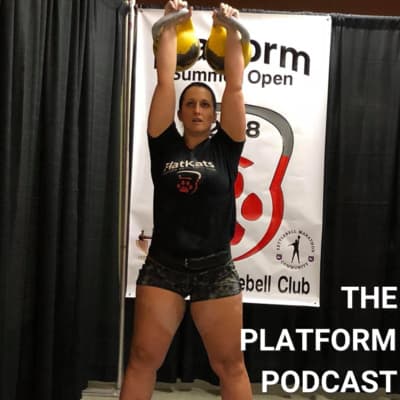
The Platform Podcast · Episode 73
Mandy Grace | Curler, Kettlebell Enthusiast, Ruby Player
February 28, 2022 · 70 min
Show Notes
Date: 2/28/2022
Season 6 | Episode 11
In this week’s episode I welcome Mandy Grace. She is a kettlebell athlete, lifelong curling competitor, a former tight 5 rugby player, dog mom to Loki, and a personal trainer (in training).
We dive into a range of topics:
- How she got into kettlebell sport
- Her new kettlebell sport coach
- Dropping knowledge about curling
- Her career as a rugby player
- And more!
Don’t forget to Register for the 2022 Twin Cities Kettlebell Open
and if you want help reaching your goals please Apply for Coaching
If you enjoy the content please leave a 5 star rating & review, share on social media, and support my work by supporting my affiliates:- Pro Kettlebell, MADE IN THE USA Kettlebells
- Kettlebell Kings, use code TCKB to get 10% off
- Bearfoot Athletics, use code TWINCITIESKETTL to get 10% off
- Driven Nutrition, use code TCKB to get 15% off
- Revive Supplements, use code TCKB for 10% off
- 27 Degrees Apparel, use code TCKB10 for 10% off
Transcript
Machine-generated transcript; may contain transcription errors.
Season 6 | Episode 11 In this week’s episode I welcome Mandy Grace. She is a kettlebell athlete, lifelong curling competitor, a former tight 5 rugby player, dog mom to Loki, and a pers Welcome to the platform podcast where we talk to coaches, athletes, experts, and real people to learn about their approaches to training, nutrition, mindset, and much more. I am your host, Jordan Kunde-Wright, founder and head coach of the Twin Cities Kettlebell Club, and I'm on a mission to help others build sustainable, healthy lifestyles. Before we jump into the episode, I want to remind you that registration is open for the second annual Twin Cities Kettlebell Open on October 22nd hosted by our friends at the Athlete Lab in Little Canada, Minnesota.
Mandy just as we did last year, we'll be including options for video submissions for participants who are unable to make the trip in person. We'll be eligible for all of the same prizes as our in-person competitors. Just go to our website, Twin Cities Kettlebell Club.com for details. In this week's episode, I welcome in Mandy Grace. She is a Kettlebell athlete, a lifelong curling competitor, a former tight-fired rugby player, dog mom to Loki, and a personal trainer in training. Mandy we have a great conversation, get into a lot of different topics. She drops a lot of knowledge about curling. Mandy we also talk a bunch about Kettlebell Sport, and just how being an athlete in general applies across the range of disciplines that she has been successful in.
So I really hope you enjoy the conversation as much as I did. Mandy as always, I want to say that I'm incredibly grateful that you listen to the podcast. Mandy the best way you could support me is to go register for the Twin Cities Kettlebell Open, and maybe tell a friend or two. Just go to our website, Twin Cities Kettlebell Club.com for details. Mandy of course, if you haven't already, please be sure to leave a rating and review of the platform podcast in your app of choice, and particularly on iTunes. Mandy of course, you can support my work by supporting our sponsors whose affiliate links you will find in the episode notes. But not least, if you want how preaching your goals without wasting time, please go fill out the coaching interest form linked in the show notes.
I help athletes of all levels reach their goals without wasting time using my integrated coaching approach. Mandy of course, you can follow me on Instagram, Facebook, and YouTube at Twin Cities Kettlebell Club, or email me at Twin Cities Kettlebell Club at gmail.com. Now without further ado, let's step on to the platform with Mandy Grace. Alright, welcome into this week's episode of the platform podcast. My guest this week is Mandy Grace. If you don't know Mandy, you should because she is an all around kick ass athlete. She is a Curler from Canada. She is a kettlebell enthusiast. She won't go so far as to call herself a kettlebell athlete, but she's also an excellent former rugby player as many guests on the podcast have been.
So Mandy, thank you so much for joining us on the platform podcast. Thank you for having me for having me. I feel like a little bit of a stereotype, a Curler from Canada. Well, you know, that's all right. There's nothing wrong with that. I mean, there's kind of some, I think climate requirements aren't there to really get into, to get into curling. I mean, there's no, is there like a Mexican curling team or like a South American curling team? Like, you kind of have to have a cold climate. Not that I'm aware of. We definitely have a little bit of a, you know, seasonal advantage there. We do have, we do have curling here in Minnesota, too. There's, there's kind of a, there's kind of a thing here in the Twin Cities that the curling is kind of a big deal here.
There's several curling clubs in the Twin Cities. So we are home to a, well, it's in NATO, Minnesota, in Minnesota. Minnesota, sure. Yeah. Yeah, we've got, we've got a bunch of, we've actually got a bunch of Minnesotans in the winter Olympics this year. There's a, there's the person who just, just took silver in cross country skiing is from Minnesota. One of the ladies on the US, US hockey team, US women's hockey team is actually from my town. It's Vandice Heights, which is adjacent to little Canada, of course, as everybody knows, she was, she was actually the one who rang the shot off the side of the cage right at the start of the game that would have given the US a one or one zero lead. But we won't talk too much about that because it's still a little painful, but I'm just, I'm just glad that the guys in the in the chat didn't take me up on my side bet offer to do burpees for whoever won or lost that game because nobody responded.
I'm afraid and didn't respond, so nobody ended up having to do burpees or I didn't end up having to do burpees for betting on the US. So I feel, I feel okay about that. If there's one thing I've learned in the kettlebell group chat that we are both a part of or have been adopted into, it never make a bet that involves burpees. I would take that a step further and just say never make a bet period because it's always going to be awful. If you lose, it's pretty much always going to be awful. Poor Tim, poor Tim had to do the Merkel, the Merkel and long cycle pyramid a couple, a couple of weeks ago, so. It's always going to be awful and you're always going to have an audience of people watching you while it's awful.
Yeah, yeah, it's always like it's, it's never like money or anything like, no, it's always public humiliation and pain. It's. We are all kettlebell athletes or enthusiasts and you know, we all like a little bit of pain. Yeah, you have to be a little bit of a maskist to be a kettlebell sport person and to be in that group. So it does, it does track it's it's very on brand for us. So. So how, how did you get into kettlebell sport? So kettlebell sport and I stumbled on each other through a bootcamp at good life about about a decade ago, I guess I. For the Americans, what is good life? Cause to me, that sounds like a church. Good life is one of our biggest fitness chains in Canada. It's the one that you'll find in pretty much every city and town.
I don't know what the equivalent for Americans would be, but it's your typical big box gym. So it was close to home, I worked out there anyway, and I saw an poster on the wall for a kettlebell boot camp. Mandy I thought, oh, that sounds fun. So I signed up, it was a six week, two times a week boot camp fitness through kettlebells. Mandy I really enjoyed it. At the end of the six weeks, we did receive a certificate that awarded us quote level one gear away. Mandy I was like, cool. At the time, I thought that was a thing, the trainer made it up, but that's okay, but I did really enjoy working with kettlebells. Oh, brand it. I got to get credit there. I know, right. So it was the first time I will tell you who he is at some point and he is an athlete who still competes. So we can make fun of him.
So I really enjoyed the boot camp, but I couldn't find anything else to do with kettlebells in my area. So I did the six week boot camp a second time. Same boot camp, same trainer, different group of people. Mandy once again received my level one gear boy. Mandy then I purchased a couple bells and started just doing fitness workouts on my deck. Mandy within about a year, I was getting pretty tired of that and stumbled on another location in Halifax. I'm in Halifax, Nova Scotia, where they did a kind of like kettlebell boot camp, which seemed, you know, to be right up my alley since I've been working with kettlebells for a while. Mandy it's like, oh, cool. There are other people who lift these things. So I did that. Mandy that boot camp was run by a person named Tim Bell.
Some Canadian lifters want to know the name Tim Bell. He does compete in kettlebell sports. That's where I really learned that this thing I like to do for my workload could actually be something that you compete in. Mandy I was like, whoa, that sounds cool. So Tim told me a little bit about it, got me training snatch a little bit. Mandy we walked me into my first competition. So that's how it kind of all came to be. Mandy I've never been able to walk away. Mandy how long ago was that? I think, you know, memory is a hard thing. Especially now around like 26, 27. So that would put it about 10 years ago. Okay. Yeah. Mandy rumor, rumor has it a little birdie told me that you recently hired a new kettlebell sport coach.
I did that rumor spread very quickly. So I am very fortunate that Mandyrea Lloyd has agreed to start coaching me when I hopefully have a little bit more time to commit to kettlebell come April first. I'm really excited. You know, I preferred to start tomorrow, but I know if I start tomorrow, I won't be able to actually commit the time. That makes sense to be training consistently. So Mandyrea's agreed to take me on and she knows what she's getting herself into, I think. Evidently, she only goes to girls named Mandy is kind of what you know what you're getting yourself into. I do have a good sense. Mandy I'm forward to it. Yeah. We're kidding, of course. Mandyrea's a great coach. You're going to be a great hand. It's going to be.
I have heard that she really likes to make you suffer in the best possible way. Yes, she makes you very successful at suffering. She is very, very good at like redlining people right to the edge of their capability, but not pushing them over it. She's fantastic at that. I'm really looking forward to it. You mentioned that I curl. So the cycle of I don't want to say it's a problem because it's a really good problem to have, but I really enjoy kettlebell sport. Mandy I really enjoy curling. But when I'm curling, there's very little time to train kettlebell sport. So through the last six, seven years, I very consistently trained kettlebell sport from spring into summer into early fall. Mandy then I basically put the bells down and don't pick them up again until spring.
So I'm really starting from where I was before, maybe a little bit ahead of where I was the past spring, but not that far. So I was definitely not picking up where I left off. So this spring, my goal is to start and then not stop the swinter to see where that progression can really take me. Mandy I knew I wanted some, you know, expert guidance along that path. Fantastic. So you're going to have to forgive my ignorance around curling. I am only tertiary familiar with it as a sport from watching it on the Olympics. It's super entertaining to watch. I have never tried it. So I have no idea how actually physically taxing it is or difficult it is or skillful it is. I assume it's all of these things, but I have no idea.
Give me, give me like the, give me like the, the version of explaining curling to somebody that you would give to like a high school, because that's probably my level of understanding. Well, do you want better? I'll give you curling for a kettlebell athlete. Think about grabbing that beautiful purple bell that we all loved to lift and sliding it down 144 foot sheet of ice. That is what curling is essentially because the curling stone weighs 42 pounds. So very similar to a bell that we'd be familiar with. Typical curling sheet is 144 feet give or take with a little bit more room on the end. So you have room to move in behind. Have you ever watched a curling game? Yeah, it's super entertaining. It's, I mean, it's, to me, it's like shuffleboard, but so sober. I'm assuming.
You have two teams. Two teams of four alternating throwing. Mandy while somebody is throwing two people are brushing or sweeping. That's where, you know, curlers get made fun of because we do the hurry hard to try to get the person to sweep harder and faster. Mandy you're throwing towards the target, the hopes of concentric circles. Okay, what does the sweeping, what does the sweeping do started interrupt you, but I'm like, I have to ask the question before it escapes my brain. What is the sweeping dude doesn't make it, does it make it, does it make it go faster or slower or does it depend on on, like, I don't know, I don't know what the function of the sweeping is. It both makes it go faster and can change the curl the direction of the stone.
So if you think about a broom, like a curling broom, which is essentially like a nylon type pad, moving quickly over ice, it's creating friction. So the friction is just ever so slightly melting the ice surface, which is going to make the stone glide faster over the surface. So that's one purpose. But sweeping is really developed into a bit of an art form over the last, I'd say, five years in particular. So we sweep in a certain direction, depending on the path we want the curling stone to take. So a curling stone will naturally arc down the ice or curl down the ice in the direction that it's turning. So if I turn it say clockwise, it's going to arc as it moves down the ice towards the right and the kind of the clockwise direction.
You can sweep against the direction of the curl. So it's turning clockwise. The person on the side is turning towards sweeps in the opposite direction and actually straightens out that curl. So it doesn't curl as much or the person on the side of the direction that's curling in can sweep and make a curl more. So it's going faster and changing the direction. Okay, that's super interesting. Mandy it is interesting and it has made curling very complicated. I was just thinking that like my brain is going through going through the physics and like because there's so many dynamics there because you're not the part the sweepers are not the one who pushed the stone so they don't know how much inherent momentum it already has other than what they can judge based on their eyes. So they didn't get the time of the rocks. Oh, really? Okay, cool. That adds another dynamic to it. That makes sense, but I didn't know that.
Oh, you can time a rock from when you first throw a rock, the very first line you crossed while you're throwing the stone. It's called the back line. Mandy the last line before you let go of the rock, there's a hog line, so it will time from the back line to the hog line. Mandy based on that split time, we'll kind of extrapolate to where that rock is going to end up. Okay, and when you say we who is who is running the stopwatch, is that happening while is that happening while you're while you're sweeping like does everybody have a stopwatch like on the wrist or like, okay. Yeah, so you're sweeping your timing, you are still using your head and guessing because if you watch enough rocks, you get a feel for how fast they're moving down the ice.
Mandy then you have somebody at the other end, the skip in the house, those are usually the famous people, we give them all the credit, but they also get all the blame when things go wrong. They are watching the rock coming towards them and they can really see if it's staying straight or if it's curling a lot and then they'll give you the direction to sweep to make a curl more or less if needed. Okay, and so the stone, the people sweeping the stone, really are kind of, you know, quote unquote, in charge of judging the weight, like how fast it's going, the person that the stone is coming at is really watching the line, how much it's curling or not curling. Okay, and so i'm assuming i'm assuming that the people that are in the four positions on the team, especially when you start talking about high like high level curling teams, you don't switch positions right you're not like going from you're not going from being the skip to being one of the sweepers right like the skip is this.
Typically, no, you will see teams kind of break and come back together and people might be playing different positions, but typically somebody who plays the front end so throws either the first lead set of stones or the second set of stones, they'll usually continue to play front end, you might eventually see somebody move positions, but most of us have our niche that we like to stay in, especially at the more amateur level, which is where i'm at. Okay, and so so what position or what position is your position so i play mate, so I get a little bit of the best of both worlds so I throw third so the lead throws the first two stones the second throws the next two stones, I throw the third two stones, which is why i'm called the third and then the skip throws so when the skip the person in the host does all the yelling when that person is throwing i'm in the host doing all the yellow.
Nice yeah so it's not much pressure of actually calling the game and executing the strategy, but I do get to work, both a little bit on the sweeping side and a little bit in the host calling the game side so it's kind of like keeping one foot in both rounds when you're kind of the clincher then, though to right like if you're the if you're the third you're the third and then you go to that and then you go to the house to help help the the skip throw his stones right like. That those are the those are the final stones that get thrown in that in that round right so that's kind of we can either set our skip up for success or set them up for something that we call a skips doose, which is when everybody else has completely shut the bed, but they somehow still manage to make both of their stones count and they get a skips doose.
Mandy what does that do did they just get two points on their own, we didn't really help them okay yeah, so I will say curling has changed a lot I started playing when I was five years old. So from that point in time, the game has changed so much I played through high school fairly competitively, but I look at the competitive teenage athletes now versus the competitive teenage athletes when I played in high school and the level of play is just crazy now and I don't know if it's that way with every sport, but I definitely see it in the curling world. Cool. All right, so all right, so we're going to set curling a little bit to the side, just because you gave me a nice, well, I mean, it can be this one certainly can be no, I definitely it's super interesting to me, this is my problem, what guy, I'm so like infinitely curious that I could literally just chat with you about curling and ask you questions about curling for the next hour and I would lose the audience entirely.
But really, if you have any interesting curling and since he's from close to your hometown, try to get Matt Hamilton from team USA on your podcast, okay. He is on team USA with John Schuster, they play sport this year, but John Schuster has been to the Olympics five times now, Matt Hamilton is a self-proclaimed mustache enthusiast, like tattooed up like crazy hair. I'm a glorious mustache carries a lucky green tooth in his pocket while he curls he's just, you know, a bit more of a character than we typically see in curling, especially at the high level, at the elite Olympic level, he is a pleasure to talk to and hear interview, he would be a great guest. All right. I will see if I can I will see if I can make that happen. I have a feeling it's probably going to get a lot of interview requests after he's kind of he's he's pretty popular right now.
But that is true. I will see I will see I got to find out which which curling club he he practice that locally and we'll see if I can see if I can make a connection because that'd be that'd be awesome. I would I was your segue. I think I'm not you're fine. It's fine. This is this isn't structured. We don't we don't have a plan. I was just I was going to send you alluded to you alluded to you started at the age of five I was I was going to go back to the origin story is always something I always find interesting like how did you how did you grow up how did you get into curling and then what like what was your athletic background. What was your background like as a kid and then, you know, how did how did your Yeah, my athletic background was almost nothing. I will say I am not a very, you know, natural born athlete. I'm incredibly clumsy. I can tell you about some notable bone breaks, especially once I started playing rugby, but my mom was a curler my mom curled in national competitions, some of my earliest memories are walking down the block and watching my mom curl on the ice at our local hometown curling club when I was like five or six years old, sneaking out past my bedtime and watching curling.
So curling I came by very naturally. It was never a question of if I would curl. It was when I would curl. The rest of sports were, you know, a bit more of a struggle for me. I did play some basketball and volleyball through junior high and high school until I caught a ball at the face and broke my nose the first time. I did run cross with your hands. I heard that. It seems like that's probably a better approach. Yeah, I did run cross country and track, but that was more because we really didn't have many people at our school who were doing those things and they needed a couple more girls for the team. Not through any, you know, incredible level of skill that I have and to possess just stubbornness that I could get through a race.
Mandy I think that stubbornness has translated well into kettlebell sport and run before me. I'll call it resiliency. Resiliency sounds better than stubbornness. I mean, yeah, they're both admirable traits. I think I'm, you know, I'm pretty stubborn myself. So I'm always I'm always proud of my stubbornness, but yeah, resiliency is probably a better. A better way to frame it up, but that's, that's all, that's all good. So I, I have to, I have to ask, um, I got a story handed to me from from our mutual friend, Mr. Boris. He, he told me at the, at, at nationals, he wasn't going to do a five minute set and you apparently decided to make sure that he did. Can you give me the details on that? Oh, I was at the lift that I did a 20.
Yeah, you did a 20 kilogram, you did a 20 kilogram, five minute long cycle set when untrained is what I, is what I hear. So I've been training for 16 kilogram long cycle that and I have been battling on and off for many years because of the cycle I mentioned of training through the spring and summer, then stopping, then training through the spring and summer, then stopping. It's not a really hard time progressing past 16s because I'd really like to hit my favorite number 100 before I'd progressed to our past them. But I had been starting to dabble in the 20s and by dabble, I mean, do like one or two minutes, but Boris was being a wimp as usual. I thought that if I did the set with him, that it would provide some, you know, extra moral support. So I decided to do probably ill advised, but decided to do my first 20 kilogram, five minute long cycle set.
Mandy it was probably the most painful thing I've ever experienced. I think I died a little bit more than him, but we both did last the five minutes, which was my primary goal. How many reps did you hit? I have a number of the heat. It was pretty low. I think maybe 32 or 33. He said you hit 40. So that would be eight or five minutes. Okay, Matt, you're a liar. Very much lying. I believe I was under 35. Okay. The goal was definitely 40, but I did not fully understand what those purple bells were going to do to my soul during that five minutes. But you, but you still decided that you saw, you saw a friend in need and you're like, I will suffer with you so that we can make so that we can make this, make this happen. Like that's, that's pretty cool. I do, I, I, there was some choice words apparently about about his, his mental fortitude prior to when he was trying to quit. But I think that nobody gets to quit in our kettlebell group. I will, I really admire the, you know, there's a lot of joking, but there's also so much support.
Mandy nobody ever gets to back down from a challenge without a good reason, of course. You know, we egg each other on a lot, but it all comes from a good place and all comes from a place that I think understanding that we all really do have pretty strong lifting abilities. It's just all that other noise sometimes. How did I get in the group? Yes, I've ever done his rank one, like I'm not anything impressive as a, as a lifter. So I think they adopted me after a Niagara kettlebell sport open. It's a very welcoming, friendly group for those who aren't familiar with team riddle struck or team LaVoy, you should be definitely look them up. They taken strays from North America. We are two of the strays talking right here, but they take in strays, make us feel welcome and keep us engaged in the sport.
Yes, it is, it is a great, it is a great group of people. I do love the culture of the iron sharpens iron you get. So you and you and Boris apparently have like a sibling rivalry going on and then you've got. How it's developed, yeah. Yeah, you've got you've got LaVoy and and and riddle also have kind of their own, their own rivalry going on where they're always going back and forth at each other. Mandy they were pushing each other to, you know, to new heights, which is, which is always great. It's, it's a lot, it's a lot of fun. I really, I do really enjoy that, I really enjoy that dynamic. Mandy until I backed off lifting a bit, it kind of felt as though Sarah and Mandy, the other Mandy and I am God, we're in Mandy and Mandy.
We're in a bit of a race for the 16 kilogram bells to see who was going to kind of come out on top. I plan to rejoin that race very soon. Nice. Yeah, I'm looking, I'm looking forward to seeing you get back, get back under the bells. Mandy especially with Mandyrea pushing you, it's, I'm going to be very excited to see what, what's your highest rank that you've, that you've achieved in competition up up to this point. So I have CMS and 20 kilogram snatch and rank one in 16 kilogram snatch. Mandy CMS in 16 kilogram long cycle, no wait, rank one in 16 kilogram long cycle my bad. Okay, well, when you start getting into CMS territory, you can't not call yourself a kettlebell athlete. I'm sorry. That was just once a long time.
But it still counts. It still counts. You still, you still hit that rank. So, and what's your, what's your favorite? Oh, that has changed over time. So when I was working training with Tim Bell, out of his bells, kettlebell's facility here in Halifax, his whole group really only did snatch it first, Tim lifted snatch, we all lifted snatch, I'm not sure I actually knew there was anything but snatch to be honest. The first time I actually ever tried like a long cycle or even a jerk movement outside of like a fitness workout was at my first night or kettlebell sport open, there was a team really after the event. Mandy I was on a little team where we did a jerk really, and that was my first time ever doing double bell anything and also my first time doing double bells jerk. Mandy I was like, this is really cool.
I died a little, but I liked it. Mandy around the same time, a couple of lifters from New Brunswick, which is the province next to Nova Scotia, came down to Halifax for a little in-house competition that Tim put on. Mandy they, to me, looking back, were like these superstars busting through the door of the gym, like stradding in, they did their lifts and they were lifting long cycle and jerk and double bells, which I'd never seen in competition. Mandy you know, some people did snatch too. Mandy I was like, whoa, there's this whole kettlebell world out there that I don't know about. Probably makes sense that within about a year I had enlisted Kimberly Eagles, who was one of those people that I was like, who was this Amazon on a platform just like killing it like this beautiful technique that makes it look so easy.
I enlisted her and she fortunately adopted me and agreed to take me on and coach me for a couple of years. Mandy that really brought me further into the kettlebell world, so to speak. You know, it was through team platform, which is their team. Mandy through Kimberly and Michael Eagles coaching me that I went to, you know, Ontario for my first competitions, met the Riddlestock crew, met Jen Hintonberger, met some really wonderful people in this world. Mandy kind of got further into the sport and really had it get its cause in me because I liked it before. But when I learned like how far you could take it, I started to love it. Nice. That's awesome. So my long way to avoid answering my favorite.
I'm not going to let you. So I'm going to say like, so what is your favorite lift right now? I still love long cycle. I hate long cycle, but I love long cycle. Yeah, that's fair. That's fair. I understand that. I don't need to abandon it yet. What is it that you, what is it that you love about it? Why can't you quit it? I feel like it's a bit of a challenge because I want to achieve, you know, X number of reps with X weight. Mandy then I'm like, oh, then maybe I'll go to buy off one for a while. But I know once I achieve that, I'm going to want what comes after that and what comes after that. It's like this never ending cycle. I do really enjoy the double bell lift. I know there's no double health half snatch, which I am not sure I have the coordination board from the few times I've tried it.
I've almost taken my knees out. But there's just something about long cycle. I don't know. It's hard to put into words. Okay. Okay. Mandy what was that your favorite lift? I don't know this. Oh, that's a good question. Mandy I can't really say I like literally I can't I can't choose because in the same way that like it's changed over time, it was long cycle for a long time. Mandy then, and then I got, and then I got pretty, I got pretty heavy into into by Athalon for for a little while. Mandy then I, and then I really went full after triathlon. Um, and so I actually, I actually really enjoy triathlon because there is something I love and hate about each of the lifts. Mandy I can, I can, I can enumerate what that is like.
In jerk, I love, I love how I, I think jerk is probably my best lift. Mandy for me, it's like I just get to express my power because I'm not, I'm cardiovascularly, I'm never, I'm never like gassed. It's really just about localized suffering and how much, how much pain can you take? Mandy usually the answer is quite a bit. Um, so like I like, I like that about jerk. Um, but you also don't ever get to, you don't get any relief in jerk. So there's that, there's that part that I hate about it was snatched like the, it's such a fickle bitch like you feel like. Pretty too. It is, but it's, but to me, it's kind of like golf. Like it's one of those things where we're like, just when you think you've got it figured out, then you start hitting the ball sideways. Mandy then you're like, what the hell, why can't I just, just make this can say like, I don't know, you're like, you get one, you get one that goes up so smooth and you're like, fuck that felt easy. What did I do?
So there's, there's so many moving pieces on snatched, but I love it. Like when you get in the flow and you get in the groove, like you can just like I stopped being able to count. I don't even have to count. I just like kind of get into the pocket and I love that. But it's also, it's also just a fickle to me that that lift is so detailed oriented and so fickle. Mandy then long cycle was my first love, but it also broke my heart in my back. Mandy so it's like, it didn't football broke my back. But, um, you know, it was one of those like I, I got so obsessed with. With getting to a higher rank on long cycle that I trained it, I over trained it. I went like 18, 18 plus months with nothing but long cycle. Mandy I ended up, I ended up with some pattern overload. Mandy I ended up getting myself hurt. Mandy then I had to step away from long cycle for a while, which is probably a good thing. But, um, now now coming when I come back to long cycle. I don't know, I just like the cardio, the cardio component of it crushes me because that's never been the strongest part of my game.
cardio has never been the strongest part of my game. So I'm always like, yeah, I'm always, I'm always just like when people are like, I love, I love long cycle. I'm like, doesn't it feel like your heart is going to explode and your soul is going to fall out of your bottle because that's how I feel. I'm like, no, no, I'm okay. No, it does. It really does. Yeah, I do have to say, I'm looking forward to snatching some again when I have picked up a bell over the last couple of months. It usually has been snatch. I'm looking forward to having a chat with Mandyrea to see, you know, where I'm headed over the next little while. I'm leaning long cycle. But I don't know, snatch was my first love. I mean, they're not mutually exclusive. I mean, I train, I train triathlon. You can, you can train all the lifts. If you want to, you're just not going to progress as rapidly at any of them.
If you, if you focus on, you know, multiple, but, you know, not just the lift where I had, I think my biggest aha moment when it finally just clicked into peace or into place. I struggled with it. You know, I could, I could, I'm strong. So I could kind of muscle through for a long time. But when you start working with the heavier weights, you can't muscle through a 10 minutes set anymore. Mandy I was still trying, trying valiantly. Mandy I actually have a video saved on my phone. I think it's the only old video on my phone I haven't gotten rid of. It's from a one-on-one. I did probably five years ago with Abby Johnston. I did a one-on-one, like one hour of snatch work with her. Mandy you can actually see it on my face as she's actually like physically moving my body in the way she thinks I should be moving.
You see my face go, oh, that's how I should be moving when I snatch. Mandy that aha moment changed it entirely for me. Mandy snatch became one of my favorite lifts work quite a while after that. Yeah. That's awesome. I think Abby. I love that. I love those. I love those aha moments. I love, I love those when I see them with my with my athletes. Like, when you get those moments where you give somebody a little, a little cue or a little tweak or some, you know, some type of change. Mandy they're like, oh, oh, this isn't, this isn't as terrible as I thought I was just doing it. Something so minor. Mandy that's one of the things I love about kettlebell sport. Very similar with curling is such small adjustments can make such a substantial difference. Mandy you never stop learning.
That's a very diverse. Nothing to do better. There's always something that you can do better. Amen. I. I do. Yeah. It's, I mean, yeah, it's the love hate thing. It is, it is absolutely one of those things that you, there's always something to improve on. So it's never perfect. But that also means you always have something to work on, which is, which is great. on after not lifting for six months. I mean, it's gonna get easier at some point, right? No. No, it never does. You just get the belts just get heavier or you do more reps. That's all that that's all that happens. It never. I work at a gym and often clients when they first come in will say something like, oh, you know, everybody's been doing this for so long. It must be easy for you now. Mandy the answer is no, it doesn't get easier. You just go harder. Yeah, you just get better, which is great. I mean, if you did your old workout, yeah, it's like if you were like, oh, yeah, that if I went back to my original workout, yes, that absolutely would be easy for me now. But what I heard to go back to our old workouts. No, God, no, we do that. We interrupt this episode to announce a new sponsor for the platform podcast. Driven nutrition is now the official supplement company that I am affiliated with for the Twin Cities Kettlebell Club as well as for the Twin Cities Kettlebell Open in 2022. They offer a wide range of high quality supplements and I am very, very excited to partner with them. They are a small company that communicates really well, good customer service. Mandy I really love the quality and the taste of all of their supplements and they have everything that you need, basically, from jump. You can get creatine monohydrate, high quality proteins, as well as sleep aids, fish oil, all of the quality supplements, the basics, you know, the fundamental supplements that I recommend for all of my clients and for all of my athletes. So check it out at Driven Nutrition. There's an affiliate link in the episode notes and you can use code TCKB to get 15% off of your order. So where did Rugby come in? When did Rugby elbow its way into your life? Rugby was a terrible life decision in a lot of ways. I was 30 years old. I had never watched a rugby match in my life. I'm not even sure I knew a single law. I didn't know a single position.
I knew people kind of ran around a field and fell down a lot. But I was kind of looking for a new activity social thing and it was around the same time I went back to curling because I did stop curling after high school and I joined a club again when I was 30. A friend of mine had just joined a rugby team. I was in my head. I thought it was more like a social cloud, like something intramural, non-contact, like flag football-ish. Like a drinking team has a rugby problem type of thing? Yeah, so I went out to a field with her and it was a practice and I became a river lake rambler and never looked back three weeks later. I was in my first scrum in a game. Nice. Mandy what position did they put you at when you started?
I played second row. Okay. So I was never a super skilled rugby player by any means. I didn't grow up playing ball sports. I wasn't very agile. I wasn't very fast. But that's one of the things I actually I wish I had known about rugby. I wish my home community had rugby because it was the first sport I'd really played where my size and my strength were a really good thing. So many different positions, every position with different requirements, everybody was welcome. I was like, dude, this is pretty cool. The ramblers, I mean, it's a rugby club. We play against other provincial rugby teams. But as you said, a drinking team with a rugby problem, that's probably the best description of River Lake, which was my club. I quickly became part of kind of the club community, part of the club executive. I stayed with the club for only about four or five years. The time commitment and the level of brokenness of my body were just not worth it at a certain point to me. But my god, I loved rugby. Still loved watching rugby. I did finally learn the laws of rugby. At what point did you walk away? When did you decide enough pounding was enough pounding?
I was about 34 and it was getting to the point that I was getting a bit more serious about kettlebell sport. I was working with team platform. I was breaking a finger. I was bruising my sternum. It was just really impacting the other goals I had for myself. Mandy I stayed on as part of the kind of club exact and like social side of the club for a while. Even after I stopped playing, I loved mini rugby. We had a mini rugby club for youth. That was a lot of fun. Youth age, like five and up, teaching them to play the sport for the first time. I stayed on a little bit, but then you know, kind of fell off. Your plate or your shelf, I guess, I've learned in my old age can only have so many things on it. Mandy my shelf usually has too much on it. So something either had to fall off or the whole shelf was going to fall off the wall. I understand. That's a great analogy. I'm probably going to steal that one because I always use the cup analogy. I'm like, you only have so big of a cup and you can't put more, you can't get a bigger cup. But I like the shelf analogy better because it feels kind of how life feels when you're overloaded. You're like, everything's going to just collapse on top of me if I don't take it. It will. The whole shelf will fall off. You will not be able to function at the level you need to. Mandy I think that's something I've learned.
You know, with kettlebell sport, I really love it. When I'm training, I enjoy it so much. I love the community, but I've never put it first. It's never been my number one priority. I mean, there's work work because I work two jobs. Mandy then my dog, who everybody who knows me knows I love my dog. So those are the top three. Low key. Yes. Mandy then it's been like kettlebell sport or curling, kind of flip flopping in that fourth and fifth position. Mandy I always try to manage my expectations that if it's my fourth or fifth priority, it's only going to be so good. I'm only going to excel so much. Unless I'm open up that list. Yeah. That's that's that's great. That's very that's very good perspective. So for you, curling, curling, you've you've toggled between curling and kettlebell. Are you going to continue curling? Is that is that part of the plan? Mandy like how long how long can you curl? Like I'm assuming you can curl from most of your life, but I made curl until you're not alive anymore.
Okay. Yeah. Is that the plan for you? Keep curling? Oh, yeah. You know, in the last couple of years, curling has been a focus. My team has left Nova Scotia. My province twice at our nationals in 2018. Mandy then this year about three months ago in 2021, we were at nationals. Mandy with those two events coming up. Mandy then of course, COVID in the middle, it was really, you know, curling has been my focus through the last while. Mandy I'll certainly continue to curl. But when you're getting ready for say a national competition, you're not just heading out on the ice once a week and biff and some rocks and drinking a beer. The time commitment was a little bit more, but I don't think I have any competitions around the corner. So it might be just heading out on the ice once a week and biff and some rocks and having a beer and then focusing on kettlebell sport a little bit more. Okay. So I'm I'm curious because you know, when we were talking before, you're like, I am not an elite level curler, but you're talking about you represent your province. Mandy then you've been to nationals and your team did well at nationals. So like, how far removed are you from? Mandy I'm how far removed are you from being an elite level curler? Because like, I don't know what the gap is between like representing at nationals and doing well there as opposed to qualifying for the Canadian Olympic team.
Like, I don't know what the gap is there. There are sort of like two tiers of curling in Canada, at least. I'm not sure what it's like in the States. There are the, you know, professional athletes who do this as more of like a career who are competing to be at the Olympics in the world. Mandy in Canada, at least to the men's national championship, it's called the Briar. The women's is called the Scotties. Like, going to those events is this huge thing, like every curler in this country would love to represent for me as a female at the Scotties or at the Briar. But there's this level just below that. That's more of like a grassroots curling level where there's still a national program that fosters kind of club level, more grassroots level curlers to have something to compete for, something to strive for. So none of us are doing this professionally. None of us are touring. None of us are competing to where the maple leaf on our back. But it's still a national. You can beat out of your province. So they're going to be 14 teams at the national. Mandy you do compete to be the national curling club championship or champion, which is kind of distinct from the Briar and the Scotties.
It's like tier one and then this is like tier two curling. I call it for curling for people who need to have a life. Like we need to have careers. We have families. We have other stuff on the go. We can't be on the ice five or six days a week and traveling several times a month if not more. It's a really accessible level. We were really fortunate. The event looked like it was going to disappear after we lost our title sponsor. But a new title sponsor has taken it over. Mandy they've really kind of you know started to shepherd in this new era where we have some really big name curlers. I know that's an oxymoron to some people. But like Jennifer Jones who is at the Olympics this month and Mandy Furby and Cheryl Bernard. They're this executive committee who are working on this national event to make it a really like killer experience. Mandy having been there a couple months ago, I can say it was a really great national experience. So elite level questionable, not just recreational though. Cool. Okay. So I understand a lot better now. So I'm basically there's incorrect me if this is making it too reductive. But like the tier two is basically the amateur level, which is still serious. Like if you're at the top level of the amateur, you're still pretty serious about it. But you're not it's not professional where like the tier one is kind of the professionals the people that are doing that like curling is their life. That's what like that's what they do.
Tier two is tier two is like amateur, but still serious. Like it's a big part of their life. But that's not their entire life. That's kind of only reason the professional term is so tough with curling is at least in Canada, very few people do curling as their job. Almost everybody has a full-time career. They just make the ultimate sacrifice of time and family and everything to still curl at that elite level. But yeah, it's like curling with a life. Yeah, that's yeah, that's I mean that's the downside of being in a niche sport, right? Like I've had people ask me like, well you really love this kettlebell sport thing. Like why don't you just do that for a career? Mandy I'm like, I would love to. Mandy I'm like, because I have kids and they need to eat food. If you find a way to make money doing just kettlebell sport, please let me know. Yeah, that would be that would be fantastic, right?
But they would be the best with unlimited time to train, but it would certainly help. It definitely it definitely would help all of us. I think it's and I think that is one of the one of the challenges like, you know, I always talk about the sweet you got to find the sweet spot of the things that you really love in that the rest of the world values because people are probably not going to pay to watch me suffer through a 10-minute set. Mandy that's okay. I understand that. I don't even know. I know I know about 10 people who would watch you pay to suffer through a 10-minute set. All in this Facebook chat group. Yeah, they would all put up $5. You could buy a pizza. Yeah, yeah, which I would definitely need after after that always, always.
So what is your what is your your favorite post-lift nosh speaking of? Because it's dinner it's dinner time here. So getting home. So I eat a lot, like a lot. I can eat a ton of food. It's a it's a little shocking. Pizza is a really good one, but Indian food. I love Indian food after a lift or after a competition. I would never want Indian food the night before a competition. Yeah, the night after we'd love some good Indian. Okay, I like that. That is not an answer I've heard before. I like I like that a lot. I love Indian food. So I definitely like that. Mandy yes, you're good calling. Not the night before, but after the lift after the lift is over. Yeah, I could definitely, I could definitely crush them in. But you know what? I could probably crush anything after a lift is over. Actually, I think one of my last events that I actually lifted at was at a a a crosshage and locally here. Mandy it happened to be down the street from an Ikea. So after a lift for Don we went and we got Ikea hot dogs and a soft serve. All right, not like not like after the event was done like we walked off the platform, changed our shoes and went and got hot dogs.
Mandy then we came back and watched everybody else compete. All right, I like it. That's that is a new one. I like that a lot. That's fantastic. That's great. So I have a I have a another question and this is this is more around because again, I don't know how challenging curling is like how would you compare it across the because you've competed in some pretty hard sports physically. How physically challenging is curling? It's much shorter bursts of energy. So you're really looking at like fast twitch energy instead of, you know, kettlebell sport. Mandy which energy system does that tap into? No, don't make me do the energy systems. That was earlier today. I know you've been studying for 12 hours and I'm quizzing you. I don't think we've mentioned this on air, but I'm or on recording, but I'm studying from a personal training certification. So my brain is on a little bit of overload right now.
But you know, curling is it's short intervals. It's bursts of energy. So sweeping, I mean, sweeping really sucks. It's hard. You are moving fast down a piece of ice trying to keep your balance putting all your pressure over the broom, trying to move your feet and move your arms and like a broomstroke at the same time. But it's only 20 seconds and it's done for a few minutes. Mandy the other side of it is really flexibility and mobility to be able to get into that sliding and throwing a rock position. I'd say flexibility is probably my biggest challenge for that. So in terms of like just like grit and endurance, definitely, you know, kettlebell sport rugby require more of that. But curling, it's a lot of, you know, short bursts of energy. It's a lot of leg strength to push out of the hack and push your stone because as much as your first instinct when you get on the ice for the first time, it's just a shove that stone with your arm. That is going to change the line, change the rotation. It's going to just not be a good stone if you're curling at a competitive level. So you're pushing with your leg entirely. The leg that you're pushing out of the hack, which is the thing you push out on to slide down the ice. It's very specific flexibility and strength.
Whereas kettlebell sport and rugby seems to be just like overall full body, go as hard as you can for 10 minutes and try not to die. That is a good summary of that. So the injury question is, have you ever gotten, have you ever gotten injured curling? I have. Mandy what were those injuries? Injury or injuries? Have you been given a preview of any of my recent injuries from curling? No. Oh, okay. This was a completely off the cuff question. I was just, I was just curious because I like, I know the damage that I took playing American football. I know the damage I took playing, playing rugby and, you know, but I can't, I can imagine myself trying to curl and being like, I would break my butt. I would break a wrist. I would, like, I would fall. I would, like, tear a hamstring. Like, you know, I'm just going through all of the things that would make curling hard for me. Mandy so I was like, I'm curious. Like what? So I did come home from Nationals in December with a black eye from curling, which is not your common experience. But it wasn't from actual game play. I mentioned earlier when we were chatting that I'm a little bit clumsy. We played our semifinal. We lost on the last shot of our semifinal, so at the very, very end. Mandy it was okay. It was fine. We're still going to be playing in bronze medal game. We're walking off the ice. Mandy it was a really great game. So the folks who were there watching were clapping for us and, you know, cheering both teams. I was the first person coming off of the ice. Mandy I tripped and slammed the end of my broom into my eye socket and gave myself a black eye, a massive skull and black eye, which I then had for both the bronze medal game and the awards ceremony in banquet. So that's kind of a curling injury.
I don't think it counts as being clumsy when you do it on ice. I feel like I feel like that's environmental. I was going up carpeted stairs. I tried to give you a pass. You could have just been like, yep, you're right. No. There's no past. There's video. There was press. It's well documented. But actual curling injuries, you know, without actually falling down, which does, you know, happen from time to time, although not as much when you've been doing it for a while. It's really just overuse injuries. I find your knee, the knee that you slide on when you're delivering the rock takes, you know, it takes a lot of pressure. Mandy there's a lot of torque, depending on like how much you turn your foot out when you're sliding. So that knee that you slide on is definitely prone to injury. Low back when you're sliding, you hyper extend the other hip. It's just a lot of overuse injuries. Mandy then your forearms and your wrists from sweeping the pressure on the broom. But in terms of like, you know, comparing it to rugby or comparing it to football, you're not going to typically see that like impact injury in curling unless something goes terribly wrong. Unless I was trying to do it, then I would fall and break a wrist because I'm clumsy. Mandy I would be on ice. So it's kind of falling outside of falling, yeah.
No matter what your level, you still fall. It happens. I wish it didn't, but man, it happens. It's a game playing on ice. Like you're going to fall. I'm sorry. Yeah, that's true. That's very true. There's a very notable video circulating the internet of the team that is currently represented Canada, the men's team at the Olympics. They're skip a few years ago. He was playing here locally. Mandy he fell like directly on top of a rock and gave himself a block. I like on the ice and the stone. So, you know, even at the most elite levels, it's ice. I'm moving quickly. It can happen. Yeah. I definitely think overuse injuries. Mandy if you aren't flexible enough, it will show and come back to haunt you. Okay. How about rugby? Mandy any any war wounds from the from the old rugby days?
I did tear tear my hip labor. I'm all I was playing. Mandy that has been, you know, an injury that has haunted me since. Probably another factor in why I stopped playing, I guess. But just, you know, small stuff like a finger, my nose, bruised ribs, bruised sternum, sprained ankles, rolled ankles, nothing. It just takes to play the game. Exactly. Okay. Okay. So this is no serious serious question here because you're you're regardless of what you will say. You are a high level athlete across a number of disciplines. Mandy you probably have some some insight to bring to back about what what do you think it really takes to to be successful at any athletic endeavor at a high level? That's a really good question.
To answer, I would probably look at what I think I've been lacking when I'm not successful, which is commitment and consistency. Sure, there's skill. Sure, there's some innate ability. Sure, there's great coaching. There's technique, but working at it, putting in the time, making the sacrifices for it, whether that's time or financial because we all know that competing doesn't come cheap. Even in something that only requires a couple of kettlebells, there's the shoes, the belt, the travel, the coach, the this, the that. It's, yeah, I'd say commitment and consistency are my kind of number one and number two. I'm not sure which one would be number one and which one would be number two. Same thing with curling. If you want to be good at curling, you gotta spend time on the ice. You have to be hope there. You can watch curling, you can talk about curling, but you have to go curl. I gotta get reps in, no matter what it is. You do. You need to lift the things up and put the things down. I like it. That's great. Mandy I can work on my overall fitness, working at a gym, I try to work on my overall fitness, but that's only going to translate to a certain degree and to success in kettlebells for it because there is so much technique involved.
There's such a nuanced movement, movement patterns that my body needs to just innately understand. Mandy general fitness is never going to give me that. Yeah, that specific adaptation to impose demands thing is, is unfortunately very, very true and real. Mandy it's like, I will say, like over time, your body certainly does have muscle memory. You know, having curled since I was age five, you always think we usually leave a Nova Scotia, we stop curling mid-April. Mandy typically by the time the club gets ice in again, because it's a really expensive Jamaica ice in the summer. Typically it's like late September-ish by the time we're getting on the ice for the first time. That's a solid like half year gap. Mandy when you slide for that first time, no matter how much you warm up, how much you stretch, you're like, oh, this is going to hurt. But it didn't hurt as much as you think. So you're like, I guess my body really does know how to do this.
Yeah, there's those neural pathways are there. I'm like, once they're there, it's just a matter of reactivating them. I hope they're there for long cycle. I really hope they're there. They're there. You're, and you're a good athlete. You don't give yourself enough credit for being the caliber of athlete that you are frankly. I will accept the compliment, which I normally don't do. That's a trend. There's a lot of, there's a lot of people that don't accept compliments well, but that's okay. I'm not going to stop giving them because I think it's, I think it's important because you really, you are, you are a very good athlete. It's very impressive. The breadth of your, the breadth of your skill. I'm curious. I'm curious. What do you think it looks like for you now that you're, you're thinking about not stepping away from the bells and curling at the same time?
What does that look like come September, November next year when the ice comes in? Mandy you've, you've been kicking ass at kettlebells for, for, for five months. Mandy now it's time the ice is in. Mandy you're, and you're ready to, you're ready to do both. What does that look like? I think without a national looming two months away, which is what the last really two full seasons post and pre-COVID have been for me, without a national looming going, I need to be on the ice every night I can. I need to be playing on weekends. I think that it's just, you know, a night away from the bells. Mandy if I'm looking to train sport specific three times a week, one night that I'm not doing kettlebell sport is not going to make it or break it now. But three or four nights that I am committed to curling and not doing kettlebell sport would break it. Like most people I know who do kettlebell work and are competing day job Mandy to Friday, you know, eight to five for me. Mandy then I work for a time in a gym. So that's usually a couple evenings a week and a weekend day. So that leaves fairly limited time for recreation. So that's why it's always been an either or for me.
I'm moving into a new role at work, which I'm hoping is going to let me commit less hours to it. Mandy then by only having, you know, one night a week of curling instead of trying to be on the ice three or four times a week, I should be able to manage the trade off better than in the past in my commitment to myself. Mandy I'll say this to the world. I'll say this to you. I'll say this to team Ritalstruck. I'll say this to Mandyrea. Hold me to it. If you see me disappearing from the group chat again in October, call me out. All right. Deal. I mean, I can hold you to that for sure. I made you ready. Well, that's all right. That's what accountability partners are talking about is getting some more kettlebells to know the Scotia. My gosh shipping is expensive out here. Oh, yeah. That yeah. I wish I had a I wish I had a solve for you there, but that's just the reality of living in Nova Scotia and the constrained supply chain right now, unfortunately.
There really is. Yeah. So what so what is your what is your goal for kettlebell sport when you're when you think forward you think forward six months like what are you what are you really what are you really hoping to achieve now that this is going to be like you're I mean, you're saying this is going to be kind of the first time in many years where you're making it the top priority of your not work and other life commitments. What what are you what are you aiming for? I'd love to throw a number out there first, but I think my first aim is really to nail in my technique. I know that when I watch my lips because I of course record every training when other people watch my lips even things I post on social media, I can see, you know, the small things that I really need to fine-tune.
I'm hoping that lifting more consistently will give me an opportunity to do that along with feedback from a coach. I know that when I was being coached by team platform, I made like far more improvements than I ever would have been able to on my own. So I'd really like to just be that lifted you look at and go man that looks like smooth, but I love numbers. So I'm still chasing 100 with the 16s long cycle. 90 was I want to say when was that last fall for me I finally hit 90. So I'd really like to hit 100 with the 16s and I'd really like to survive a 10-minute set of 20 long cycle. I don't have a rock count in mind survived as the keyword. Well if you can hit 100 with the 16s 70 with the 20s is in the realm of possibility 60 to 70 and that's that's not talking about like that's a serious output.
I do but I don't know how much this really factors into how we perform as kettlebell sport athletes but the percentage of the bells to my body weight is so much less than a lot of other people I know lifting that I feel like I should be able to lift more. I want to show it on yourself it's not a good not a good luck trust me. But I'm like I like being strong I like being big but I'm like man these bells shouldn't be as heavy for me as they should be for that person but they are they truly are bells are very humbling. You're talking to somebody who's in the super heavyweight category and I still I still lift 20s and 20s and 24s when I'm healthy and right now I'm on 16s and I can't I'm not cleared to go overhead right now so like hopefully is the important part healthy is so important so that's why that's why technique I think has to be my first focus I have to make sure I'm doing it right I have to make sure that I have mobility to non kettlebell injury I just want to put that on the record non kettlebell injury this is not yeah I don't have any kettlebell injuries I don't think I've ever had a true kettlebell injury other than really slamming a finger once I've lost I've lost a fingernail or two but that's that's not that's not the bells fault no that's our fault I'd really like to chase 100 with the sunshine bells I'd really like to last 10 minutes under those 20 kilogram monsters and I do what is gonna have you doing that in like three months famous last words and I do want to explore what you know by a honor snatch might look like to introduce again because my god like sometimes I just really like kettlebell snatch and I never thought I'd say that I love it I love it all right last question because I'm gonna be respectful of your time and people loyal listeners know what the question is if you could go back in time and give yourself one piece of advice starting your kettlebell sport career what would that piece of advice be I knew this was coming and I still didn't prepare an answer and I'm like the most like methodical OCD person but stuff like this that you could probably find but I still don't have a good answer I think for me I didn't know what a journey it could be back then like I had no idea where kettlebell could take me the people I was going to need the experiences I would have I would tell myself to throw myself into it more I wasn't broken I had more energy I had more disposable income I had more time I would have gone like full force right from day one and instead of being like oh yeah I do this with camp once or twice a week I would have just thrown myself into it right away I love that answer that is an answer that resonates with me I would totally echo that I love I love that answer that's great thank you for that well mainly thank you very much for taking the time and and joining me I really I really really appreciate it if people if you want to if you want to share your insta handle where people can follow you or how do they how do they see your progress feel feel free to do so how do people get at you so I have two instances one is public for posting mostly kettlebell videos which is at mandy.kbell and then the other one has mostly dog pictures which is at mandy mg yeah I'm totally I'm totally a liar I forgot to ask about Loki because I love Loki so you have to tell people how did you how did you come about acquiring such an awesome example of dog beastness dog beastness is right so I have a four-year-old German I say German Shepherd rescue he looks like a German Shepherd DNA tests prove he's actually mostly cattle dog I was fostering dogs about three years ago and so was a friend I went for a hike with her and her foster dog Loki L O W K E Y like Loki and fell in love with him so I decided her foster dog should be my dog and I adopted him tweaked the name to Loki which is much more suitable for him of course the Norse god of mischief yeah it was around that time that I actually stopped working with team platform I didn't have time to commit anymore so I stopped being coached and Loki kind of burned my life for a few months we didn't we had no schedule I was exhausted but he is truly the love of my life he's been hit in the face with the kettlebell more times than I cared to count because he's very curious about lifting I would stop being curious after the second or third whack with the kettlebells on Instagram on my mandy dot k bell account because of course I'm recording my sets so it gets recorded when I hit him in the face but he's become a great little training partner he curls up in his bed in the corner when I'm doing workouts and he has this innate sense of when I'm done and I slam the bells to the ground clops panting and he comes over and looks my face and we have it again so he's he's been definitely you know a time hog in terms of time I could be spending training but I wouldn't train him for the world yeah awesome well cheers to a training partner that you will let lick your face who wants to lick your face thank you so much for coming on I really appreciate it and I cannot wait to see what you do under Mandyrea's watchful I and what it's I have no idea it's gonna be awesome I have no doubts about that so thank you very much thank you so much Jordan of course all right goody thank you for listening to this episode of the platform podcast we'll be back with a new episode soon please be sure to leave a rating and review of the platform podcast in your app of choice support our work by supporting our affiliates and of course if you have questions or you want help reaching your goals reach out to me until next time thanks for listening
Want This Kind of Coaching?
Everything on the show comes out of real coaching. If you want a plan built around your goals and your life, the first step is a free intro call.
Apply for Coaching