The Platform Podcast · Episode 82
How Specific Does Your Training Need to Be?
July 13, 2022 · 37 min
Show Notes
In this episode I discuss why it is hubris for a generalist to think they can beat a specialist at their chosen discipline, and a little bit about the principles behind that. I hope you find it helpful!
Don’t forget to Register for the 2022 Twin Cities Kettlebell Open
and if you want help reaching your goals please Apply for Coaching
If you enjoy the content please leave a 5 star rating & review, share on social media, and support my work by supporting my affiliates:- Pro Kettlebell, MADE IN THE USA Kettlebells
- Kettlebell Kings, use code TCKB to get 10% off
- Bearfoot Athletics, use code TWINCITIESKETTL to get 10% off
- Driven Nutrition, use code TCKB to get 15% off
- Revive Supplements, use code TCKB for 10% off
- 27 Degrees Apparel, use code TCKB10 for 10% off
Transcript
Machine-generated transcript; may contain transcription errors.
Welcome to the platform podcast where we talk to coaches, athletes, experts, and real people to learn about their approaches to training, nutrition, mindset, and much more. I am your host, Jordan Kunde-Wright, right? Founder and head coach at the Twin Cities Ketaba Club, and I'm on a mission to help others build sustainable, healthy lifestyles. Before we jump into the episode, I want to remind you that registration is live for the second annual Twin Cities Ketaba Open on October 22nd, hosted by our friends at the Athlete Lab in Little Canada, Minnesota. As we did last year, we'll include an option for video submissions for participants who are unable to make the trip in person, and you will be eligible for all of the same prices as our in-person competitors.
Just go to our website, Twin Cities Ketaba Club.com for details. This week, I'm diving in on specificity in training. There's a reason for this choice of topic this week. It has something to do with an online challenge that was issued by a large company and Ketaba Club Sport people showed up and showed out, and that's all I'll say. I will let you into the episode here, and you can learn more about it. But as always, I want to say that I'm incredibly grateful that you listen to this podcast, and the best way you can support me is to register for the Twin Cities Ketaba Open, and maybe tell a friend or two. Go to our website, Twin Cities Ketaba Club.com for details. Of course, if you haven't already, please be sure to leave a rating and review of the platform podcast in your app of choice, and you can support my work by supporting the sponsors who's affiliate links you'll find in the episodes.
And last but not least, if you want help reaching your goals without wasting time, please fill out the coaching interest form linked in the show notes. I help athletes of all levels using my integrated coaching approach. You can follow me on Instagram, Facebook, and YouTube at Twin Cities Ketaba Club, or email me at Twin Cities Ketaba Club at gmail.com. Now, without further ado, let's step on to the platform and discuss how specific do you need to be to reach your goals? All right, welcome into this episode of the platform podcast. I am your host, Jordan Kunde-Wright, founder and head coach of the Twin Cities Ketaba Club. This week, we are going to be talking about the specificity of training.
Now, this is a bit topical right now for me because it is July 6th. I hope you all had a good 4th of July. For those of you who are state side, well, and even those of you who are not, you know, 4th of July may not hold any significance for you, but I still hope it was good for you. But you know, it was 4th of July holiday this past weekend, got to spend some time with the family at the lake as we like to say in Minnesota as if there is only one. But you know, for us, that's Lake Buchanan in Central, the Central Channel Lakes regions here in beautiful Minnesota, and it was a lovely weekend, got to spend some time with the family and soak up the sunshine and all of those good things. It was wonderful, except for it was the first 4th of July in many years that I have not brought a kettlebell with me, which was really weird because I'm still recovering from shoulder surgery.
I'm about a month removed or it'll be six weeks, it's actually six weeks today. Now that I think about it, so it's been six weeks since I had my labor room repaired and my biceps ended repaired and things are generally going well, but I am not cleared to lift anything heavier than a cup of coffee yet. So I'm still, I still had to do a lot of sitting and watching and being in my sling and all of those, all of those things, but all in all, it was, it was a great, a great 4th of July weekend. But anyways, I digress, just figured I would give a little update there, very much looking forward to being able to get back to training. But the specificity required of training, the reason this is topical for me right now is in case you missed it, there is a company called Rogue Fitness here in the United States.
Not a sponsor, but they manufacture equipment, fitness equipment, you know, barbells and squat racks and racks for cross fits for gyms and all sorts of stuff, including kettlebells. They actually bought the Beleri Federico patent for his original Beleri Federico in bells with the indents on him, not a huge fan of those, also not a fan of the Rogue version of them, especially, but that's neither here nor there, high digress. They put out a thing called the sling shot challenge and the sling shot challenge for this most recent iteration was max repetition, one hand kettlebell snatch. So you have to do as many reps as possible in 10 minutes with one hand switch. If that sounds familiar to you, then you are probably a kettlebell sport athlete because that is what a snatch event in kettlebell sport is.
And the prescribed parameters for there were two divisions. There was the RX division for men and women who was divided by gender and men had to use a 24 kilo bell, 53 pounds, women had to use a 16 kilo bell, 35 pounds. And then there was a scaled division, which is scaled as just parlance for reducing the load for people who need it to be a little bit easier for whatever reason, either age or injury or ability level experience, whatever. So I give Rogue credit for putting out two different divisions where you could do a heavier weight or a lighter weight. And in the scaled division for men, it was a 16 kg and 35 pounds. And for women, it was a 12 kg, 26 pounds. So you had 10 minutes, one switch, max reps, tie breaker was a total number of reps completed in the last 60 seconds.
And then for tie breaker one and tie breaker two was total number of reps completed with the first hand. And you could take as many attempts as you wanted, but you had to pay 10 dollars to register. And there was a big prize on the win. I want to say that it needed to be, that it was going to be like $15,000 to the winner in the RX division for each gender. So that's a pretty big, pretty big prize. And as such, there were a lot of people signing up. And when I saw this go out, now Rogue as a brand tends to have a pretty big CrossFit component to their audience, a lot of CrossFit lifters. And they also, those stuff for strength athletes, you know, strong man athletes and others, but they started out primarily servicing CrossFit as their main demographic.
Now they've clearly branched out. And in this competition, there were a lot of people entering because, you know, anytime you got that level of money on the line, people want to throw their name in and give it a shot because why not? And what ended up happening as was incredibly predictable for those of us who do kettlebell sport, is that once the kettlebell sport athletes caught wind of this, there were a lot of kettlebell sport athletes that signed up, but because Rogue has a massive CrossFit audience and CrossFit is a, you know, much larger demographic than kettlebell sport, there was also a lot of CrossFit people that signed up. And there was a lot of shit talking going on beforehand that people thought, for sure, there was going to be a CrossFit person that would win this because a lot of them aren't even familiar with kettlebell sport as a discipline.
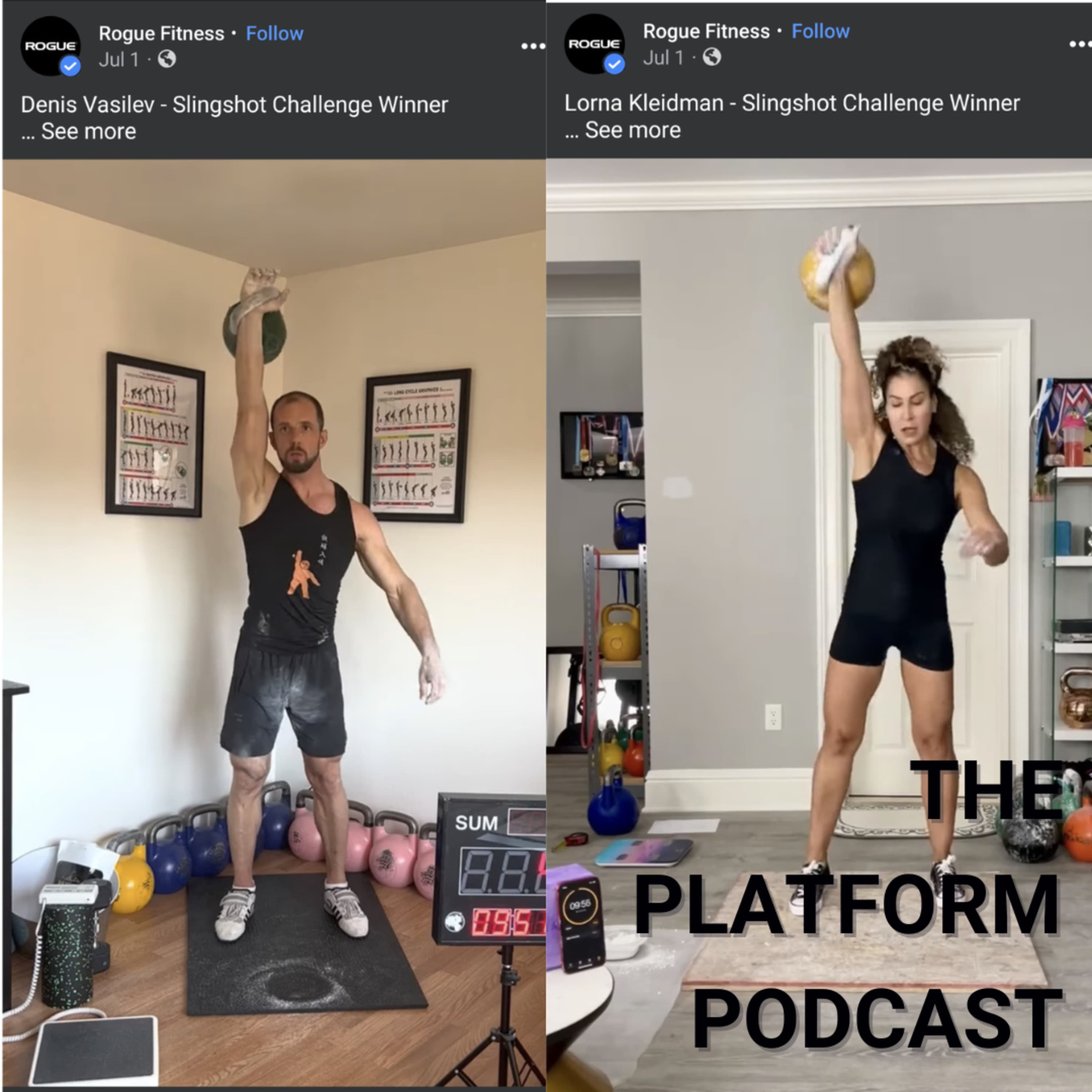
And so, there were some people that came in with some pretty high expectations that they had a really good shot at winning, you know, Moses Dunga sounded the alarm and put out a notification to all the kettlebell sport people on his Facebook page, you know, saying, let's show these CrossFit people what's up, basically. And boy did, boy did we ever. So what ended up happening is it was a clean sweep of the top prizes for kettlebell sport athletes in this challenge. Lorna Clydeman, who has been on the podcast, ended up putting up 268 reps in 10 minutes with the 16 KG, which is just insane pace, pretty much as fast as you can, you can humanly go. And then Denis Vasilev, who is not human, Russian cyborg, as is well established fact on this podcast, put up 279 reps with the 24 kilogram pro kettlebell.
So yeah, that is nuts, that is absolutely nuts, incredible performances by both of them. And this was such a predictable outcome for those of us who are kettlebell sport athletes and people who live in the space of health fitness, strength sports, etc, because it is always going to be somebody who specializes in that discipline, who puts up the best number. You know, when you think about, you know, Lorna, for example, who has been on this podcast and we talked about her approach to kettlebell sport training, and she has been focused specifically on snatch almost her entire competitive career. Now that's not that that's all she does in general, but when it comes to kettlebell sport competition, she is focused entirely on snatch, she is a snatch specialist, she is a world record holder in snatch. In that one lift, she has focused for years and years and years and years of her training for competition. Now Dennis, as most of us in this sport know, is probably the goat of kettlebell sport.
Well, I'm going to call it and say he is the goat of kettlebell sport. He has been doing it at a level untouched by other people for a long time. I don't think he's ever been defeated in competition. And the thing that is hilarious to me about Dennis is 279 reps is his previous, he did it twice. He had attempted it once and I don't know what his first output was, but it wasn't up to his standard. And so he decided to take a few hours off and then give it another shot. So he he took like a three out, he did one 10 minutes at then took like a three hour break and then did a second 10 minutes at and it ended up being the 279, which I think won him the grand prize by like a solid 10 reps, 9 or 10 reps. So he just kind of dominated everyone as is to be expected. But the reason I found this so funny, and I posted on Facebook, you know, essentially saying the CrossFit athletes never stood a chance in this. And that is by no means a knock on their ability as athletes.
It really just goes to show the level of specificity required to perform at this level is incredibly high. Dennis has dedicated his life to kettlebell sport. Lorda has dedicated her life to kettlebell sport in particularly snatch, right? Like this is what they do. This is what they focus on. So of course they're going to be the best. Like they are the best of the best in that sport already. Like world record holders master sport international class like the highest level of performance possible within the sport. So when the challenge is specifically to a specific sport, you would expect that the people who are best at that sport already would win. It's like, you know, who would win a hundred meter dash like Usain Bolt. Maybe that's not relevant now. I know Usain Bolt has retired. But you know, it's like to me, the people in CrossFit that were talking all this shit saying that the CrossFit people that were talking all this shit saying that it was going to be a CrossFit athlete that was going to take home this prize was basically like the NFL fans who think that somebody like Tyree Kill could win the hundred meter dash in the Olympics or something. You know, it's like now he trains to be a football player and he happens to be, you know, world class fast.
But he's not a track and field athlete. Like there's a reason he's not an Olympic sprinter because that's not his discipline, right? And for the same reason that Usain Bolt would not be a good wide receiver in the NFL, because, you know, you have to get hit and there are other things that's not just straight line speed. You know, it's not to say that those people couldn't have been great at those things had they chosen that discipline. Obviously, they're world class athletes, but the point is if you are not specialized in that discipline, it is hubris, in my opinion, to think that you are going to come in and beat people who specialize in that discipline. That is an incredibly rare athlete who can do that. And you don't have very many examples of it ever, of it ever really happening in sports, at least at the highest levels. You know, you'll see it, you know, it's slightly lower levels.
You know, it can still be at a very high level, but, you know, not at the highest level of the sport. It just performing at that high level requires specificity of training. So this was an incredibly predictable outcome for me and for others. And I found it hilarious that there were so many cross-fit people who were mind blown, just absolutely flabbergasted at the number of reps that Dennis and Lorna put up. And then, of course, you had the the form trolls who came out in droves. And, you know, we're talking about how Dennis isn't doing it right because he doesn't have enough hip hinge or there was one Jack S on Facebook who was saying that that Lorna's reps were asymmetrical and her at the end of her set, she was she was setting herself up for injury because, you know, she wasn't in control of the bell at the end of the set. Now, the video clip that the guy was commenting on, they showed like the first few reps of Lorna's set when she was brand new and fresh on her right hand and had started the set out. And she was brand new and fresh in her form, of course, was perfect. And at the end of the set, after she had been holding 26 RPMs for, you know, almost 10 minutes at that point, her last few reps, she understandably had kind of transitioned to survival snatch mode with a more vertical path and, you know, your grip is fried, your lungs are on fire, you know, and you're just trying to not throw the bell at your TV by losing control of it. So, yeah, of course, her biomechanics degraded a little bit over the course of the 10 minutes, but it was just just hilarious to me, you know, this guy coming on who doesn't know anything about the sport and can't even identify the fact that, you know, comparing the first, the first three reps to the last three reps and expecting them to look biomechanically the same is just stupid. It's, you know, it's fallacy at the deepest level, like you clearly don't understand biomechanics and how, you know, formed a grades over time, regardless of what the discipline is, like you're just not going to be as biomechanically efficient at the end of a 10 minute max effort set, as you are at the start of it, like I don't care who you are, that's just, that's just being a human being. So, you know, I couldn't hold my tongue, so I had to say something to that guy, but, you know, the form trolls, you know, just made me laugh, and it also, I found it funny, like how surprised some of some, not all, some of the CrossFit athletes were, or the CrossFit fans were, that, you know, CrossFit athletes weren't anywhere close to the top of the leaderboard. In the RX division, I think it was, it wasn't until you got outside of the top 10, when you started seeing CrossFit athletes in the in the leaderboard, like it was like said, clean sweep by, by Kettlebell sport people. So, calling all Kettlebell Dringer, you honorable warriors and wielders of the steel, the time has come to raid, join us, and fight for honor, glory, and the spoils of battle. Sign up today for the Twin Cities Kettlebell Open on October 22nd, in person in Little Canada, Minnesota, or by video submission from anywhere in the world. Come, fight for your clan, or for glory all your own to be told in your saga, claim your spoils, and make your name ring out forever in the Hall of Champions. Sign up today at Twin Cities Kettlebell Club dot com. Anyways, that is a long winding introduction into the topic because that this is what, you know, precipitated me wanting to speak more on this topic is how specific does training need to be. So, we're talking about training specificity. And what does that mean? And how specific does your training need to be? And if you've listened to me talk very much, you probably can predict the answer is going to be, it depends. What does it depend on? How specific is your goal?
And what is your expected level of performance? Right, so if you are trying to be the best in the world at a particular discipline, your training needs to be pretty specific. Now, there's also the general adaptation necessary in the general conditioning necessary in order to be good at anything. And I think this is where the expectation of some of the CrossFit people was misplaced, because their entire intent, that was the word I was looking for, their entire intent behind CrossFit is to be a well-rounded athlete who can handle any physical demand and handle it well. And I would argue that they do a pretty good job of that. Most high-level CrossFit athletes can handle just about any physical task that you throw at them and handle it well. I'm not saying that the CrossFit athletes didn't come in and do well in this sling shot challenge. They did.
They came in and did very well, especially for people who don't specialize in this movement, right? But they don't specialize in it. So, expecting them to be the best at it against people who do specialize in it is just hubris, it's foolishness, right? So, specificity of training requires requirements very depending on the specificity of the goal, right? So, the general guiding principle for human adaptation, and this is not just in training, this is in nutrition and other areas as well, is a three step feedback loop, stimulus, response, and adaptation. It's a very simple in concept, but it gets very complex very quickly depending on what system you're looking at, right? So, this is where systems thinking is important, but stimulus is what has changed that is creating a response, and from that response, what is the adaptation, right? So, stimulus causes the body to make a change, and adaptation is the product of that change. We are adapting to the stimulus that is provided. In response to that stimulus, we create an adaptation, right? So, that is the general principle, stimulus response adaptation, right? And so, general adaptation to impose demands is the first principle of physical adaptation when we talk about strength conditioning, right? So, the general adaptation to impose demands, that means that whatever imposed demands are placed upon your body, first, there are going to be general adaptations to those demands, right? So, if you think about strength, you think about a strength athlete, you think about a strong man, right? They tend to be strong across implements. That is the point of their sport, that is the point of their training, they are just generally very strong. That's why even if they haven't bench pressed specifically in five years, but they've done all sorts of other pressing movements, they've lifted other implements, and they maintained their strength, they still tend to be very strong at bench press, you throw them on a bench press, and they can still press more than most human beings would be capable of doing, right? Because strength tends to generalize across implements. Cardiovascular conditioning also tends to generalize across activities, right? So, somebody who is a well-conditioned soccer player, for example, could probably step in and play football at the appropriate position and be okay from a conditioning standpoint, right? Maybe not from a skill standpoint, but they're not going to fatigue because the demands of that sport are very similar, they're not exactly the same, but they're cardiovascularly very fit, right? So, they tend to be able to step into other sports that demand cardiovascular respiratory fitness and do well there. They might struggle with some of the strength demands because those demands might not be met by their current training, right? They're training for a specific application, right? So, cardio tends to generalize across cardiovascular activities. Flexibility and mobility tend to generalize across activities, and if you're not familiar with the difference between flexibility and mobility is flexibility is the ability of your muscle to reach end ranges of motion, so soft tissues ability to reach end ranges of motion and maintain its strength and or be resistant to injury. Mobility is the ability of joints to be mobile and to move throughout their intended ranges of motion smoothly and without restriction or pain or injury, right? So, flexibility, think of soft tissues, mobility, think of joints, right? So, just a quick definition there. Flexibility and mobility tend to generalize across activities as well, that's why people who do yoga tend to be very flexible in other applications, right? That tends to generalize across across activities as well, but I will say for all of those things, the caveat is to a degree, to a certain degree. Now, we'll go back to the strong man example. You could take the world's strongest man and put him in a powerlifting competition, and even though he will likely do very well in his total, he might not win because he might deadlift really well or bench press really well, but not squat as well or whatever. Powerlifting is those three movements. It's squat, bench, and deadlift, right? A strong man is atlas, stones, farmer carries, deadlift presses, you know, et cetera, et cetera.
It's across, it's across very diverse implements. The entire point of the strong man discipline is that it has varied implements. So, the more specific the application of the sport or the more specific the application of the demand, the less general adaptation will predict success, okay? So, that's where specific adaptation to impose demands comes from. And that's called the said principle in personal training, parlance, and strengthen conditioning circles, specific adaptation to impose demands. The more specific the demands of a sport or activity are, the more specific your training needs to be in order to perform at a high level. Now, how do we apply that from a practical application standpoint?
What does that mean for us as strength athletes are, you know, in general fitness, right? If your goal is just to get in good shape, you know, I'll put air quotes around good shape. Then general adaptation is totally fine. And you don't need to be doing anything specific. And in fact, I would say that you want to be varying your stimulus pretty well. You know, you generally want to be providing different stimulus to provide different to get different response and generate adaptation. And the more varied that stimulus is, the more consistently you'll get response. You'll get a lot of response. Now, it won't be as directional and you won't get specific response. But if you're not seeking specific response, that's totally fine. But think of general fitness, general adaptation as the foundation upon which specific adaptation is built. So what do I mean by that?
That means you can take, you can try and go top down and start with a very specific approach to improving your fitness. And you can achieve general fitness by starting with a specific approach. But if you focus wholly on kettlebell sport, you will get better strength, better cardio, better flexibility and mobility, especially on kettlebells. But then if you are then asked to go run, you might pull your hamstring when you run. Even though your cardio is good, you have good cardio, you have good strength, and maybe you have good flexibility and mobility as well. But because it's all stationary and it's in a specific plane of motion, you may have very different demands placed on when you are asked to run.
And that could lead to an injury. So that's where starting bottom up is usually a good, is usually a good approach, making sure that you have good general fitness before progressing into specific, before progressing into your specific requirements. So if you are starting from nothing in kettlebell sport, you're just totally fine to start with kettlebell movements. But you also want to make sure that you have general requirements in your program as well. Because if you do nothing but kettlebell sport, you will get in better shape, but you will, it will not generalize to other activities as well. Right? So I would recommend that you have a diverse group of activities. You can focus the majority of your training on kettlebell sport and focus on acquiring skill within that sport, but your adaptations will be more specific. Whereas if you start with generalize strength training, generalize cardio, generalize flexibility and mobility, and then move into specific modalities, you will progress more rapidly, in my opinion. Right? So this is where I think it's important that we start every session with a general warm-up. We start with a general warm-up. We do general joint mobility.
We do a dynamic warm-up. Those are all general things. And then we move into a sport-specific warm-up. And we do long cycle on days. We're going to do long cycle or we do snatch on days. We're going to do snatch. Right? And we do warm-up sets of our specific activity. And then we move into our specific training for that particular movement or movements that were focused on that day. So we move from general to specific, do our specific training at the front end of our session. Because if that's the goal, that's what we're working on. We do want to do the highest level of work in our specific activity when we are fresh, warm, and not fatigued. And then we move to general training after that. So you may do your kettlebell sport. You may do your kettlebell sport work sets. And then when your kettlebell sport work sets are done, move to conditioning activities like cardiovascular training or and or move on to your general physical preparedness of GPP. So that might be your strength, your strength activities like squats, dead lifts, mace work, band work, etc. And then do flexibility and mobility work at the end of the session as part of your cooldown and to restore the functional length of your muscles. Right? So that would be my that would be my general prescription for within a particular session. Right? But also making sure that across a training week, depending on the number of the depending on the number of sessions that you're doing within a week, that we're that we're doing some general training as well as as specific training and trying to keep those things fairly in balance. Because if you over index on specificity, you can lead to pattern overload, you can increase your risk of injury. But I will also say that is further out from competition. The closer you get to competition, the more specific you want your focus to be. So when we're when we're just getting started or we're just in our general training phases earlier on GPP and general conditioning, other modes, very good to focus on in very, very useful.
As we move into our season or as we move into our competition phases, we get nearer, nearer into our competition. We want to spend more and more of our training budget focused on specific movements, specific adaptation to impose demands so that we can perform at our highest within those specific trainings because we'll be able to translate that general preparedness that we've done into more specific application to the energy systems needed to the muscular systems needed. Right? So we move, we transition that general training into a more specific mode, the closer we get to competition. And then once we're done with our competition, then we can pivot back to a much more general approach, right? Even potentially taking taking time off entirely from our preferred implement or our preferred competition, right? There's a reason that after you know every professional athletes season completes, there's a period of time where they go into recovery mode and they're often not doing the sport that they were doing. And it is to to give those energy systems and give those muscular systems a break from those specific demands and really start placing demand elsewhere.
So we can start getting adaptation and the adaptation we might want might be recovery of those of those energy systems or of those muscular systems, right? So it's very important that you understand that there are different phases of your training, right? And that your training needs to be built with a goal in mind if you have a goal in mind, right? And the more specific the goal, the more specific the training. If the goal is simply to be fit or to lose weight, the training stimulus doesn't need to be as specific. But if the goal is to perform at a particular activity, then we'll start talking about strength and conditioning for a specific application. So hopefully you find this helpful. I realized for a lot of people, this might be very general information or stuff that you already know.
But for some people, they've never been exposed to these these concepts, right? So if this sounds overwhelming or like there's a lot of pieces to it because I didn't even get into psychology, I didn't get into nutrition, incorporating nutrition or incorporating it into your lifestyle, right? There are a lot more pieces to it and that's really where integrating the different components come in. If it sounds intimidating and you want help, please feel free to reach out to me. This is obviously something I'm really passionate about, something I really enjoy. So understanding how specific to make your plan and tailoring it to your specific needs, tailoring your nutrition as a part of that and making sure that we're training inappropriate seasons so that you continue progressing, but also don't hurt yourself and that you recover appropriately, that we create the right response at different times so that you can continue progressing in the right direction without wasting time.
That's how you get where you want to go faster is by doing things in the right manner and in the right order. So hopefully you found this helpful. If you did, give it a like, give it a share, tell a friend, all of those things. Thank you very much and I will see you next time on the platform podcast. Thank you for listening to this episode of the platform podcast. We'll be back with a new episode soon. Please be sure to leave a rating and review of the platform podcast in your app of choice, support our work by supporting our affiliates. And of course, if you have questions or you want help reaching your goals, reach out to me. Until next time, thanks for listening.
Want This Kind of Coaching?
Everything on the show comes out of real coaching. If you want a plan built around your goals and your life, the first step is a free intro call.
Apply for Coaching