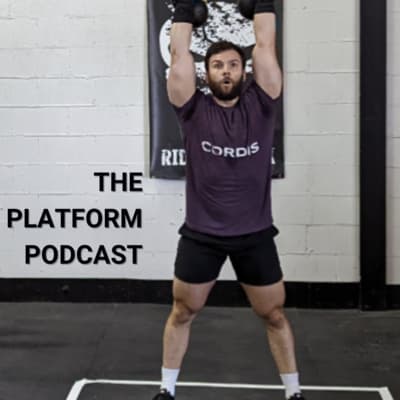
The Platform Podcast · Episode 90
Dru Gallagher, Coach Evangalist, n00b kettlebell sport athlete
September 19, 2022 · 57 min
Show Notes
In this episode I welcome in Dru Gallagher (@0ldmangallagher) who won Best New Lifter at the Riddlestruck Open on August 14th. We talk about his experience competing in kettlebell sport for the first time, his background racing go-karts, and his coaching philosophy on what makes good CrossFit programming different from bad CorssFit programming.
Don’t forget to Register for the 2022 Twin Cities Kettlebell Open
and if you want help reaching your goals please Apply for Coaching
If you enjoy the content please leave a 5 star rating & review, share on social media, and support my work by supporting my affiliates:- Pro Kettlebell, MADE IN THE USA Kettlebells
- Kettlebell Kings, use code TCKB to get 10% off
- Bearfoot Athletics, use code TWINCITIESKETTL to get 10% off
- Driven Nutrition, use code TCKB to get 15% off
- Revive Supplements, use code TCKB for 10% off
Transcript
Machine-generated transcript; may contain transcription errors.
Kettlebell Drengir, the spoils become clear as the time for battle draws nearer. Our sponsors this year will be Barefoot Athletics just giving away $600 gift cards. Pro Kettlebell was giving away a $300 gift card, a $200 gift card, and a set of magnetic chip weights. Kettlebell Kings is giving away a $150 gift card, living.fit giving away $450 gift cards. Sorenson Strong giving away a pair of 1.5 pound Indian clubs with the event logo engraved. CK Mace Works is giving away two custom plate-loadable Mace's or clubs. Elevator is giving away two 50% off discount codes for a custom lifting belt. In addition, there will be a $500 cash prize for the best lifters in the event. Sign up today at TwinsittiesKettlebellClub.com.
Welcome to the platform podcast where we talk to coaches, athletes, experts, and real people to learn about their approaches to training, nutrition, mindset, and much more. I'm your host, Jordan Kunde-Wright, founder and head coach of the Twinsitties Kettlebell Club. I'm on a mission to help others build sustainable, healthy lifestyles. Before we jump into the episode, I want to remind you that registration is live for the second annual Twinsitties Kettlebell Open on October 22nd, hosted by our friends at the Athlete Lab in Little Canada and Minnesota. And just like last year, we will include a video submission option for participants who are unable to make the trip in person. You'll be eligible for all of the same prizes as our in-person competitors.
Just go to our website, TwinsittiesKettlebellClub.com for details. On this episode, I welcome in Drew Gallagher. He is a CrossFit coach and athlete, and he won best overall lifter at Best New Lifter. Excuse me, at the Riddle Struck Open in August. So I had the pleasure of getting to meet him while we were up there. It was hosted at his CrossFit box, and then he stepped on the platform and did awesome, especially for his first competition. So we invited him on to talk a little bit about his experience, as well as just coaching in general. So I really hope you enjoyed the episode, and if you do, as always, I would appreciate if you would share a five-star rating and review on Apple Podcasts or your app of choice.
And of course, please support our sponsors, whose affiliate links you will find in the episode notes. And of course, if you want help reaching your goals, please reach out to me. Fill out the coaching interest form linked in the episode notes. I help athletes of all levels using my integrated coaching approach. And you can follow me on Instagram, Facebook, and YouTube at TwinsittiesKettlebellClub. Or email me at TwinsittiesKettlebellClub at gmail.com. Now, without further ado, let's step on to the platform with Drew Gallagher. All right, welcome into this week's episode of the platform podcast. I am your host, Jordan Kunde-Wright, right? My guest this week is Mr. Drew Gallagher. I had the pleasure of meeting him at the Riddle Struck Open up in Canada, August 15, something like that.
Something like that. Something like that. And he won the award for best new lifter at the Riddle Struck event, which means he has the distinct honor or pleasure, maybe, or punishment of coming on here and letting me grill him. He is a coach evangelist and he is a CrossFit athlete and coach at the Corpus CrossFit, which hosted the Riddle Struck Open. So Drew, thank you so much, man, for taking the time to let me bombard you with questions and her asks you for a little bit. I appreciate you. I love it. I'm in for the pain or the pleasure. We'll try. Maybe we'll blur the line a little bit. That's great. Great. It's going to be fun. All right. So we'll start off with I always like to give people context of who the hell are they listening to?
So give us a little bit of the Drew Gallagher origin story like, how did you come up? What did you do for sports and competition, growing up, anything like that, and then how did you end up getting into fitness? Sure. Yeah. I'm pushing 30 years old now, so it's been a while. That's a bit of a throwback. Whoa. You're ancient. Yeah. Pushing it. You know, I grew up, I played a lot of baseball when I was growing up, and then I actually raced GoCarts competitively for about eight years, which was pretty cool. Is that a big thing? That's big in Canada, right? Like, F1 is big, and you raced at a pretty high level, if my intelligence is correct. Like, you got some pretty big engines with some GoCarts that go pretty fast, and with some guys that ended up eventually being like F1 drivers, right?
Yeah, exactly. Yeah. They were like 125 CC shifters, and yeah, you know, not a name drop, and I don't know them not well, but I've raced with a Lance Stroll and Nicholas Latifi back in the day. Great couple guys. They're doing, they're living the dream, you know, F1 was, F1 was the dream at one point, and then, you know, it actually cascades really well into where, you know, I started working out, you know, after that, just trying to get better shape, and I got too heavy to race anymore. Is that what you stopped? That's why I stopped. Yeah. You just got too big. Sorry. Yeah. I'm too, too jacked. I was too big. It's all about the minimum weights, it's all about the minimum weights, so yeah. So I started working out.
I guess a little bit more seriously when I was about 15 or 16. I got into CrossFit at that time. And then for the last boy, 12, 13 years, it's just kind of evolved. So obviously CrossFit was kind of an infancy back then. Yeah. Not luck going on. And that was you. I was this. I was this for scene setting. Was this in Toronto? Like, where did you come? Was it around Toronto? Are you born and bred Toronto area? Yeah. Yeah. GTA. Yeah, GTA Burlington more specifically. And, you know, I'm still, I still live in Burlington. So, yeah, I came up in Burlington, and yeah, that's, that's where everything kind of got started. And yeah, I kind of just found my way into into a gym back in the day, and that's, that's the long and short of the start of the fitness journey, I would say.
I wasn't, you know, baseball was baseball, go-carding was go-carding. I wasn't really working out or anything like that up until then. So. So, I'm, I'm the thing that I'm seeing that, that I can think of in my head that logically connects between those two sports, having done one of them fairly well and never having done the other, which is baseball I did, and I've never raised go-carts at a competitive level. But. I, I assume that there's like a reaction time, hand-eye coordination, visual acuity that's kind of like a skill that translates pretty well across, across those two sports, but correct me if I'm wrong. Like, what, what are your strengths as an athlete that, that you either learn from, from F1, from baseball, from CrossFit, like, what, what makes you a good athlete in your mind?
Yeah, yeah. I would say, you know, the, you, you made the right correlation there, obviously, between my kind of hand-eye and reaction time for things like baseball and, and then go-carting. I did a lot of pitching when I was playing baseball. So, you know, I consider myself and I would consider what I've become is much more of a like a power focused athlete. I excel at those sort of exercises and in that kind of domain compared to more endurance stuff. So it made sense with baseball, you know, it's a lot of stopping and starting and that sort of thing. And some sprinting. So, yeah, it didn't play into where I ended up, but it would, it, there's no correlation with go-carting there. It's all, that was all grip strength, actually, believe it or not, a lot of grip strength.
That makes sense. Yeah, I could see that. Yeah, I could definitely see that. So, kettlebell sport would, would definitely, definitely help with that. Exactly. So this was your, this was your first comp, right? This is the first time and you gave yourself like a really, I mean, being the coach evangelist that you are, you're like, I really need to handle this properly, give myself a full proper training block before I really jump into this. I can't even fit in. A full, how long did you give yourself before you decide, yeah, fuck it, I'm going to give it a go. Full, full two weeks, you know, gotten, gotten touched with, you know, the Riddle struck team there. That had been organized a little bit in advance, but then it kind of crept up on us.
And I figured, you know what, like get the, kind of get the gym community potentially involved to step up. I've been coaching for a number of years at court of fitness and Oakville. And I thought, you know, maybe if I give it a go, a couple other people give it a go. We had lots of support, but I was the only one who ended up diving in from the gym. That's okay. I didn't mind, but two weeks from the front, man, I love that. Yeah, yeah. Absolutely. That's great. And so for the, for the people listening, what were your results? Because I vaguely remember, but I don't, but I was distracted by your quads. So I don't, I appreciate that. Yeah. I don't fully remember what your results were. It was a five minute long cycle set with the 16s to start, right?
That was your first. That's right. First event. What'd you get in that? I think, I think we did 54 reps for the long cycle with 16s. And then snack for the snatch with the 16, I believe I did 90 reps. Nice. And did you beat Boris? Was that who you were chasing? I was chasing him. He, he, he stepped up and said, listen, I'll do it with you, which was great. I think I scared him on the, the, the long cycle a little bit. If I recall correctly, we were at 30 at about the same time. I think you picked up the pace a little, just to make sure he, he really nailed it because he's been doing it a lot longer than I have. But he smashed me on the, on the snatches snatches is jammed. That's his, that's it.
He smashed it. That's a lift. I was, I was giving him, I was giving him shit privately, like, dude, if you let a brand new CrossFit athlete step on and beat you in five minute long cycle set, you will never hear the end of it. Yeah. This hard style hero over here. Oh my gosh. Yeah. So now that, now that you, now that you've done it a little bit, what was, what was like the most surprising aspect of, of kettlebell sport for you, like having, having just gotten, gotten into it. Uh, I, I would say like it's the amount of time under tension, which I definitely understood was going to be a challenge. But when you pick up those bells and you just go for more than, I'm just going to call it more than about a minute, uh, it just, you just suddenly start to really feel like the weight of those things and it's, it's pretty incredible how, uh, I mean, how potent it is because really, I would be normally throwing around maybe 24 kilo bells, uh, in the gym.
And, uh, you know, at 16 was the right decision, but it was, it was very challenging, um, particularly the clean and jerks, uh, that the long cycle was, was challenging for me, even with those 16s. What, so what do you think, um, translated really well from, from CrossFit and what were you maybe not, I don't, I don't want to say, yeah, I will say not prepared for it simply because you, you didn't give it a full training cycle like you, you know, Kudos to you for, for just jumping in and being like, yeah, I'm going to go for it. So like, what did you feel like translated really well because obviously put forth a really good performance? So you, yeah, I appreciate it. I must have done something well.
Um, so what, what do you think translated well and what do you feel like, like there's clearly a disconnect between the asks of CrossFit versus what you're learning about, uh, your voice word? Yeah. So I would say, uh, you know, things that would, things that transferred was definitely just like kind of general conditioning, um, being able to tolerate the, the load for the five minutes that I was, I was doing each of those lifts. Um, you know, I've, I'm, you know, traditionally using barbells more often than kettlebells. So, um, that extra load definitely helped me out there, um, when I was, uh, more in like rest positions on the long cycle, um, challenging for sure grip, um, grip was, you know, a big factor of both of the, both the snatch and the long cycle, um, more than anything else that I think I've ever done.
I actually would start to correlate that back to like longer sessions at the track and a go-kart, uh, compared to anything that I've done in the CrossFit world. Interesting. Is that, is that because, because of the, you can't set them down. So there just is no, there is no re, there is no recycling time. Whereas on CrossFit, like, I mean, you're, even when, even when you're doing really heavy grip taxing stuff, you can drop down from the bar and shake your hands out and, and, is that the difference? Exactly. And just even, even those short breaks, right? Like, even if you're only taking 10, putting something down for 10 seconds and picking it back up afterwards, um, that little flush that you get on your forearms, um, and even just open, being able to open your hand and flex that hand is, uh, it's, uh, it's, uh, it's clearly a big benefit because when I picked those up and just realized I couldn't put them down for five minutes, I was then for, uh, a little bit of a wild ride there.
For sure. Okay. Cool. Well, I'm also curious. I mean, I, I think it's fair to say a high level CrossFit coach, right? Like, you, you coach people at a high level, um, so what do you think, um, CrossFit athletes would benefit from kettlebell sport like I, because I feel like the, I feel like they're two very complimentary disciplines, actually, and it's kind of ironic to me that there's not more crossover yet, but I'm just, I'm curious what your thoughts are coming from the other side of the, the other side of the, of the aisle, right? Like, what, what do you think CrossFit athletes would benefit from, from kettlebell sport? I mean, I think it's just a, for like major, major difference in conditioning, um, there's not a lot of, uh, exercises that were able to complete five minutes straight of, um, so that's the, or five to ten minutes, I guess I should say straight up, um, you know, you're not picking up, you're not picking up a barbell for five minutes straight, you're not picking up, uh, like, doing a, anything with maybe a medicine ball for five minutes straight, um, our time domains and that time under tension factor, um, is something that I would, I actually have been including in some of the programming for the gym since I started to pick up, I, I, I, I'm putting the members through it too, um, since we started, or since I did that competition, uh, you know, almost, I guess it's just about a month ago now. Yeah, well, um, just so everybody's aware, we were trying to get this set up earlier, but apparently Drew thought it was more important, um, to go on vacation, and then apparently had a question he needed to ask somebody, uh, while she was on vacation, you want to, uh, or did it happen on vacation or did it happen at that back, so you want to tell them to hurry? Yeah, yeah, uh, uh, the vacation piece was important, um, but it was also, uh, you know, it was time to, to pop the big question to my, now fiance, um, yeah, it was, it was, you know, perfect night, that sort of thing, a really nice sunset and, um, up north in, in, uh, Minden, Halibut, and area, if you're, uh, kind of around the GTA, familiar with that area, um, it's kind of an embarrassing story actually because I took a knee, and, uh, I mean, we alluded to the large quads earlier, um, but I happened to have the wrong knee up, and, uh, the ring was in the wrong pocket, so I ended up with both knees down, which was begging, you know, yeah, begging to bury me, so, yeah, it was, uh, it was, it was, it was great, I, I did recover, I got back to the one knee before actually, you know, saying the, the important words, um, but yeah, I was pretty, pretty amazing, um, she obviously said yes, so, she did, yeah, that it's not a sad story, sad story, yeah, yeah, that could have been an awkward day, and I was on a dock, so I didn't drop the ring in the lake either, so nice, I, I proposed in Venice, Italy near, near the canal at sunset, and my wife, like, literally shoved me, um, well, because I surprised her so much, me and it was one of the same, I was like, holy crap, like, you almost pushed me over, so, yeah, that's, that's fantastic, man, congratulations, and she's a fellow CrossFit coach at courtist, right? I met her at the competition, she seemed, she seemed lovely, so congratulations, yeah, yeah, we met at the gym actually, so, um, it's come full circle, and, uh, now we're, uh, now we're, uh, making it official, so, okay, who, who initiated that? Um, it was, I think it was mutual, I think it was mutual.
Oh, such a, that's such a PC answer, yeah, I don't, I don't think it was, uh, nobody was kind of hounded after anybody else, it was, uh, it was a mutual, mutual get together, I'd say. And did it, did it happen right away? Like, you guys met each other, and it was, and it kind of, it kind of clicked, or was it slow, the slow burn kind of? There was a bit of a slow burn, I think it was a bit of a slow burn. Um, but you know what, she, she was, uh, she was out east, um, uh, in Newfoundland beforehand. Um, it had just come back, and then was kind of getting settled back in the, in the GTA area, so, um, yeah, long story short, the slow burn is definitely, it was definitely a slow burn. I have, so now I have this vision in my head of where it's like, it's like a, uh, CrossFit box version of the office where like, you guys are giving Pam and all of the members are just watching you two, like, hoping that you guys will finally, finally get together, and then maybe it could have been like that. That's true. I've never asked anybody, but I'll bring it up now.
That's, that's awesome. That's awesome, man. So, um, speaking of your members, um, Matt is one of your members, and he, uh, went to the Liberty of collecting some questions from your members. Oh my gosh. For me, for me to ask you. So we could do this, like, we could do this, like, family feud style, where it's like, what's the number one response? Which, okay. I can tell you it was, what the fuck? Like, seriously? What is wrong with you? What's wrong with this guy? What is wrong with this guy? Um, so, no, that, so I'll read, I'll read these and give you a, give you a chance to answer. So, what was your, what was your biggest reason or motivation for getting into fitness? It, uh, it, it really fell into my lab. Um, that, I guess the story would really be like, you know, in, I was, I was in high school, um, towards the end of my, my tenure in high school.
And, uh, my girlfriend at the time, her, her parents opened a gym. Um, and I was like, hey, like, you know, go, go to the gym. Like, I've never really done this before. Um, and it just kind of, it really snowballed. So, it really snowballed hard because it's a big part of, uh, it's a big part of my life now. You could say, I guess you could say things have gotten pretty serious now. Things got pretty serious. That, yeah, you know, different relationship, but, uh, it got pretty serious. I picked up, uh, I picked up the CrossFit and, and that sort of thing at that point. And, and that would be the kickoff, for sure. Um, like I said, 12, 13, what's kept you going for so long? What is it that you love about it? Like, because I mean, a lot of people get into a new thing and then they're like, yeah, that was cool. And then they move on to their new thing, right? But like, you've, you've found it at 15 years old and you've been with it now for half of your life.
Almost half my life. Yeah. That's a good point. Um, I think it's really the, the relationships, uh, that you've built. Um, and, you know, I've, uh, I've had, I've had been fortunate to, to make a lot of friends and keep a lot of friends and, and, you know, kind of revolve in those same circles for the last almost 15 years. Um, and I, I just love the community. Um, it's always been like kind of a key part. And actually, it's, it's interesting you bring that up because, um, you know, during the kind of comp, a couple, a couple of weeks ago, a month ago, um, that community of, of kettlebell folks felt so familiar to me, um, coming from a CrossFit background. Like, it was like, I was walking into a CrossFit competition. Um, yeah, it's really cool. Yeah. That is one of the things that I really feel like CrossFit really got right and that I feel like the kettlebell sport community also gets right is, is, it is that, um, we're all in this together alone kind of attitude where it's like, yeah, when it comes down to it, like, you're the one doing the toes to bar, you're the one doing the, you're the one doing the snatches, but the person next to you wants you to succeed. Like, they might want to beat you, but they also want you to succeed. Like, they want you to do your best, and they want to do their best. And of course, they might want to win. But it's not at the cost of you not doing your best. They want to beat you at your best. Like, that's the attitude that I see in most CrossFit communities. And I feel like that's the attitude in kettlebell sport as well.
Absolutely. Yeah. I couldn't, couldn't agree more. 100%. Now, I will say there is definitely a bad reputation that CrossFit has gotten and setting aside CrossFit corporate and all of that. We'll set that as a separate issue. But I mean, CrossFit, the boxes and CrossFit, the coaches and the injury risk. And I'm throwing that in quotes because I don't think it's actually any statistically higher than any other high level competitive sport. Right. Um, there is definitely good CrossFit and bad CrossFit that I've seen and experienced. And that's the same with any sport. But like, what, what is it? Look, what does that look like to you? What does it mean to you when, when you hear that? And how do you, how do you try and reassure somebody who has only experienced, who has only heard about like the bad cross, the bad things about CrossFit?
Like, how do you, how do you separate yourself? Yeah. So, I mean, poignant question, because, because I've been doing CrossFit for so long, I've really seen and experienced the evolution of, you know, dirty gym equipments all over the place. Nobody puts their stuff away, sweat all over, you know, just like rusty equipment and all that sort of thing. And then just kind of a fly by wire programming methodology, right? Like, you know, the hopper model where you're just kind of saying, oh, I'm, I'm going to do deadlifts, kettlebell swings and back extensions for my workout sedan. It's like, that's probably not really a great idea. You know, muscular overload is one thing, muscular overload for time is usually, you know, you've got to be careful. You want to be very much the thrusters and then 500 yards of, 500 yards of walking on our hands. Yeah, sure, push ups. And it's like, okay, great. Yeah, and I think, I think the real kind of evolution that I've seen and hopefully been a small part of through the communities that I've been involved with and through the coaching that I've been fortunate enough to have the opportunity to do is, you know, moderation, but also moving the needle. And I kind of like to think of that from everything that I do within, you know, our gym and even even my own life, right? Like, every small thing you can do to move the needle can be beneficial. But that doesn't mean that your needle has to move a whole bunch all at once, because that's where oftentimes people are overdoing it. You know, you can use your classic compound lifts like a deadlift for example, you know, I want to go from 200 to 300 pounds. Well, you know, that's not going to happen overnight.
And if you're, if we can do that in a smart fashion where you don't injure yourself along the way, that's kind of the idea. Versus, let me see your back in a full arched position and drag that thing up your quads and hopefully you can look at it at the top. But I locked it out. Yeah, you locked it well, you got it up the ground and I have an easter egg, right? Yeah, and it's virtuosity, right? Like it's, it's, it's caring enough about your movement. And in my case, you know, the members that are gym caring, caring about the way they move, not just what they move or how much weight they move. The way you move the weight is more important than the weight that you move. That is such a poignant, that is such a poignant thing to try and reinforce with people. And I think I think that is another one of the things I see the crossover amongst our communities.
One of the mistakes that you see young lifters making, thankfully you didn't make this mistake. Like the first time I, the first time I did long cycle, I was very similar to you. I was, I was young and, you know, fairly fit. And I grabbed double 24's because I thought, I thought, hey, I can lift all this powerlifting. I'm, you know, I'm 1,500 pound total. I can, these are light, you know, 10 minutes, no problem. And I came in and just could not handle. I couldn't hang like that's, you know, so I see people come in way too hot, way too young. And they, it's the like, because I got to lift the heavy weight. And it's like, you know, start with 12's if you need to. There's nothing wrong with that. The 16, the 20's will be there. The 20's will be there. The 24's will be there. The 32's will always be sitting over in the corner of like laughing. Exactly. Exactly. Maybe for a single kettlebell event. Maybe for that. They're waiting for you. Yeah. Please come by me. Come. Exactly. Oh my gosh.
Yeah, that's awesome. So what, so what is your, what is your coaching philosophy when it comes to programming for CrossFit? Because I think that is, that is a huge evolution that has happened. And that's something that, you know, keep throwing it back to, to Boris. Like he has, he has bragged about like, oh, no, Drew's does great with his programming. Like I love his programming. So talk to me a little about how you approach programming because programming for a group fitness setting like CrossFit with various skills and people showing up can be, can be challenging. So how do you, how do you make it a cogent program? Yeah. So, I mean, once, and it's another, it's a term that you, you'll hear thrown around a little bit more these days is like varied, not random is kind of a big component of CrossFit as it's evolved. To move away from that, you know, we just grabbed a bunch of random movements. I picked these things out of, out of the air, you know, shuffle the deck of cards. Yeah.
Exactly. What's happening today? Yeah, I threw, I threw the cards on the ground and we picked 52 different exercises to do. Like that's not, that's not really how we, he want, we want to go about things. And and I think a lot of it is, you know, CrossFit pulled together a lot of different elements. You know, it pulled, we, we do some kettlebell clean in jerks, what we're calling them clean jerks, or kettlebell snatches. You know, we have brought in the clean in jerks and snack like regular snatches like Olympic lifting style. We get those powerlifting elements, we get the gymnastics, we get the plyometrics, we get the conditioning. So, how do you put it together? In periodization, some sort of periodization. So, really what my kind of goal is is it comes back to them moving the needle element. You know, I want to be able to show people that they're making progress in some way, shape, or form through the programming, right? Maybe it means the, the exercises get harder, maybe it means the exercises change, but the stimulus remains the same or vice versa. Maybe the exercises stay the same, the same and the stimulus changes. There's so many different elements to play with, excuse me for, in the gym, and with, you know, we're very fortunate. We have a ton of equipment at our disposal at Cortis, which is amazing. That's a great facility. It's a really nice box here.
I appreciate that. Yeah, it's, it's, it's, it's come together over a number of years, but we've got, we've got pretty much anything you can ask for, is that our fingertips? So yeah, again, it's a kind of that combination of, of the varied, not random, and then moving, aiming to move the needle. With so many, with so many variables to choose from, how do you, how do you start, how do you baseline people? First and foremost, like what are, what are your baseline assessments that you do with, with new people that are getting started so that you can, so you can show them that, hey, we are moving the needle on these things. How do you, how do you baseline? Yeah, so, you know, once in a while, and the challenge is that it's a group environment and that, you know, the programming is continuing to cycle no matter whether you show up for the class or not. So that has to be taken into consideration at some point. So every once in a while, we're doing those kind of, okay, let's do that one rep, three rep, five rep, ten rep max of a lift. And that kind of kicks us off onto a block of programming that is aiming to move that number upwards or, you know, improve your capacity in a, even, in another word, right? I'd rather your five rep look better even if it's at the same weight by the end of a cycle. It doesn't just have to mean that the weight itself increased. Yeah. Calling all kettlebell dringer, you honorable warriors and wielders of the steel. The time has come to raid. Join us and fight for honor, glory, and the spoils of battle. Sign up today for the Twin Cities kettlebell open on October 22nd in person in little Canada, Minnesota, or by video submission from anywhere in the world.
Come fight for your clan or for glory all your own to be told in your saga, claim your spoils, and make your name ring out forever in the hall of champions. Sign up today at twincities kettlebellclub.com. Are there particular workouts that you guys, or that, or that your members like to use as like that go on the wall like best Karen or the best mirror for any. Is there anything that you guys use in that regard either? Yeah, I mean, we used to a little bit more emphatically and we've moved, we've moved into and out of, you know, programming, you know, maybe you're familiar with the girls in that sort of thing. Fran, Jackie, those named workouts. I like to use those. I call them deserts, the witches. I like that. I might steal it. I might steal that. I don't mean to take it.
But those are those are good ones because, you know, they're benchmarks that are easy to revisit, and that people can also look at other, there's a lot of database information that you can look at. It's open open. And if you show up at you show up at a crossfit box, it's yeah, a thousand miles from home, you can be like, you could like tell somebody I can do, I can do Fran, you know, scaled at, you know, whatever your time was. And they'll give them an idea of your capability. Yeah, it's, it's the power lifters equivalent of the bench press or the deadlift, right? You're walking into the gym. How much do you bench? How much do you deadlift that sort of thing? Yeah. And then, and then the other one, you know, I like to dip into a little bit is, you know, actually leveraging the crossfit open workouts. We'll revisit those from time to time because, you know, if you've been doing this for a little while, you know, that those are pretty potent tests.
And, and you might have a number that's kind of something we can revisit more specifically for something more conditioning related, not just, you know, our squats, deadlifts, that sort of thing. So another member question, speaking of how much do you bench? How much do you bench? Okay. I've got, I'll answer. It's, it's by far my worst, my worst lift, I think the most I've ever benched is 275. It's hilarious to me how often people ask me like how much I, how much I can still bench press because I will be like, I literally have not bench press. Like, I'll do like, I'll do like close grip bench with, with 85 pounds, like for 100 reps or something like working on lockout or something like that, but like, I'll do pushups, but I have not like heavy benched in like, like a decade plus, and people still just because I'm big and because I still have the massive chest, they just assume that I, that I bench, I'm like, no, I do a lot of overhead pressing, but I just do the throwback.
It was 500 pounds, 10 years ago. Yeah. Yeah. Best, best ever was 455 in, in 2008. Big. It's like something like that. So yeah. Not my forte, but I can snatch more than I bench, which is great. Nice. Yeah, that's crazy. And yeah, I was one of those rare people that could deadlift more than more than I squatted, which was most, most people, at least, you know, college offensive linemen, where we're better, bigger squatters than my, the thing that I'm actually most proud of is when I was, when I was squatting heavy, I could single leg like Bulgarian split squat, 400 pounds with either like, that was, that was what I was most proud of. But I couldn't, I couldn't back squat 600. Okay. That doesn't make me, but you're like, it's one of those things. It's like, no, but 400 plus 400 is not 800. Trust me. It's not right. Yeah. That's what people thought. It's like, exactly.
Bulgarian split squat 400 pounds with either leg. Why can't you just just back squatting? 100 pounds. I just, I can't. I don't know. It's not the way it works. It's just not the way it works. But anyways, that's funny. So if someone were just getting started in, set aside the venue, just say anybody that somebody comes to you and they're like, Drew, I want to, I want to get, I want to get back in shape. Like, but I'm intimidated or I'm a little, I'm a little hesitant. Like, what would your, what would your first piece of advice be to them? I'm pretty firmly in the camp of just checking your ego in a lot of cases. You know, a lot of people come into, to use a specific venue into CrossFit style gyms and they're worried about performing and who's looking at them and that sort of thing. When in reality, it's, there's no one, we're all trying to survive. There's no, yeah, we're trying to, I can't even see there's somewhere sweating my eyes.
God knows who's equipment. I just picked up. Yeah. But I mean, it's kind of just, you have to be prepared to do some work. And the more you can exclude your ego from that process, the more legitimate progress you're going to make. It's not about the number, just like it's not always about the number on the scale. It's not always about the number on the dumbbell, the number on the kettlebell. You know, taking your example from earlier with the, you popped into your first kettlebell comp and grab 24th, you know, if I didn't have some instruction before I started, maybe that would have been something I might have considered too, but the, you know, the 16s, I even was considering using 12 kilos to try and get through the five minutes. No, Matt wouldn't let me do that.
Matt wouldn't let me do that. But it's, you know, you got to take things one step at a time and, you know, you can get, you can get to the moon, but it's going to, you got to, you got to trust the process. You got to trust the process. You got to trust the process. Yeah, you sound, what is the 76ers? Yeah, trust the process. Not that, not that same, not that process. No, not that one. The incremental progress applied over time without ego and with the guidance of a coach. I think that's right. That's right. That's right. Yeah, that's awesome. So who would be your, your biggest influence to date? As a, well, I'll say as a coach, because coaching is, is clearly your passion. Who would you say is your biggest, your biggest influence as a coach so far? It can be multiple. What are your biggest influences? I'll give you, I'll give you breath. Wow. I am, that's a great question.
That's one of the member questions. Is that a member question? That is a member question. Yeah, I'm just peppering him in there. I'm not even calling. Yeah, yeah. That's okay. I like it. I like it. Geez. I am a big fan of some methodology that actually doesn't necessarily track with my specialty, which is not endurance, but I'm a big Chris Hinchoff fan who kind of has been at the forefront of the aerobic capacity movement and has brought a lot of, you know, traditional crossfitters. Now this was a long time ago, guys like Rich Froning or Matt Fraser, out of the, I can't do any sort of running to, I can smash these running workouts and still snatch 300 pounds or whatever it is. I find his methodology and his approach to be very compelling.
And he always seems to just kind of be very straightforward with his. Give me the close notes because I'm not familiar with him and now I'm super intrigued. Well, you know, he was, he was pretty, pretty honest when he jumped into it, right? Like he was coming into a fairly new sport and, you know, he had all of these athletes start to approach him and his biggest concern was, well, hey, like I can get you to run, you know, I don't know, your 535 minute mile, right? Like a good mile time. But what's going to happen to your lifting? Because you can clean and jerk 350 pounds or whatever it is. Different energy systems, right? Like you were really talking about, right? The ability to produce power output calls on a very different energy system than the ability to run at a good clip for, you know, 10 minutes. Yeah. And then these, and then these individuals, you know, the guys and the gals saying, you know, I don't really care what happens to my strength. I need to get better and to use the word I've been using out here or the phrase move the needle on my endurance and on that kind of longer, longer energy system so that I can improve my scores on these workouts where I'm getting demolished at the games or whatever would have you by other people who can even just run at a mediocre pace because I can't run.
I'm stopping to walk something like that. That's, you know, he's somebody who I've followed pretty closely for a number of years. So he's a, he's a big one. And then I would say another, another kind of group who I really like what they're doing is the team over at misfit athletics has been really developing their methodology for a number of years. I listen to their podcast pretty frequently. They're down in Portland, Maine, I believe. They're a good group of guys and gals and I've been following closely what they've been doing because I just like their approach. You know, they've been evolving over the years and it's clear to see in some of their training pieces and their cycles. So I just like to see the evolution of the evolution of kind of where people are taking these training systems and, you know, it's clearly causing, it's clearly causing an impact because we're seeing things that a lot of people probably didn't expect to see five or six years ago.
Yeah, and coming from the nutrition side of it, I just did a nutrition seminar a couple weeks ago at a CrossFit box and one of the things that I said that I set out loud that I've had in my head for a long time, but I haven't set hadn't set out loud in public before before that set before that session was I think paleo like CrossFit athletes embracing paleo is one of the worst things that ever happened to CrossFit athletes because it might have been because of the demands of the sport are so glycolytic and and people went so far down the like no carbs rabbit hole that it just crushed there it just crushed their recovery it crushed their hormones, you know, and especially the really high level athletes that really needed a lot of a lot of carbohydrates but they wanted to keep their six pack they were shredded they were shredded all the time right they were shredded they wanted to keep that but then you get you know the again the evolution of the sport and you start getting these people that are that they got you know good nutrition coaches got it got a hold of them and they're like dude you're doing you're doing six hours of training you know five days a week like we got to get you more energy we got to get you some carbs and and suddenly like you know guys like rich fronning are jacked but not necessarily shredded all the time but they're crushing everyone because they have the appropriate fuel and nutrition and everything so I thought that was a that was a huge thing that I've seen over like the last I said the last like five or five or six years probably yeah really yeah in the nutrition kind of shift and cross 100% yeah you don't hear like I mean if you if you look to like really strictly at level one level two that sort of CrossFit continuing education stuff they're still talking about it but I would have to agree like you got to get your carbs it's it's pretty much mandatory if at this point especially if you're looking to be any sort of kind of higher level athlete it's it's pretty essential yeah yeah completely completely agree um so speaking of the five years remember question it was where do you see yourself in five to ten years this was this is like the interview question where do you see five to ten years geez yeah I've been I've you know of all the things that fall into in my life it's been there's been a couple you know fell into CrossFit I fell into cyber security which is a big thing I'm you know career wise for me right now you know there's some some aspirations I'm I'm actively trying to I'm pursuing a firefighting career nice so yeah I'm I'm pretty excited and and that one's kind of it's a long process I don't think it's as long of a process in the States it's a long process up here and it depends on the municipality like right so like in Chicago you can be on the wait list to become a Chicago firefighter for five plus years and in other places they're trying to recruit people exactly firefighters so really it really depends totally depends so would you be so would you be um I'm sorry I don't know as much about the fire service in in Canada so it'd be more for for GTA or would it or you talk on wildfires or either like how does it it would be more like like a department like a like a GTA area like one of the cities exactly yeah 100% so that's been something I've been working on for for a couple years too you know we had that two two years plus pandemic that was kind of slowing something down that was just a little blip yeah exactly so that's kind of a that's kind of a short to long-term goal you know it's gonna take some time still especially because you know I'm pretty active with the cybersecurity security career that I have going and and coaching and my involvement in the gym is high as well you know I'm doing the programming kind of running a lot of the day-to-day stuff so busy is the way I usually am and that's probably where that that question came from too what do you see yourself doing it by doing one or two things I get that question I get that question too because I mean we have very similar you know I work in AI and tech and you know I do the coaching as well I'm not trying to be a firefighter though that good on good on you there I that is something I thought about at one point but I'm a decade older than you is that that's that ship has that ship has sailed I'm not gonna I got you the 40 year old new firefighter but that's doing it people are doing it that is true that is true I will not I will not be that guy I definitely will not be that guy so what do you think is the the most challenging part of coaching for you most challenging part of coaching I really like coaching so let's start with the easy part then what's the most rewarding part what's the most rewarding thing for you coaching just seeing people's progress and I would extend that beyond just in the gym the role the role that I have and my cyber security job is a team lead role as well and I kind of have found myself in a lot of leadership positions throughout my life and I seem to just get sucked towards those which is which is great like I really enjoy it and I enjoy kind of extracting people's potential through really any means possible it's a little different when you're not not having to push somebody you're not being able to push somebody physically but you know challenge them people mentally is is or emotionally even is is pretty rewarding as well kind of you know working with people maybe they got to take a couple steps back to take more steps for that sort of thing but definitely definitely the reward is is seeing people make progress and putting a smile on people's faces I know it sounds kind of cliche but it is it is cool to see people you know they did something they maybe never thought they could do or that they really wanted to do just put some effort towards it and and they made it happen at the end of the day smile usually comes after the swearing though they usually they usually swear at you and call you a few names and I just tell you your anger feeds the tum tum of my soul you know just make just makes me stronger but I could see that so all right I won't let you off the hook for the hard for the hard question though like what is the most challenging aspect of being a good coach I think the most challenging aspect would be patients and yours are theirs both so you know I consider myself a pretty patient person I think you kind of have to be to be in some of these roles that I find myself in but you know it's challenging working with people who can get down on themselves sometimes and then that's you know that's their patients as well right how long are they going to keep persisting at this and when you want it I often say the joke I'm like I want it for you enough that you're going to be able to do it because I'm going to I'm going to put forth the effort and I'm going to try to push you to achieve whatever you're trying to try to achieve I think I've had to tell I've had to tell people I can't want it more than you want it I want it for you but I can't will I can't will you to it yeah I try I try to impart my way as much as you want to you you can't you can't necessarily do that sometimes it's been my frustration yeah so it's I mean it's a bit of a it's a bit of a a cop-out answer for sure because you know I consider myself a patient person so it's lots in world but I understand when people kind of struggle with you know being patient with progress it's the same thing you don't have to move the needle all at once it's just gotta go up slowly sometimes well it's I mean it's it's a it's a as my as my boss would say it's a polarity we have to manage we want our results right now but we also have to understand that for any meaningful for any meaningful sustainable results we need to be patient and it's going to take consistently applied tension over time right and that's yeah that's not that's not an easy an easy thing to do so that's the nutrition thing too right you don't you want to see those results but oftentimes and I would probably say more on an average it takes three to four weeks for a lot of people to see any changes even if they've been doing the right thing for those three or four weeks a lot of times it takes three to four weeks just to establish baseline that's like just to establish maintenance like so that you know like that's always you know talk about challenging things from a patient's perspective you got somebody that comes to you and says I want to lose weight I want to lose whatever 60 pounds and you're like great first we need to not lose weight for the first month and then hurry up and wait hurry up and wait wait a record scratch wait excuse me as well let me explain in order to lose weight we have to know what we're deducting from right that's right that's right that that process that baseline process can be frustrating and slow and then there's always the times tours like well how many times have you tried to lose weight oh my entire life okay how many diets have you done a million for how long my entire life great I can't start you on a diet we need to build muscle first we need to build your metabolism back we need to you know with most those are those are hard conversations absolutely for sure so what is what is your plan for next year for Riddle struck are you you're coming back right I'm pretty sure you said you're coming back and competing again are you competing in the interim two are you going to keep doing kettlebell sport yeah I'm gonna keep keep kind of working on it we'll see what sort of comps come around as well I'll probably leave one in four weeks you can do four weeks yeah I'll have that one's mine four week training cycle for that one twice as much preparation as last that's true I could maybe move up to the 20s maybe I'm just kidding maybe I could do 10 minutes with the maybe 10 minutes with the 16s I don't know I mean yeah pick one or you could do a triathlon you could do all three lifts you can do a five minute triathlon I've got people doing that I'm a big fan of that too I have to have to talk a little bit more about it for sure yeah I will for sure do Riddle struck next year and in the meantime do a little bit more I mean we talked about this at the competition like an actual cycle yeah actually train for it maybe for for once see how it goes right like I've done a lot of different cycles for different things you know if back squat cycles I've done probably a hundred back squat cycles that's how you get the legs but you know lots of strength cycles lots of kind of conditioning cycles as well and I think this is just it would be cool to do this as as a standalone thing just to see you know where you can take it yeah for sure I think and it's it is really complimentary like coming at it from from the kettlebell coach perspective of it like I like what you guys are doing at CrossFit is generally what we would just call GPP right and it's something that we do as our adjunct because pattern overuse is a problem right in our in our sport so you have to do all of these other things and the the bad thing of kettlebell sport is it can get a bit monotonous and well how do you break up that monotony we'll go to CrossFit box where yeah you know like you know it's going to be different stimulus and it's going to be what it varied but not random right a good crack box is going to be varied but not random so whereas your kettlebell sport training is going to be largely a lot of the same patterns a lot of the same things repeated over an overgreen like powerlifting is like Olympic weight lifting is because it's a skill based it's both fitness and skill base but you know you have to practice the skill in order to get better at it and CrossFit can be a great adjunct and I think you could you could invert that as well where it's like well if kettlebell sport isn't your sport that you're trying to get you can use it as an adjunct just to improve your cardio especially if you hate running but you don't mind lifting weights for five minutes straight or 10 minutes right like it's a really good way to get some adjunct cardio in for somebody like I ran for an hour but I just did kettlebells for five minutes right like I feel like there's a ton I feel like there's a ton of overlap there that could definitely that could really that could be yeah yeah it was it was interesting to reminds me of when we were at the competition you know about a month ago and just the warm-ups that you guys were doing obviously were very specific to what we were about to do long cycle or jerks or snatches whereas like I'm hopping on a bike trying to get my heart rate back like up into a zone where I know I'm gonna be and that sort of thing beforehand not just with kettlebells but you know with like an assault bike or with a roller and that sort of thing so um I think you hit the nail on the head like it'll be some like adjunct training for me to start um and I'm interested to see how it affects the other stuff that I'm normally doing right like the Olympic lifting I'm a big into the Olympic lifting stuff um and then just kind of generally in any of the weight lifting I haven't um that might be something on the five-year plan um I'd consider just kind of backing off on the uh the the the the crossfit part of it and just focusing on snatch and clean and jerk um well especially if power if power output is is your jam and um I mean I've seen your mobility you've got great mobility so if you have if you have mobility stability and power output like you're going to be a pretty good Olympic weightlifter should be okay right yeah and I've never really given a true like it a true shot in that regard where I've just kind of stuck with an Olympic lifting kind of cycle it's brutal it's the same it's the same kind of thing as uh same kind of thing as you guys go through I'm sure with it's kind of monotonous it's the same lifts over and over again if you're just focusing on that but um we'll see we'll see what happens that's that's also what made like that's also what makes it fun right it makes a certain type of person right you have to there's a certain type of person that really enjoys that kind of repetitive detail oriented I think you called it virtuosity which I love the great descriptor other people that are focused on the virtuosity of their movement and not necessarily just the variety or the stimulant because you're not going to get virtuous at it if you're if you're not practicing the the little things over and over and over and over exactly I love that I love that emphasis all right well we're we're coming up against time and I do try and be respectful of people's time so um I will I will ask you just a couple a couple more questions um so when is the wedding where are you guys getting married those really the follow-up questions are any ask me decided I got I've got nothing for you there you're interviewing the wrong person no at least you know that that's yeah that's that's half the battle I know that 100 you know I think we'll probably we'll hope to to try and do something within the next year we're not in the throes of a global pandemic anymore uh let's see how the monkeypox goes but I think we'll be okay want me Ricky yeah I know I don't put that out of time oh gosh oh yeah okay yeah I'll I'll I'll take that question away I'll get back to you okay okay and then the so the the question so you're going to keep doing you're going to keep doing kettlebell sport are you setting a target is there a rank that you want to achieve is there a just beat Matt Boris in any and all the time is that like you know is this the public Matt Boris call out for usually usually does 24 is that right sometimes yeah he's he he does 24 is he's dabbled with he's dabbled with some heavier weights I've seen him go wide degrees yeah it depends but I think I think he's trying to get back to the 24 is and really perform well at the 24 is I think that's what I think it'd be I'd be I'm looking forward to to touch him on the shoulder and saying let's do a couple sessions together and and train a little bit together and he can he can kick my butt and then he can come in the gym and I'll kick his ass and then we're yeah yeah we're good we're good you've got you've got the you've got the nice you've got the nice trade-off right like he can work your up with your ass and kettlebell sport yeah then kick his ass and crossfit and hopefully it's an iron sharpened iron kind of exactly yeah yeah 100 that's fantastic well Drew thank you so much for for coming on if if people want to follow you they want to they want to get at you they want to reach out to you for for coaching or if anybody's in the GTA area that's greater Toronto area but yeah yeah just GTA every every nose of that is yeah everyone knows what that is but if you people are in the greater Toronto area and they want to they want to come to your gym like how do how do people find you yeah so if you want to come out to the gym cordis fitness Instagram I think we're we got a Facebook for sure or DIS for DIS yeah look for heart logos look for heart logos um and then I mean me specifically yeah yeah these these ones big it she's a big influence she's a big influence she's not she's not big not doing much country or pop music and then me personally I'm I'm old man Gallagher on Instagram uh I think it's with a zero but yeah if you look me up I'm DRU Gallagher so it's hard to it's hard to mess up that search old old man Gallagher old man of 29 going on going on 30 it's uh where does that come from it comes from a people for approximately the last you know 10 or 15 years saying that I have an old soul um I've heard it countless times so I just stuck I just I just uh I leaned into it as it worked that's fine well then I'll let you go do it a bed I mean it's it's nine it's almost nine it's almost bet time it's almost bet time yeah so you're probably you're probably getting up early to read the newspaper and drink your cup of coffee and that's right it's right look forward to my afternoon nap old man old man Gallagher exactly exactly thank you very much do I really appreciate you coming on and we'll talk some good luck good luck with your cat about sport journey and powerlifting Olympic weightlifting cross fitting whatever it is you you decide you're going to you're going to focus those those luscious quads on oh I appreciate it thanks Jordan thanks for having me on good brother take care thank you for listening to this episode of the platform podcast we'll be back with a new episode soon please be sure to leave a rating and review of the platform podcast in your app of choice support our work by supporting our affiliates and of course if you have questions or you want help reaching your goals reach out to me until next time thanks for
Want This Kind of Coaching?
Everything on the show comes out of real coaching. If you want a plan built around your goals and your life, the first step is a free intro call.
Apply for Coaching