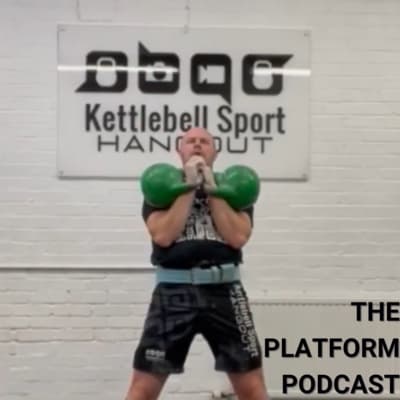
The Platform Podcast · Episode 88
Chris Guyll, Kettlebell Sport Hangout founder
August 22, 2022 · 51 min
Show Notes
In this episode I am very excited to welcome in Chris Guyll. Chris is the founder of the Kettlebell Sport Hangout, and an experiend kettlebell sport athlete & coach. We go all in on kettlebell sport in this chat and talk through a range of topics on technique, coaching, and why Chirs hates long cycle so much. I hope you find it helpful!
Don’t forget to Register for the 2022 Twin Cities Kettlebell Open
and if you want help reaching your goals please Apply for Coaching
If you enjoy the content please leave a 5 star rating & review, share on social media, and support my work by supporting my affiliates:- Pro Kettlebell, MADE IN THE USA Kettlebells
- Kettlebell Kings, use code TCKB to get 10% off
- Bearfoot Athletics, use code TWINCITIESKETTL to get 10% off
- Driven Nutrition, use code TCKB to get 15% off
- Revive Supplements, use code TCKB for 10% off
- 27 Degrees Apparel, use code TCKB10 for 10% off
Transcript
Machine-generated transcript; may contain transcription errors.
Welcome to the platform podcast where we dot coaches athletes experts and real people to learn about their approaches to training nutrition mindset and much more I am your host Jordan Kunde-Wright founder and head coach of the Twin Cities kettlebell club And I'm on a mission to help others build sustainable healthy lifestyles Before we jump into the episode. I want to remind you we are eight weeks out for the second annual Twin Cities kettlebell open on October 22nd hosted by our friends at the athlete lab in little Canada, Minnesota and just like we did last year We will include an option for video submissions for participants who are unable to make the trip in person You'll be eligible for all of the same prizes as our in-person competitors Just go to our website twinsies kettlebell club dot com for details This week I welcome in Chris Gyle He is the founder of the kettlebell sport hangout He is a kettlebell athlete and a kettlebell coach and this chat is pretty much wall-to-wall kettlebells So you get about yeah about an hour or 45 minutes to an hour of just kettlebell chat between two guys nerd not on kettlebells having a few laughs Talking a lot about technique different approaches to coaching how you Ask different questions and assess different athletes and I really enjoyed it I could talk to Chris for hours because you know, he's he's my people nerd not on kettlebell sport So I really hope that you find the episode useful and if you do please do us a favor and Give us a five-star rating and review on Google podcasts spotify Apple podcasts wherever you get this podcast and of course Share it with a friend and support our sponsors by Using the affiliate links you will find in the episode notes So without further ado, let's step on to the platform with Chris Gyle All right, welcome into this week's episode of the platform podcast I am very happy to welcome my guests from all the way across the pond We have Chris Gyle from the kettlebell sport hangout. He is a pretty high-level Lifter as well as a kettlebell coach the founder of the kettlebell sport hangout anything else that you that you want to throw out there Chris All right, well, thanks for coming on man. I really I really appreciate it Where where are you at physically right now?
Where is the gym physically at? That's how the gym is physically in the how you know if you're sure Yorkshire, okay, so you're from England. How did that happen? Born there I see well, so I'm gonna I'm gonna ask the the typical the typical Origin story question that I that I love to get from people because I find at least on a state side Nobody gets into this sport on purpose. So how did you discover kettlebell sport and how did you get into it? Like what was your athletic background coming up? And you know, how did you how did you finally fall into kettlebell sport training? Oh, I call so Can I go I was always into martial arts so I started off with gradians stuff like that and I was always competitive And then I got into Thai boxing did that for quite a few years And then when I kind of got tired of getting beat up, I was looking for something else And we competitive in try a few different things running and stuff like that, but I'm not really built for a run-in And we use we were I was using kettlebells just for conditioning training and stuff at that point And I thought it must be some way of competing with these things So I look around on the internet and Found it out way really and then just got into it and and never look back as I say nice nice So what when when was that chronologically what what year was that if you if you remember?
So my first my very first competition. I think was 2013 So like 2012 2013 was when I was getting to it. So you're an OG at this just like just like I am we have the hairlines to prove it I haven't been at it for a while but so before before this your idea of fun was either getting punched in the face or punching people in the face I'm not sure what I'm not sure what that says about the psyche of people that end up in the kettlebell sport And so you're you're largely known as a biathlon specialist, right? That's that's kind of that's kind of your jam. So why do you hate long cycle? That's a very good question It's too much like hard work in the long cycle. It's it's just hard craft And a lot of you go to there and I just never really get on with it. It's something to do with the swinging swinging the doublebells Just just obsessed me a little bit even when I'm doing during one one clean is enough Something something about something about those cleanses. Yeah, that is it is very it is very hard You have to move those bells a long way, too Because you're what how tall how tall we call you the big cat, right? Because you're because you're a fairly you're a fairly long athlete like how how tall are you?
Okay, and it looks like your arms are even longer than than somebody who's six three like you're honestly your your wingspan looks like somebody who's like six five or six six when I see You know, was that an advantage for you when you were kickboxing? Did you did you outreach most people of the same height? How do you find how do you find it for kettlebell sport? It can kind of be a double-edged sword is what I always tell my my tall athletes, right? Like if you if you learn how to work the lever as well You have really good leverage, but you also have to move the weights further than then short people You know people with short short arms and short legs. So so how have you how have you found it for kettlebell sport?
How have you found your length both as an advantage and a disadvantage? Well, well, as a as I get my left wing, I tried to to be as technical as possible So I tried to use those levers and the connects as much of my advantage as possible Sometimes it can be a bit of a problem especially in You know, like spring relays or when you when you're really going fast When fixation doesn't actually happen Yeah, yeah, especially in snatch and I was doing snatch the the bell has got a long way to go You know, you get some some Some less tall people and they can just like photos bells open down and I can't get any idea that kind of pace So He has his limitations. Yeah, what what is What do you find is kind of like your top rpms that you can hit with with legitimate fixation?
Like what what is kind of your top level rpms that you you feel like you can hit with your with your length? On snatching Yeah, on snatch. Yeah, sorry Yeah, I would think 2022 maybe 2024 is like it's really borderline Whether it's got any fixation or not. Yeah And then when you see like guys like Dennis facility of doing 26, 27, 28, you're just like how? Yeah, it's really it's really hard to get anywhere near that for me. Yeah Yeah, that makes that makes sense. What about what about on jerk? I mean, I think I frankly I use I use your technique as one of the examples as far as under squat Because I think you have one of the best second dips in the game because of your because of your long your long levers Where did where did that come where did that come from? Did you did you always focus on on second dip or as it has it Just been something that you've acquired over many years Um, it's Well, it's definitely a working progress as everything in double sports And I know I find more more is that that It's all easier to get under the bells than it is to drive the bells up So you know, especially in 24 or 32s if you want to get them above your head Right, especially for me with long arms. If I'm trying to get them momentum to really drive those bells up That's a lot of efforts to get those bells moving Where is the fact I can just get them get them wait less for a split second And then you almost use my height in the opposite way to drop right underneath Then that makes it a lot easier for me. Yeah And I've been progressing that quite well and you know I can do that pretty It's all about that stability in that second bit Get under them strong fast to get down fast And then stand up easy. So yeah, that's that's how I do the joker Getting out getting out of the hole is how you you don't stay down very long though You're you're pretty good at getting getting under them and then getting out of the hole is what I call it We call that the hole where where I come from and you're getting out of the hole pretty quick Yeah, but I try and be precise So I really work hard on trying to be precise getting fast fast legs to get underneath them fast You know, if you're lazy, we'd be second bit then you know you've got all sorts of Polynesians with his stability So I try to get under them fast like really snap that that second bit position And then then you can stand up for easier than What are the cues you use with your athletes to to cue that you know Mentally to cue that getting getting under aggressively and then standing up easy Uh, just kind of like sitting second down and sitting back fast And you know we do a lot of work Without the bells, you know going through the go through the movement patterns without bells trying to Trying to you know getting from there from the back position And almost a little bit like in a little bit lifting when you do this nice balance technique where you just just trying to just drop And it's the same thing with the bells. It's like you're almost just you know without almost doing any Bumper all just just drop And if I'm going really fast Um, they would lie a bell like 16s them then basically I'm not doing any any All and just literally dropping Snuff in the arms strong stand up and then re-wrecking Interesting I like I really like that idea of the What I like the shadow reps right shadow like shadow boxing right where you're doing it without without the bells I've actually done that when I've been on vacation with that and forgot you know Couldn't bring my bells with me and people look at me like I'm a fucking lunatic because I'm On the beach doing you know doing doing shadow reps or or whatever But you can like even even like just working working through the motion of like long-cycle or snatch like you can get your heart rate up Just just do it just go into I also think um, you know when you when you do it without any weight you can really Focus on those movement pounds and you can exaggerate them. So you know from doing it away I'll try and get along with them what I would get with the bells so that I'm I know that I'm more uncomfortable at that depth So because obviously once you start with the bells and when you get tired, you know You start to get tired and use the white kindness the second it goes a little bit people You can't get underneath the bells faster. Yeah But for me it's almost the opposite side so I get tired I have to get under the bells even faster because I'm at the bone It's less I can get the bells physically up. So I've got to get faster Faster underneath is that is that something you've come to just understand about about yourself as a as an athlete Because this is one of the things as as a coach that I try and assess when I'm when I'm looking at an athlete like what do they do?
Well, and it's like okay, well this person maybe isn't as explosive, but they're very smooth So I so I try and coach them on on things that are that are gonna Play to their strengths because if you tell them hey be more explosive on your first on your first dip They're like okay like how like I don't know how to bump these anymore explosively than I am whereas But if I'm like hey you just lower your set if you can just work really focus on getting yourself under the bells For some people that that that really works. Is that something do you find that you you just found it not worth the squeeze on I'm trying to be more explosive or do you find that that's just something that you've learned about yourself as an athlete that you're you're better suited by that It suits me, but I think I think it suits most people I think you know they if it they takes Bunk in the bells up even if you're a strong athlete That that fades over time. So you get you get more and more tired and and as you get tired in a ten minute set Obviously those bells aren't going up as much. So and that's usually what's what kind of stops the set You you start you get to the point where you can't get the bells up when you can't in the neighborhood Well, I think that You know you can always get you can always go lower especially you know when you start you you're going to a certain depth But then you know when I get into trouble especially on the heavy bells of the toes I can always drop an extra inch. So I'm having them thinking I need to spend that effort going up It's a lot easier to like gravity help me to get to get down So and I think for most people it's it's like an energy saving saving tactic Yeah, I can definitely I can definitely see that although I do think there is a Mobility requirement to it There are some people that that struggle with Well, there's a cut there's a couple of things but I'll disassociate them There are some people that just struggle with just being able to squat you know get that squat depth And that's one thing that that you have to train and then I also notice there are some people that really struggle with being able to disassociate their hips from their lumbar spine Like being able to open their hips up so that they can under squat without having without having their spine You know ramrod without having their spine ramrod straight right That's another that's a maybe a separate but correlated thing. Have you done it?
Have you done a lot of mobility work over over your over your time or did you already kind of have the the mobility Necessary was under squat I had some useful mobility from from my match that's backgrounds. So I was always pretty mobile But you know like everything you've got to work on it. So and I did a lot of work where they kill He's great with his mobility stuff. He's a good go-to guy to stuff like that Um, good friend of the podcast. We love we love us and we love us some David Kion on on the platform So yeah, you know working with guys like him that helps And but it's like you know you've only got so much time and effort that you can point to these things So it's like well what are you gonna work? Are you gonna work on your strength to get more power to go up?
Are you gonna work on your mobility to so you so you can get down and get underneath easier Um for me because I'm lazy so it's a lot easier to work on on my mobility to get underneath And then it is to work on my strength. Yeah, but obviously you kind of need a little bit of both but You know, I think that um I'm always I'm always looking for those efficiencies key efficiencies. What how can I make this easier? Uh, so I can I can either lay tedium along and for me kind of just adding more power It's like hard. Yeah, this this game suits people who who like to work hard but are inherently lazy at their core That's me too like I like I enjoy the I enjoy the feeling of having worked hard But uh, you know, I think I was looking for the easiest way out So I think that's I think we I think we've we've landed on The perfect ethos for uh for kettlebell sport like hardworking lazy people Is really really really what kettlebell sport is about all right, so um I wanted I also wanted to ask about kettlebell sport hangout like um Well for people that aren't aware of what kettlebell sport hangout is you've got the you've got the banner behind you I didn't put on my shirt. I was gonna I was gonna put on my shirt to kettlebell sport hangout shirt, but it's uh in my pile of dirty laundry behind me So I word on a word on a ruck earlier this week and you don't want to put that back on but Tell people tell people about what kettlebell sport hangout is and and then how did it come about Uh, so so kettlebell sport hangout really it's it's multiple things really it's We we have it we have a gym where we train and we coach from Uh, it's basically the money. It's myself and Tracy house them that don't run it um and it was kind of But more than that it's it's like the Facebook group and they can really hear the people Uh, we originally set up the group just just really before that all um COVID pandemic sort of hit Really just just to kind of share videos of our own training with with guys who um You know, at that point we only had small number of people and it was just like Uh, you know, people like touch web and and Andreas and thank you on those kind of guys and we were just post videos Open just chat about our videos and that will look at them and things like that And watch me suffer friends Yeah, exactly. Yeah, and just just you know hand out a few tips and things like that. Help it your route um, and then the kind of um, the whole Uh, Facebook group kind of exploded a little bit You know, I think we'll put over five thousand people on there now and and people Subspins itself now everyone just anyone to do with anything cabal sport Chucks things in that in that group and it's just like an open group for people to post videos and chat about still for ice questions or You know, anything they want um And we kind of said this the gym buzzer is now um Kind of just after the with the whole coding thing hey Uh, I had a gym that I was teaching Thai boxing from and doing cabal sport from as well And it's like yeah, this isn't going to worry me more because we got a gym when you're the smaller area Let's just shift it all all online on on Zoom and everything like that And that's really how it began and it's quite like that. So even now when when you know, we can help people in the gym We still prefer to just do things online. Yeah That's that's very similar very similar to how my my approach had had to shift because I was training out of the I was training out of a facility, you know, just down the road and then Everything everything went crazy and I kind of kind of had to do the same thing But uh, I don't have 5,000 people That's that's that's that's pretty that's pretty awesome and you guys don't you guys don't charge anybody anything right like it's it's the I know the the Facebook group is the Facebook group is free, but I've also heard you just let people pop in and train At the gym for for free if they want to if they want to And obviously which we charge them and we run classes on a weekly basis You know several times a week if I'm six days a week And but you know in the first year of the the COVID situation we kind of we wanted to reach out to more people So we started asking like guests lift us to come on and they were set and just opening up to anybody that white You know, obviously everyone was struggling. No one was able to go to a gym everyone was struggling on their own It's like welcoming them to get everyone together. So I remember some of those we got like Ivan Markov and come and come on and be like oh, we're gonna do a nice we're gonna do a nice easy You know double double long cycle, you know, one minute on 30 seconds off times 30 sets and then you're like everybody's I think because you know, what he thinks is easy us mere mortals are like this guy is insane Yeah, we did have some top ones that was fun you know, we did that for quite a while Yeah Like the asshole that I Yeah, yeah Yeah, that was a lot of fun. I loved I love seeing um of the you know You get all these different coaches and high-level lifters and things and and it was it's always fun to see like we're all doing The same sport and we're all training for the same thing and yet we like people have different ways of skinning the same cat You know like just just seeing how different minds think about how to go about building capacity How they construct a challenging workout or a fun workout or what like and just seeing like different how they cue different movements Different techniques that different people have and like I found that to be like a Super educational but also just really fun like just like mentally stimulating because this you know It can get monotonous because we're doing three, you know, we're doing three lifts and you know at a certain point like I'm doing three lifts. You're doing two lifts at a certain point you're you know You know, it can get a little monotonous So it's always nice to have like different perspectives different people Different people coming in and doing those things. So yeah, that was that was a lot of fun and and and really really cool to do Are you guys going to do any more of the like special guests? Are you guys gonna bring those back now or?
It's it's something that we'll go about. We're quite good here, but it's definitely something that's on the cards at some point so Nice, that's that's very cool. I very much and I very much enjoy it and I didn't know it was I didn't know it was that big like You know 5,000 people that's that's that's fantastic. It's a that's a really cool. That's a really cool thing And so how many how many people are Athletes that you coach out of there that are like full-time athletes that you that are you know part of your team? We have a team What we have now probably only about 15-20 people that train those that most of them are the UK Competitors that train relatively high level and then a few guys even then everywhere else And do you do you discourage them from long cycle as well or Or do you let them do it despite your personal your own personal disdain for long cycle?
It's kind of you know most of them come in thinking that they're going to do long cycle at all I definitely want something else and and eventually I'll whittle them down so that there's Some of them you know, there's always a little bit of You know backslash have been done again so we said we'll have to do a little bit of long cycle Tracy likes like long cycles so she looks after the long cycle. Yeah And in all seriousness though when you get a new athlete like how do you how do you Because this is something I struggle with myself sometimes because people will ask me Well, what should I do like what what lift what what lift do you think I should do coach? And I'm like I like doing all of them and I think that there's value in all of them You know, but how do you go about assessing like what you think an athlete should like where you want to steer a A new lift a new lifter like when they ask you like what lift should what lifts should I do Uh, if they're like a brand new lift that then then obviously you can do anything Um and work through and then see what they see what they like or they they kind of gravitate towards Um, I tend to find that that long cycle It's like the hardest physically, but it's it's almost the easiest to get into because Um, you can spread out the suffering. That's that's what I say like you get because you can stop in the rack on the way up You can rest overhead You can you can stop on the way down if you need to Right and you get to go with like yeah, you're moving the weights further But there's also you because of that you do much fewer much fewer reps and there's it's much easier to downregulate the pacing Whereas like in jerk there's nowhere to escape like you're Once those bells start getting heavy and your hands start hurting or your feet start hurting or your shoulders are pumped or whatever It's like you know, check the list of things that start sucking once you're passing a minute four of jerk and like There's nowhere to go like there's nowhere to go You're either overhead or you're in the rack And I think so that that's where I'm The mobility come to that thing think when people start If the mobility is not, you know, most people's mobility isn't what they need To do about sport at the beginning Um, and I think jerk like you said because there's nowhere to hide You know, if you're in that position everything's hurting if you're ahead everything's hurting You know, where long cycle that that claim just kind of just get that little bit of relief in the arms in the sweat Even though it's hard to work. It's like that relief Like you say kind of shares out the pain. So um, I think You know from from the from the gears point of view long cycle Push into that and then see see how they go Yeah, I that's a that's a really good. I didn't think about the mobility the mobility component of it I always thought about it from the work capacity component or the the the the amount of reps that you have to put out You know to be competitive in long cycle as much lower, but you're right there There is also a lower barrier of entry as far as mobility Especially compared to jerk and then snatch is just so technical that like it's not it's not the best It's not the best lift to start anybody on unless they already come to you with some snatch training and then it's Then it's a matter of correcting bad Yeah, exactly, you know, I look from the snatch point of view I like to get people just swinging the bells and just doing the signal out of planes to think that that's that awkward Um, but yes, it is very technical and you know It's there's a lot of things going on with snatch so it does take a Seems to prevent it Yeah, I've I've been at it for You know roughly 12 years and I I feel like I'm probably in a master it and like another 20 or so Yeah, yeah You may know 20 30 years and I think I'll I think I'll have it I think I think by then it'll my tech my technique will be good enough like Calling all kettlebell dringer you honorable warriors and wielders of the steel the time has come to raid Join us and fight for honor glory and the spoils of battle Sign up today for the Twin Cities kettlebell open on October 22nd in person in little Canada, Minnesota Or by video submission from anywhere in the world come Fight for your clan or for glory all your own to be told in your saga claim your spoils and may your name ring out forever in the hall of champions Sign up today at Twin Cities kettlebell club.com Yeah, it's such a it's such a fickle fickle lift but I do I do love it. That is one of those It's fun when it's fun when it's going well when it's going well and you hit your groove like there's nothing quite as sweet as like a nice smooth Snatch set, but there's also some days where it's just like Who's hand is this who's bell is this I don't You can't you can't you know if I'm doing the jerks that and you would have to talk it's like you could almost weeks then and fix it Where it's snatched just like by a time you realize that it's not going well. There's no way to get it back You know, it's too late. It's too late and and the high level snatch people are going at you know 24 pms for the entire 20 minutes So if you if you fall off of your pace Good luck. You're not going to win. You know, you're certainly not going to win But you know, that's for the people that are good enough to compete to win. I just trying you know, do my do my my personal best It's me versus myself on the platform almost every time I step out there. So You're you're pretty accomplished yourself like what what are your what are your highest ranks achieved in in by Athalon like you you you work with the professional weights a lot of times I know you sometimes step down to the 28s and the 24s just to give yourself a break You've done the 32s. I've done for eightos But most of my work is on is is a 24s are I have a little personal record sheet here somewhere. So for The jerks on 32s 64 I think it's of 68 is my is my baby But this hard going the 32s are really hard 24s are my baby are if I did a competition last week And the middle strong competition Equal equal my baby on 24s and that's now is 166. I watched that said Yeah, yeah, I was I was there. I was there In can't you watching watching you lift on on the on the screen In that was a top set and again you'll see on everything it's like I self Well, I self relatively fast, but then I tried to increase the pace through the through the set And by the time I think in the last minute I was about 17 or 18 reps in the last minute and I was spent Yeah, my target for the the 24s is 150 reps Okay, I paid 146 twice now. So I'm getting close to getting there You're getting there and how and how about snatch like Do you do you tend to focus on jerk because it like most of your effort on jerk because it's more point like in competition I mean not in training because because you know it's more points. Do you focus more on putting more of your energy system expenditure into into jerk and then really just try and use technique for snatcher Do you try and like save some in the tank for snatch?
I never save any in the tank There's never anything in the tank and I'm usually just starting to call the crying crowd for now And trying to to get some kind of feeling back in my arms before or before this nice set. So it's there I was curious about that because you looked so spent after jerk and and that is one of those things that I'm trying to Decide for myself when I coach athletes if they're when if they're just doing by apple and I'm like Should I have them just sell out on jerk and like really focus on that or should I have them like Save a little bit so that they don't completely bonkers that's but you're telling me make if you're not in the corner crying on After your jerks that you didn't go hard enough Yeah, exactly. Well, the thing is that the way I see it's like you say you know, it's it's sort of double points for jerk. So I might as well get many points as possible with jerk and then see what I've got left for the snatch Yeah, and what what's your what's your approach on pacing and snatch? Do you try and do the same thing where you come out Where you come out that a solid pace, but then try and accelerate as you get towards towards the end of your of your hand switch or do you or you just try and stay steady So first snatch my right hand is much better my left hand usually so I try and try and find a pace like three out of the blocks out I want to be at the pace that I want to go at And it's almost it's almost opposite of jerk so jerk I'll start off. I always want to do jerk the first kind of Seconds as soon as I clean the bells up. I have a bit of a pause be able to kind of gather my thoughts and then set off So my first minute is always at least one or two reps down on my second or two minute And then once they get to five minutes. I'll try I try and get through the first five minutes Controlled and nice and easy and then you know see how I feel in there. I can start to Snatch is like I try and get a Ruben just trail out the blocks so for me at the minute I'm looking at like 17 18 minutes on on 24 for snatch And then try to hold that as long as you try and metronome it the whole way and just just keep it nice instead of the whole way and what tends to happen is I try I try to get as far as I can get with my when my go down as I start my right arm and get as far as I could possibly get And then switch to my left and depending on on When that time is That I'll dig to my speed that I'll set up on my left to on a good day I can get to maybe seven minutes on my on my right. Yeah, so that only leaves me three minutes left. So now I can go it Yeah, that's and that is a I would say a philosophical debate that I that I see among coaches and athletes right where it's like should you start on your Non-dominant hand and have that dictate You know because you know, I've you know, I'm always like I always start with my non-dominant my my logic behind it is If I can hit five minutes at a solid pace with my non-dominant hand and make the switch I know I'm in a position to hit my target when I switch to my good hand And if I come out and I'm in trouble with my with my non-dominant hand I know that my my dominant hand it can carry the water right like I I know I know I know my left hand can't carry the water So if I if I've already if my right hand for whatever reason is is struggling that dare the pace I can't make the pace that I thought I could and then I have to switch to my non-dominant hand to pick it up that that set is Shit like that's just a shit because if I had to switch before I planned with my right hand You know, and I try and stay I also try and stay balanced as my just as much as I can just for me Because I have so many old injuries and things like that like the idea of of per you know having seven minutes on one hand And three on the other like it just yeah, I don't know Mentally, I can't I can't get there but I see the like I can see the the validity to either approach I just for me personally like I'm just I just start with I start with my non-dominant and that's how I coach most of my athletes to go I've tried I've tried doing that Um but for me doesn't it doesn't it doesn't end well Maybe So what happens if I start with my right hand it's like I can get I can get everything into a group early on So I can get the swing nice and smooth. I can get the breathing nice and smooth. So then when I get to change I'm not as tired as if I start on my left hand It's hard to work for me. So I'm working harder Yeah, but even if I get to five minutes, I'm more than that good than what I would be if I've done You've texted your energy systems more your heart rates higher like I can I can definitely see that Yeah, so that is harder for me than to go with my right hand. I'm already not good So what you're supposed to do if you just do the Denisov you pick up a 32 with your right hand You do 10 minutes and then you set it down take about and then you like rest for 15 minutes And then you come back and do 10 minutes with your left hand like that I saw him do that in Chicago. I don't remember the year I want to say it was like 2017 or 2016 and it was just like I was still pretty pretty New in the competition seen at that at that point You know, I'd only been competing for a couple of years And I'd never seen anybody like Denisov compete like I'd seen Dennis was silly of so I guess I had seen somebody But but I'd never seen anybody do 10 minutes with one hand on the 32 and I was like Yeah, I mind exploded. I was like that isn't any did like Like 227 reps with this right hand and then went and rested for 15 minutes and drank some gatorate and then came back and did like 215 with this left it was just I like I was just so mine. I was just so mind blown I was like these Russians are playing a different game than us Yeah, I mean, you know, I In Denisov's I was he's one of the one of the greats of all time So, you know, it's but it's still just it just blows my mind when I see when I see you guys like that that can that can do that kind of that kind of Output in such a in such a short period of time. It's uh, it's very it's very crazy. So Um One well a couple more questions and then I'll I'll let you I'll let you get get on with your get on with your Sunday night, but So a lot of people don't don't know like I just recently learned that you you have You're making the metal you made the medals for the Riddle struck competition You're you're gonna be doing the medals for the the Twin Cities catabell open. So um is that is that your is that your main business and training as a side hustle or as train Is that a side hustle to to your training business or like That's just the number side hustle So that kind of came about because uh, I started I run a few competitions in the UK And the English championships and British championships and maybe metal sites like we're going on sort of medals out And then me and another guy The more we set up I think all the the cuss rules kelber league which uh, we chose all um the UK doing like five minute competitions smaller competitions Oh nice Like entry level ones way and we kind of created a system where everyone could compete There was like a point system based on the on the bell weight so the people could compete with a single bell You know, intermediate sized bells. Yeah. Yeah. So it's just co-efficient based based on whatever Well, we did what we did was we didn't have any we didn't have any way into all we completely cut out the the way classes Oh, okay Because one of the things it's like when when you first start out about sport um I think it's it's almost regardless of White, you know that the weight doesn't come into it There's a big argument about how much weight comes into it even at higher levels You know, you look if you look at the top motions the difference between the legs guys and the heaviest guys Isn't isn't that much it's a bit but it's not it's not as much as you think Yeah, um, when you like if you turn up for a competition Sometimes it can be a barrier to entry if you've got to weigh in if and you've got to do this all the way in thing And also like if you know, I'm not a little guy So me either Exactly. Yes, so but and we're not going to have you wait Yeah, and people it's like if you come to a competition and you know, it's a co-efficient It's like there's no way you're going to enter because you know, you can't get anywhere anywhere near it Well, it's just an open competition Um, it doesn't really matter. You can compete against life guys ahead of you guys Uh, and it's and you know, for for our body, it was all about having having the fun and kind of And competing on the on the reps and the things rather than competing just on a on a body weight class Yeah, I love that. I love that. You're you're making it you're lowering lowering the barrier of entry for people that so it's less scary Just For about three years All over the place and we've got a lot of people in to get the spot and I was fantastic and and again So we get I excited about the medals for those and we did different different basic pieces Um, and then people said it a lot of people were in competitions and the same way of coming to the medals out And then it kind of just grew from that side and then of course when everyone started doing them Like the zoom comes like what you're doing and things like that and the American ones and canadia Canada Canadia. I love it It's Kanaka Stan actually. I was just up there. They prefer Kanaka Stan Yeah, so um, so I just started doing doing more medals and then I started to try and do You know, you go to a lot of competitions and the medals are pretty a bit more really so yeah a lot of them are just cheap cheap like plastic with a sticker on top of it and you're like great. Thanks for this Yeah, and it's like now on the make some awesome medals and some really cool things Yeah, we're just like getting more and more creative with the with the medals design and the I mean, I honestly like like Steve Steve and Matt showed me your the medals for their competition And I was like all right, who did those because like one of the reasons I didn't do medals for my first You know, this is only the second year that I'm doing it, you know But the one of the reasons I didn't do it last year is I was like I bet like like you get these medals at these places and they suck and like nobody can't really cares And like you get a participant like I've got so many like gold medal for just being the the only fat guy that registered Like I'm the only heavyweight that registered for all three lifts So I got three gold medals. So I'm like, okay, great. Thanks. I have more to throw on my wall of My wall of participation medals that are gold colored because I was Registered, you know, so I was like, you know, I was just like yeah You know, it just wasn't just didn't seem more than then I saw those medals and I was like These are awesome like who did these and there's like oh Chris Chris from kettlebell sport hang on. I was like really I didn't know he made medals and I was like, okay, I got a I got to do something No, well you guys will see they're they're pretty they're pretty badass what Chris has come up with is They're gonna be pretty sweet. So and they'll be they'll be medals for everyone who participates And then there will be only only three people will walk away with a gold silver bronze. So I'm pretty Stoked about that. So That's awesome. I really I really appreciate it All right, I'm gonna I'm gonna ask the the last question. I'll you know, and I've got people to tell me you I shouldn't say this, but I'm gonna be respectful of your time They want me to just keep people talking as long as they're willing to I try I try and keep it I try and keep it respectful of you know because I know people have lives They got lives and wives and kids and significant others, you know, so I try and keep it somewhat short So if you were if you were to go back to the start and and you could give yourself one piece of advice When you were starting your kettlebell sport journey What would that piece of advice that you would give to to Chris Giles circa you know 2009 Oh Pay more attention to what Anything Okay, what what what makes you say that I'm curious like what do you what do you what do you mean when you say that?
Uh, I think because you know, when have you do any sport? It's like you come into a sport especially if you've come from another sport you kind of come in there and it's like yeah I'm gonna do this and I'm gonna smash out of it and then you realize after after several weeks a month that It really you didn't know any of my nails was just point point then So if you listen a little bit more and start whenever I tell you it shouldn't be less That's what you should have done. Ah that done in Kruger effect. Yeah You get that like I know I know so much and then you get into it. You're like I shouldn't know nothing Yeah exactly this is doing it I mean it kind of applies to almost every sport but but kettlebell sports especially because you know you look at it and you think I'm like I'm a little hard and then someone you should do kettlebells you try to take 10 minutes and you're like oh Yeah What am I doing wrong? What's going on here and you know much harder than they made it look Hey, exactly. Yeah. Yeah Yeah, what about what about for for your new lifters? Like what what what advice do you give to your new lifters when they start?
Is there like a is there like a standard set of advice that you give to most people or a few pieces of advice? I don't think this is kind of a standard set I think the biggest thing is to enjoy it You know you've got to have fun and you've got to enjoy it and you know don't turn it into a joke If you if you're forcing yourself to lift Right if you sit yourself under realistic targets or targets where it's like right I want to get to here and and like that's a solid target. I've got a trait. I've got to do this Then it takes a lot of fun out of it You know for me it's like But it's right with the competitions. I enter into hundreds of competitions almost every competition go where I'll enter it And sometimes I'll train specifically for them and sometimes I'll just throw them in just for fun And but it's like you know don't take yourself too seriously and and have a have a life with it You know train train really hard but you know you've got to enjoy it You've got to enjoy it And I want to ask one of the things that I really I really love about sports But you know we're there with the whole community that we've got that sport You know you can go into anything from a you know small competition One is with you guys through an international competition and everybody's super helpful And they help people out and supporting you And that's what I really love about about the sport You know you can be sat there on the platform lifting and I've been up there lifting next to Todd And you know we compete against each other but if one guy puts a belt down You have guys cheering for him and I'm cheering for him and he's cheering for me and And like you said at the start it's like you were against you against the belts That's like our common enemy across the all of the the kettlebell world It's like everyone is against the belts everyone's got their own battle to go against the belts You know it might be that he just against two or three of a guy's in the same time But really it's you against the belts and everybody understands that And then everyone's really supportive about it So so when they get new letters then it's like yeah enjoy it Do make sure that you have fun don't don't pile pressure on yourself And don't do any expectations up there You know just to see how it goes and join it Enjoy the journey it's a journey it's not about the end point Because there is no way to point it's like you so you've got to enjoy the journey If you don't enjoy it there's no point doing it Yeah you're yeah I love that so much That's actually going to I'm going to I'm totally going to steal that I'm going to put that into so like I have my I have my rules that I that I say to the to the team to my team I'm like and rule number one is is live to train tomorrow like don't get hurt We don't we don't want we never want to get injured in practice right because you can't progress if you don't Don't get injured like rule number two is going to be have fun because I've honestly have neglect I've neglected to like we make it fun and we have a good time But I've neglected to to codify that as part of our our ethos and I like I love that so much Like that is and I think you're one of the first people that's that's ever said that Like just like make sure you keep it fun because if you're if you're in this game for any extended period of time Like you got to be having fun with it or else it's Is the fact that you and you're enjoying it and you're enjoying the process If you're chasing records or numbers are targets too much then You know comes up one way you start questioning why am I doing this I'm asking yourself that question and you should be doing it So those and those are always short those are always short-lived That's the thing that I've come to the conclusion like when you when you get so like and I'm very type-A I get the sense you're probably the same way where like you you have those targets But then as a certain point when you as you get older you realize like All then you do is then you just go okay I got that goal. What's next? What's next and you never really enjoy it?
You never really enjoy that achievement and if that's the point then then like You're setting yourself up for for failure and you're not gonna be long-term successful If you don't just fall in love with the process or fall in love with some other reason why you train right and that that's You know, I had that I definitely had that as a young lifter or I was like I want to get to master of sport I'm still not there You know still haven't you'll have a master of sport You know if you're really gonna have a permanent then then those things come naturally You know, man, it's like you have a fun. You kind of you reach those milestones and those those targets and You know, it's kind of like you Just kind of breathe through and we move on to the next one Yeah, and even like I've I've come to grip like I've Become comfortable like even if I never hit master of sport like if I can still lift if I can still lift You know 20 kilo kettlebells when I'm when I'm 80 years old I'm gonna be fucking happy right like or even 16s right like Like so like if it serves some other greater purpose for for well-being in my life Like whether or not I hit master of sport like, you know, very few people are gonna give a shit about that It's like what you said on New York. You're gonna rule number one later Number one is it's like no, don't don't get injured. I don't don't train to that capacity when you potentially gonna get injured and I I'm a big fan of that, you know, most of my workouts are You know, maybe 60 percent I don't it's not well for now. I'm training to max it because you know, I'm training six seven days a week Sometimes two days two two times a day. So, you know If I put a huge effort, you know, after we did that to the little stroke the weekend That was wiped out for a good date. I did on the same day. I don't know if you know why did it I put myself down to do and Half mouth and even that forgot about and the last day the last day to do the video submission was on was on the same day It's as the little stroke competition. Oh, how'd that go?
I mean, so basically I don't know who did the probably six jokes And then about and I'll let out the hundred and fifty-three snatches and then ten minutes after that I did half an hour and then twenty eight kilo of single bell for Joe Did about four hundred and something reps on that so I was I was wiped out after that. Oh my gosh That's a big that's a big omission from from from the brain there for getting that you signed yourself for that I just I just had my my original like OG my OG member of the Twin Cities Katovo Club We headed he's in he was doing a full marathon set for iKMF He's trying he's trying to qualify for iKMF But he's in his he's in his in his 60s, so he's better in three But he came here to do it and like 15 minutes into his set his phone stopped working because he didn't realize he was out of memory And so and so he had done he had done like 153 reps I think and we're like we're like well shit What do we do now? And I was like well you can rest for a while and we can go we can give it another go or we can come back tomorrow I was like I recommend you come back tomorrow because tomorrow is the deadline for submission And so he took the he took the took the night off and then came back and and knocked it out yesterday And and he did he did six hundred and twenty eight reps I think and made it the full 60 but at the end he was like, you know Getting getting sick and I was like, man those those 153 reps you did yesterday You're coming back to bike just so that's yeah, that's crazy a lot. That's a lot of work in a in a single in a single day Those marathon and half marathon sets are Oh They're kind of fun, but also kind of I don't do them often because they do get in a little bit in the way of your regular training Yeah Yeah, honestly like if you're going to be a half marathon person that should be the focus of your training If you're going to be a marathon person that should be the focus of your training If you're going to be a ten-minute person like shouldn't really talk about with the half marathon sets very often like that should just be a fun thing for charity Or to keep your you know to keep your training fresh or something, but yeah, I wouldn't Definitely wouldn't recommend anybody to do it very often if you're mostly focused on ten-minute sets so Well, Chris. I want to I want to thank you very much for taking the time. This is this is a great great time How do people how do people find you? How do they follow you on social media?
How do they contact you if they want medals or or anything like that? Like how do how do people get at you? The best thing really is Look up the bus for hang up. I hang out on the Facebook group on Instagram. I'll just try to message me if you want to get the details on Coach, you know, training on medals or anything like that. Awesome Just message your own personal message. It works pretty well for me. Awesome. I'll put the and I'll put those links in the episode notes So people can people can harass you Tell you to go do some log cycle All right, Chris. Thank you so much. Man, have a great rest of your evening and we'll talk soon. Brother, appreciate you Thank you for listening to this episode of the platform podcast We'll be back with a new episode soon Please be sure to leave a rating and review of the platform podcast in your app of choice Support our work by supporting our affiliates and of course if you have questions or you want help reaching your goals reach out to me Till next time. Thanks for listening
Want This Kind of Coaching?
Everything on the show comes out of real coaching. If you want a plan built around your goals and your life, the first step is a free intro call.
Apply for Coaching